Resistant starch foods, ranked by grams
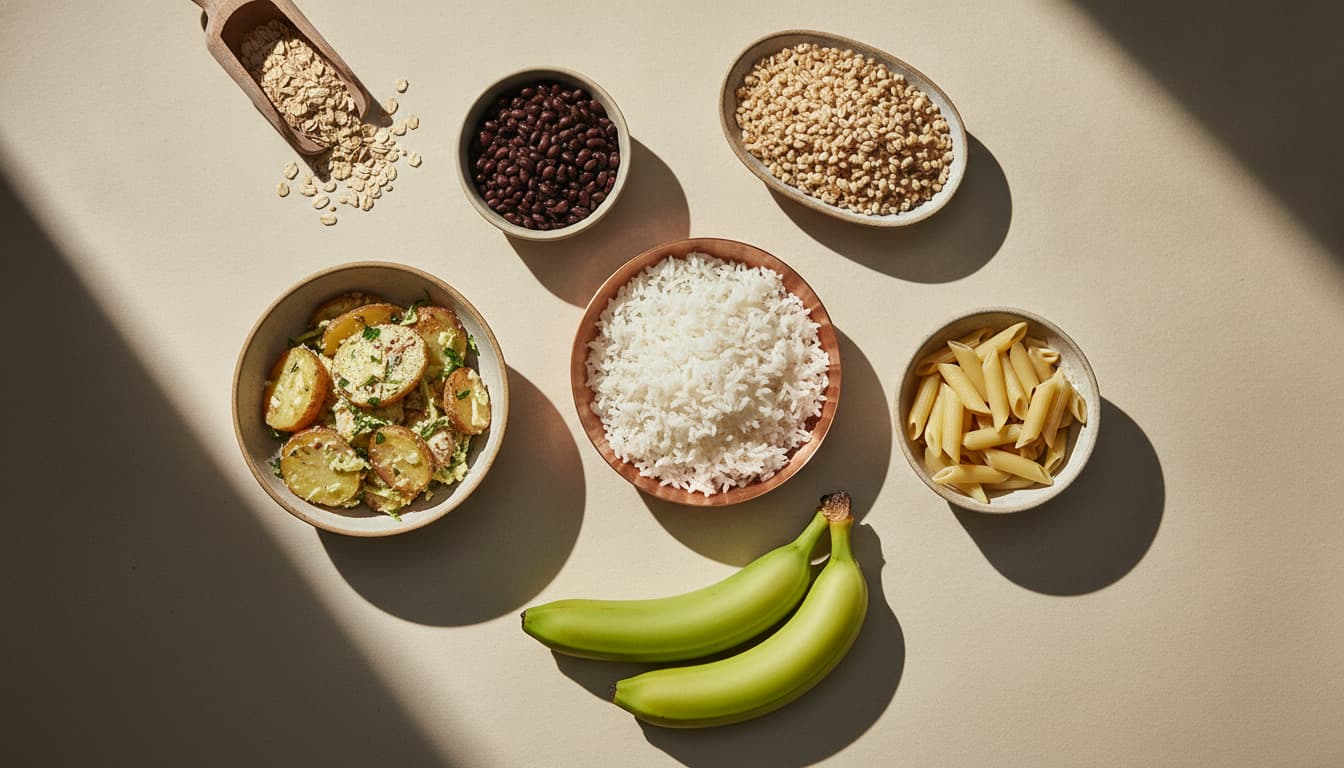
Resistant starch escapes digestion and feeds your gut bacteria, and cooking then cooling potatoes, rice, and pasta creates more of it. The ranking, the four types, and what the evidence shows for blood sugar and gut health.
- 01
Cooked-and-cooled potatoes, rice, and pasta
This is the defining resistant starch trick. Cooking starchy foods and then chilling them forms retrograded (RS3) starch as the starch chains realign into a form digestive enzymes cannot break down, so a cold potato salad, cooled rice, or leftover pasta contains more resistant starch than the same food freshly cooked (Harvard). Gentle reheating keeps much of the gain rather than reversing it. This makes batch-cooking and refrigerating starches an easy, no-cost way to raise resistant starch intake.
- 02
Green (unripe) bananas and plantains
Green bananas and plantains are among the richest natural sources of RS2, the granular resistant starch, and green banana flour is a concentrated supplement form (USDA). The key detail is ripeness: as a banana ripens and sweetens, its resistant starch converts to ordinary sugars, so a firm, greener banana carries far more than a soft yellow one. Cooking plantains and letting them cool preserves resistant starch, making them a staple source in many traditional cuisines.
- 03
Legumes: lentils, beans, and chickpeas
Legumes are excellent resistant starch sources, combining RS1 (starch trapped in the cell structure) with general fiber and protein, and they hold their resistant starch well after cooking (Harvard; USDA). A cup of cooked lentils, black beans, or chickpeas contributes several grams. Because legumes are also classic prebiotic and fiber foods, they are one of the highest-value additions for gut health overall, and their fibers are why they are best increased gradually to avoid gas.
- 04
Whole grains and oats
Whole and minimally processed grains carry RS1 starch trapped in intact kernels and bran, and oats contribute resistant starch alongside their beta-glucan fiber (USDA). Rolled and especially steel-cut oats, and cooked-and-cooled whole grains like barley and brown rice, are practical everyday sources. As with potatoes and rice, cooling cooked whole grains adds RS3, so a grain salad made ahead and refrigerated is higher in resistant starch than the same grains served hot.
- 05
Why cooling and reheating changes the numbers
The reason cooked-and-cooled starches rank so high is a physical change called retrogradation: heat gelatinizes starch, and cooling lets the freed starch chains recrystallize into RS3, a form digestive enzymes cannot fully break down (Harvard). This is measurable, cooling can meaningfully raise the resistant starch content of potatoes, rice, and pasta. Reheating gently does not undo most of the gain, so the practical rule is simple: cook a batch of starchy food, refrigerate it, and eat it cold or gently reheated.
- 06
What the evidence supports, and the dose gap
Resistant starch has promising but not miraculous evidence: it modestly lowers the post-meal blood sugar spike, improves insulin sensitivity in some studies, and supports colon health by feeding butyrate-producing bacteria (Harvard). Effects vary between people depending on their gut microbiome. The notable gap is dose: typical intake is only about 3 to 5 grams a day, while benefits in research often appear around 15 grams, so most people can gain by eating more legumes, oats, and cooled starches, increased gradually to avoid gas.
How this was specified
- 01Inputs measured
- Retail price (dated) · label claim · Certificate of Analysis · third-party test (Informed Sport / NSF / ConsumerLab / Clean Label) · leucine per serving from COA, not marketing.
- 02Protocols tested
- Per-kg target from four literature ranges (IOM RDA, Phillips 2017, Morton 2018, ISSN). Brands scored against Moore 2015 leucine-per-dose threshold (~0.4 g/kg).
- 03Cost-basis verified
- $/gram of protein and $/gram of leucine at warehouse pricing (Costco), mail-order (Amazon), and DTC retail. Re-checked quarterly, flagged when drift exceeds 15%.
- 04Confidence level
- High on ranked order. Medium on absolute $/g (prices drift). Low on serving-size claims where COA is older than 18 months, flagged [VERIFY].
Every claim, cited.
The Larderlab Team builds evidence-led frameworks for eating, lifting, and stocking a kitchen. We cite every claim. We publish the spreadsheet when possible. We buy what we review at retail price. When new data lands, we revise with a dated note.
Next in this hub.
Foods High in Chromium: The Sources, and Why the Data Is Thin
The adequate intake is just 35 mcg a day for men and 25 mcg for women, and broccoli, whole grains, meat, and nuts cover it. Why the food data is unusually unreliable, why deficiency is rare, and what the evidence really says about chromium for blood sugar.
7 min · rev 2026-08-16Foods High in Collagen: Why the Real List Is Shorter Than You Think
Collagen exists only in animal connective tissue, so no plant food contains any. Gelatin powder leads at 85.6 g of protein per 100 g, pork skin at 61.3 g. And the most-marketed source, bone broth, tested poorly against supplements.
8 min · rev 2026-08-24Foods High in Pantothenic Acid (Vitamin B5): The Densest Sources
The adequate intake is just 5 mg a day, and the vitamin's name literally means everywhere, because it is in almost all foods. The ranking, why deficiency essentially never happens, and why B5 supplements for acne and hair have thin evidence.
7 min · rev 2026-08-16Get the Larderlab Macro Planner.
A Google Sheet that calculates your protein target, splits it across 3-5 meals, and ranks 20 protein sources by $/gram. Free. Copy-and-modify your own version.
By subscribing, you agree to our Privacy Policy. Unsubscribe anytime.