Foods high in pantothenic acid, ranked by milligrams
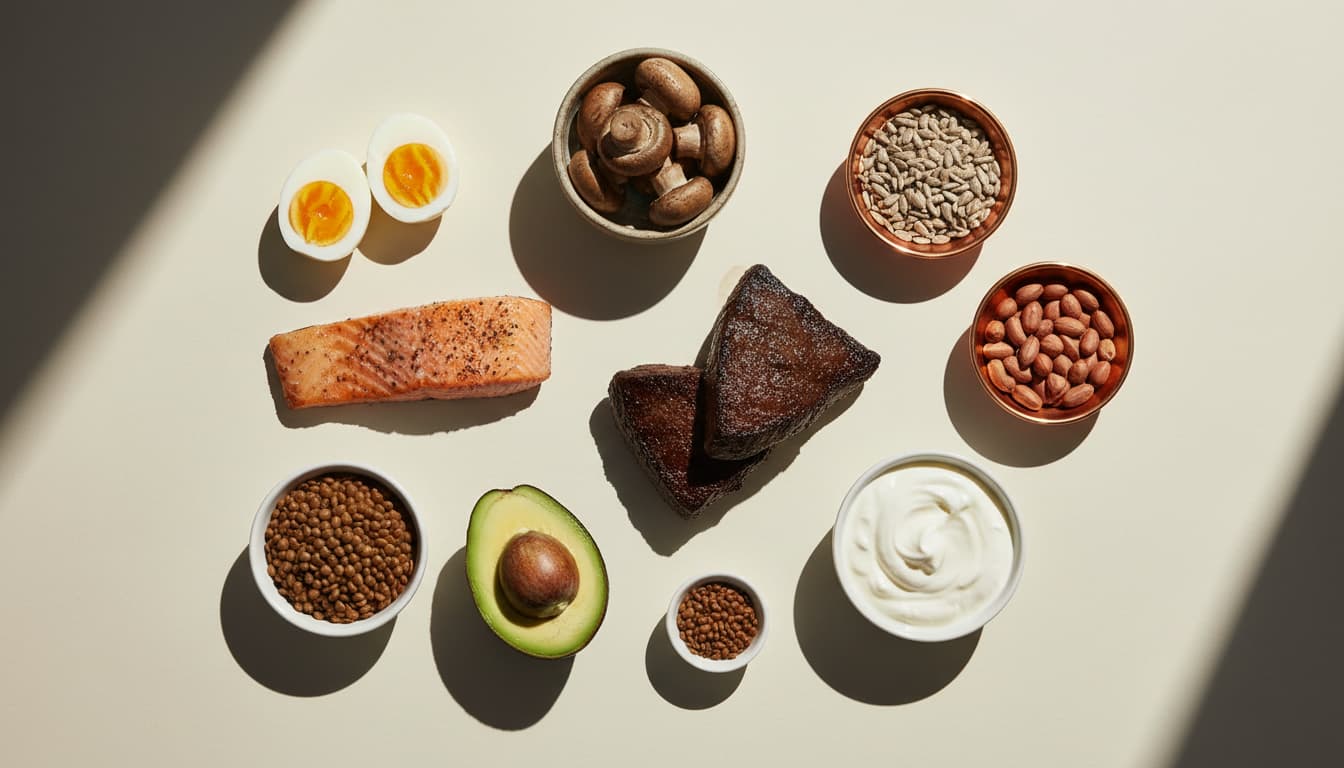
The adequate intake is just 5 mg a day, and the vitamin's name literally means everywhere, because it is in almost all foods. The ranking, why deficiency essentially never happens, and why B5 supplements for acne and hair have thin evidence.
- 01
Beef liver: ~6-8 mg per 3 oz, the densest source
Beef liver is the richest source of pantothenic acid at around 6 to 8 mg per 3 oz, more than a full day's adequate intake in one serving, consistent with its exceptional density across the B vitamins (USDA FoodData Central; NIH ODS). It is eaten in small amounts and not universally liked, but for anyone who eats it, B5 is a non-issue. Given how widespread the vitamin is, though, the other foods on this list cover the small 5 mg target just as easily across an ordinary day.
- 02
Shiitake mushrooms and sunflower seeds
Among plant foods, shiitake mushrooms and sunflower seeds are notably rich in pantothenic acid, each supplying a substantial share of the daily target per serving (USDA). They are the standout non-animal sources and matter most for vegetarians and vegans, though given the vitamin's ubiquity even a plant-based diet reaches the target easily. Sunflower seeds, as with the other B vitamins, quietly stack B5 with vitamin E, magnesium, and healthy fats.
- 03
Chicken, tuna, and other poultry and fish
Chicken and other poultry, along with tuna and other fish, are dependable pantothenic acid sources, each contributing around a milligram or more per serving (NIH ODS; USDA). None is a standout like liver, but eaten in normal portions they form a steady part of daily intake. Because B5 travels with protein foods as well as plants, anyone eating a varied diet with some meat or fish is well above the requirement without trying.
- 04
Avocado, eggs, milk, and yogurt
Avocado is one of the richer plant sources of pantothenic acid, and eggs, milk, and yogurt each contribute useful amounts (USDA FoodData Central). These are everyday foods eaten in regular quantities, so they add up. Their presence across breakfast and ordinary meals is part of why the vitamin is so hard to fall short on, and they pair the B5 with healthy fats, protein, and calcium respectively.
- 05
Whole grains and legumes
Whole grains and legumes carry pantothenic acid in their bran and germ and cell structure, though refining grains into white flour or white rice reduces it (NIH ODS; USDA). This is a reason to favor whole grains, though even refined-grain diets are not short of B5 given how many other foods supply it. Legumes contribute both the vitamin and the usual accompaniment of protein and fiber, making them a solid all-round choice.
- 06
Why B5 supplements are rarely worth it
Because dietary deficiency essentially never occurs and the requirement is small, high-dose pantothenic acid supplements have little rationale for the general population (NIH ODS). The commercial claims, that high-dose B5 or its derivative pantethine helps acne or lowers cholesterol, and that it supports hair, rest on limited, inconsistent evidence and use doses far above the amount in food. B5 is considered non-toxic with no upper limit, but for almost everyone the vitamin in ordinary food is all that is needed.
How this was specified
- 01Inputs measured
- Retail price (dated) · label claim · Certificate of Analysis · third-party test (Informed Sport / NSF / ConsumerLab / Clean Label) · leucine per serving from COA, not marketing.
- 02Protocols tested
- Per-kg target from four literature ranges (IOM RDA, Phillips 2017, Morton 2018, ISSN). Brands scored against Moore 2015 leucine-per-dose threshold (~0.4 g/kg).
- 03Cost-basis verified
- $/gram of protein and $/gram of leucine at warehouse pricing (Costco), mail-order (Amazon), and DTC retail. Re-checked quarterly, flagged when drift exceeds 15%.
- 04Confidence level
- High on ranked order. Medium on absolute $/g (prices drift). Low on serving-size claims where COA is older than 18 months, flagged [VERIFY].
Every claim, cited.
The Larderlab Team builds evidence-led frameworks for eating, lifting, and stocking a kitchen. We cite every claim. We publish the spreadsheet when possible. We buy what we review at retail price. When new data lands, we revise with a dated note.
Next in this hub.
Foods High in Thiamin (Vitamin B1): The Densest Sources, by Milligrams
The RDA is 1.2 mg a day for men and 1.1 mg for women, and pork, fortified grains, legumes, and sunflower seeds cover it easily. The mg-per-serving ranking, why refined grains are fortified for a reason, and who is actually at risk of deficiency.
7 min · rev 2026-08-14Foods High in Riboflavin (Vitamin B2): The Densest Sources, by Milligrams
The RDA is 1.3 mg a day for men and 1.1 mg for women, and dairy, eggs, organ meats, and fortified cereals cover it easily. The mg-per-serving ranking, why milk in clear bottles loses it, and why bright yellow urine is nothing to worry about.
7 min · rev 2026-08-14Foods High in Vitamin E: The Densest Sources, by Milligrams
The RDA is 15 mg of alpha-tocopherol a day, and a single ounce of sunflower seeds or almonds covers roughly half of it. The mg-per-serving ranking, why the oils and nuts dominate, and why deficiency is rare but supplements can backfire.
8 min · rev 2026-08-06Get the Larderlab Macro Planner.
A Google Sheet that calculates your protein target, splits it across 3-5 meals, and ranks 20 protein sources by $/gram. Free. Copy-and-modify your own version.
By subscribing, you agree to our Privacy Policy. Unsubscribe anytime.