Foods that actually contain collagen, ranked
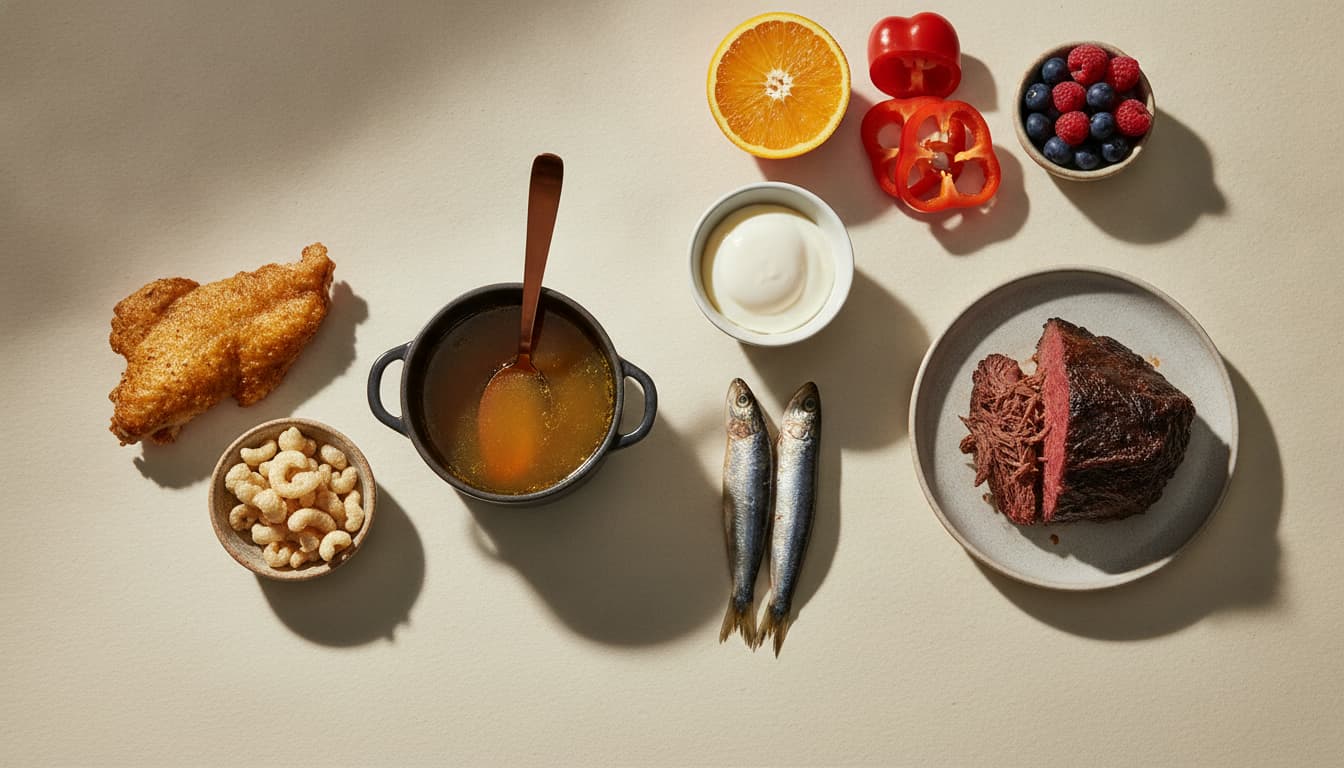
Collagen exists only in animal connective tissue, so no plant food contains any. Gelatin powder leads at 85.6 g of protein per 100 g, pork skin at 61.3 g. And the most-marketed source, bone broth, tested poorly against supplements.
- 01
Gelatin powder: 85.6 g protein per 100 g, essentially pure collagen
USDA lists gelatins, dry powder, unsweetened at 85.6 g of protein per 100 g at 335 kcal. Because gelatin is denatured collagen, the protein number and the collagen number are effectively identical, which makes it the densest food source by a wide margin. A standard 7 g sachet supplies roughly 6 g of collagen protein, comfortably inside the 2.5 to 10 g a day range used in the skin trials. It dissolves in hot liquid, has no flavour to speak of, and costs a fraction of what branded peptide powders do per gram.
- 02
Pork skin: 61.3 g protein per 100 g, with a calorie and sodium cost
USDA lists snacks, pork skins, plain at 61.3 g of protein per 100 g, the great majority of it collagen, which on paper makes it the second densest source available. The constraint is on the same line of the entry: 544 kcal and 1,820 mg of sodium per 100 g, plus 31.3 g of fat. That combination caps the realistic serving size and makes it a poor vehicle for a daily collagen dose. It is a genuine collagen food, and it is not a sensible way to hit a target.
- 03
Chicken skin and other skin-on poultry: 20.4 g protein per 100 g
USDA lists chicken, broilers or fryers, skin only, cooked, roasted at 20.4 g of protein per 100 g at 454 kcal, with the protein largely collagen and elastin, the two structural proteins that give skin its tensile strength and stretch. Skin-on poultry is therefore a meaningful everyday contributor in a way that skinless breast is not. The 40.7 g of fat per 100 g is the accompanying figure, which is why this belongs in the category of foods that contribute collagen rather than foods eaten to obtain it.
- 04
Slow-cooked connective-tissue cuts: shank, oxtail, chuck, short rib
The cuts that are tough raw are tough because they are dense in collagen, and long moist cooking hydrolyses that collagen into gelatin, which is the mechanism behind both the texture change and the body of the resulting sauce. The practical test requires no data: if the cooled cooking liquid sets to a jelly, it is full of gelatin. Trotters, tendon, and skin-on cuts behave the same way. These cuts are also usually the cheapest in the case, which makes them the best value entry on this list after gelatin powder.
- 05
Sardines eaten with the bones: 24.6 g protein per 100 g
USDA lists fish, sardine, Atlantic, canned in oil, drained solids with bone at 24.6 g of protein per 100 g at 208 kcal, along with 397 mg of potassium and 307 mg of sodium. The collagen relevance comes from eating the whole fish: the skin and the soft bone matrix carry connective tissue that a fillet does not. The amount is modest relative to gelatin, but sardines are the rare entry on this list that arrives with omega-3 fats and calcium rather than with 500 kcal of fat.
- 06
Bone broth: the most-marketed source, and it tested poorly
Bone broth is the food most associated with collagen and the one with the weakest supporting data. A study analysing commercial and laboratory-prepared bone broths for glycine, lysine, proline, leucine, hydroxyproline, and hydroxylysine found that broths made to a standardised recipe were significantly lower in all of these than a potentially therapeutic 20 g dose of reference collagen supplements, with wide variability across non-standardised recipes and commercial broths lower than self-prepared ones (Alcock et al. 2019). It is a reasonable food and an unreliable dose.
- 07
No plant food contains collagen, and it does not matter
Plants do not synthesise collagen, so vegetables, fruit, nuts, and grains contain none of it, and any product marketed as plant collagen is supplying precursors rather than the protein. That is not a nutritional problem. The body builds its own collagen continuously from ordinary dietary amino acids, and the rate-limiting nutrient is vitamin C, the required cofactor for the prolyl and lysyl hydroxylase enzymes that stabilise the triple helix, which is why scurvy is fundamentally a collagen-failure disease (NIH Office of Dietary Supplements).
How this was specified
- 01Inputs measured
- Retail price (dated) · label claim · Certificate of Analysis · third-party test (Informed Sport / NSF / ConsumerLab / Clean Label) · leucine per serving from COA, not marketing.
- 02Protocols tested
- Per-kg target from four literature ranges (IOM RDA, Phillips 2017, Morton 2018, ISSN). Brands scored against Moore 2015 leucine-per-dose threshold (~0.4 g/kg).
- 03Cost-basis verified
- $/gram of protein and $/gram of leucine at warehouse pricing (Costco), mail-order (Amazon), and DTC retail. Re-checked quarterly, flagged when drift exceeds 15%.
- 04Confidence level
- High on ranked order. Medium on absolute $/g (prices drift). Low on serving-size claims where COA is older than 18 months, flagged [VERIFY].
Every claim, cited.
- [01]USDA FoodData Central: Gelatins, dry powder, unsweetened (SR Legacy 169599), 85.6 g protein and 335 kcal per 100 g; Snacks, pork skins, plain (167961), 61.3 g protein, 544 kcal, 1,820 mg sodium per 100 g; Chicken, skin only, cooked, roasted (171055), 20.4 g protein per 100 g; Fish, sardine, Atlantic, canned in oil, drained solids with bone (175139), 24.6 g protein per 100 g.
- [02]Alcock RD, Shaw GC, Burke LM. 2019. Bone broth unlikely to provide reliable concentrations of collagen precursors compared with supplemental sources of collagen used in collagen research. Int J Sport Nutr Exerc Metab 29(3):265-272.
- [03]Shoulders MD, Raines RT. 2009. Collagen structure and stability. Annu Rev Biochem 78:929-58. Triple-helix structure and the glycine, proline, hydroxyproline sequence that defines collagen.
- [04]Paul C, Leser S, Oesser S. 2019. Significant amounts of functional collagen peptides can be incorporated in the diet while maintaining indispensable amino acid balance. Nutrients 11(5). Amino acid composition of collagen and its limits as dietary protein.
- [05]NIH Office of Dietary Supplements: Vitamin C Fact Sheet for Health Professionals. Vitamin C as required cofactor in collagen synthesis; RDA 90 mg/day men and 75 mg/day women.
The Larderlab Team builds evidence-led frameworks for eating, lifting, and stocking a kitchen. We cite every claim. We publish the spreadsheet when possible. We buy what we review at retail price. When new data lands, we revise with a dated note.
Next in this hub.
Foods High in Chromium: The Sources, and Why the Data Is Thin
The adequate intake is just 35 mcg a day for men and 25 mcg for women, and broccoli, whole grains, meat, and nuts cover it. Why the food data is unusually unreliable, why deficiency is rare, and what the evidence really says about chromium for blood sugar.
7 min · rev 2026-08-16Foods High in Lectins: The Real Risk, and Why Cooking Solves It
Lectins are proteins in beans, grains, and nightshades, and raw kidney beans really can make you sick, but cooking destroys them. The ranking, why the anti-lectin diet overstates the danger, and why most high-lectin foods are among the healthiest.
8 min · rev 2026-08-13Best Collagen Powder, Ranked by $/g (and Whether It Works)
Hydrolyzed collagen ranked by $/g of peptides, led by the honest evidence: modest skin/joint signal, and a low-DIAAS protein that doesn't count toward your protein target.
10 min · rev 2026-06-22Get the Larderlab Macro Planner.
A Google Sheet that calculates your protein target, splits it across 3-5 meals, and ranks 20 protein sources by $/gram. Free. Copy-and-modify your own version.
By subscribing, you agree to our Privacy Policy. Unsubscribe anytime.