Foods high in chromium, and what we actually know
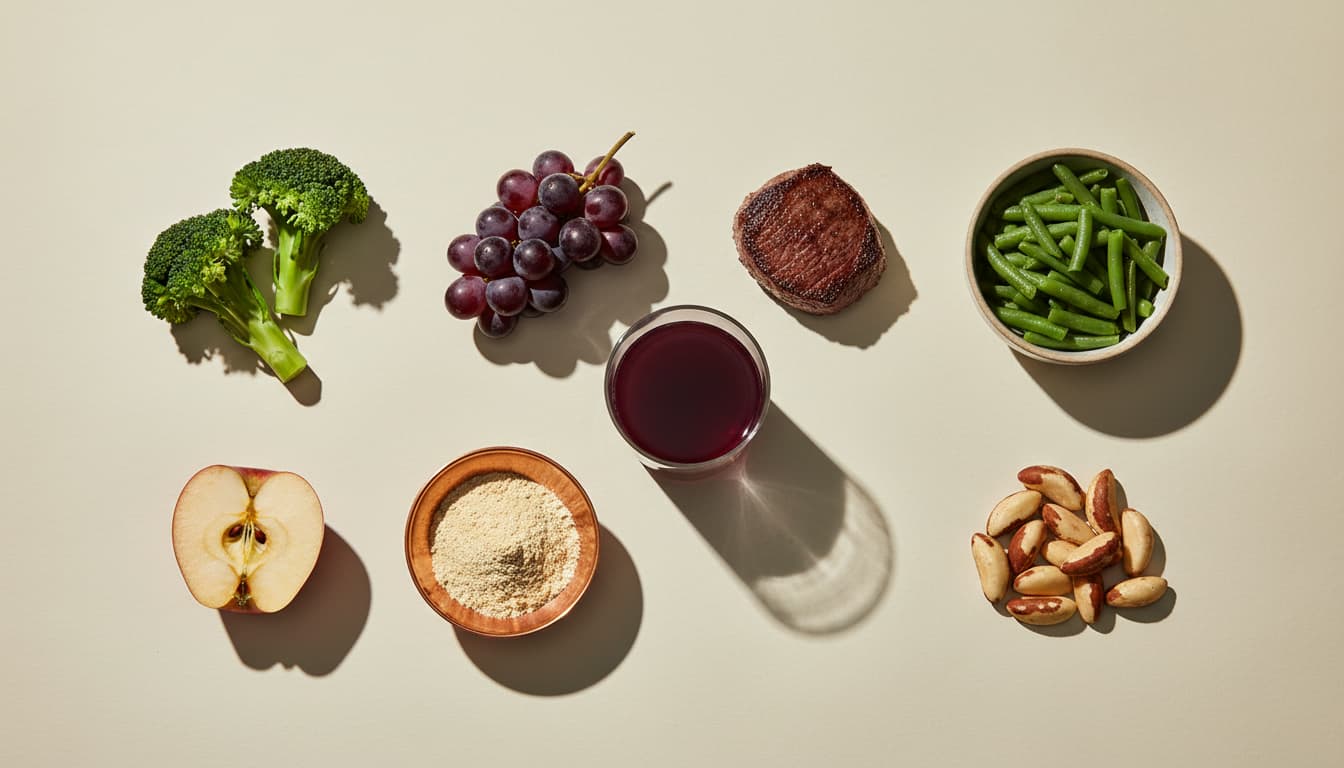
The adequate intake is just 35 mcg a day for men and 25 mcg for women, and broccoli, whole grains, meat, and nuts cover it. Why the food data is unusually unreliable, why deficiency is rare, and what the evidence really says about chromium for blood sugar.
- 01
Broccoli: ~11 mcg per half cup, the standout
Broccoli is the clearest dietary standout for chromium at around 11 mcg per half cup, a large share of the daily target in one serving (NIH ODS; USDA). It is one of the few foods for which the chromium value is reasonably well characterized. As with the other nutrients broccoli provides, it is an efficient all-round vegetable, stacking chromium with vitamin C, vitamin K, and fiber, so a regular serving contributes to several targets at once without any special effort.
- 02
Whole grains and potatoes
Whole grains and potatoes are useful chromium sources, with the mineral concentrated in the parts of the grain that refining removes (NIH ODS; USDA). This is one reason whole grains edge out refined ones for trace minerals generally. The amounts vary with soil and processing, so the numbers are approximate, but as everyday staples eaten in quantity, grains and potatoes form a steady background contribution to the small daily requirement.
- 03
Meat, poultry, and green beans
Meat and poultry contribute chromium, and among vegetables green beans are a notable source alongside broccoli (USDA). None is a dramatic standout, but eaten across normal meals they help cover the tiny 25 to 35 mcg target easily. Because chromium is spread thinly across many foods, it is the variety of a normal diet, rather than any single food, that reliably meets the requirement.
- 04
Apples, bananas, and nuts
Fruit such as apples and bananas and various nuts add small amounts of chromium to the diet (NIH ODS; USDA). These are minor contributors individually, but they broaden the range of foods supplying the mineral and, in the case of nuts, come with the usual package of healthy fats and magnesium. As with the rest of this list, the values are approximate given the difficulty of measuring chromium accurately.
- 05
Why the food data is unusually unreliable
Chromium is a rare case where the food numbers deserve real skepticism. Content varies widely with soil and processing, and food samples are easily contaminated with chromium leached from the stainless steel equipment used to prepare and analyze them, so many older published values are overestimates (NIH ODS). This is why databases list chromium for few foods and why any ranking is approximate. It is an honest limitation worth stating plainly rather than presenting precise-looking figures that the science does not support.
- 06
What the supplement evidence really shows
Chromium, usually as chromium picolinate, is heavily marketed for blood sugar and weight loss, but the evidence does not match the hype. Systematic reviews find effects that are small, inconsistent, and mostly not clinically meaningful: no reliable weight loss, and at best a modest, uncertain effect on blood glucose in people with diabetes that does not replace standard treatment (NIH ODS). Deficiency is rare, food covers the small requirement, and for the general population a chromium supplement offers little demonstrated benefit.
How this was specified
- 01Inputs measured
- Retail price (dated) · label claim · Certificate of Analysis · third-party test (Informed Sport / NSF / ConsumerLab / Clean Label) · leucine per serving from COA, not marketing.
- 02Protocols tested
- Per-kg target from four literature ranges (IOM RDA, Phillips 2017, Morton 2018, ISSN). Brands scored against Moore 2015 leucine-per-dose threshold (~0.4 g/kg).
- 03Cost-basis verified
- $/gram of protein and $/gram of leucine at warehouse pricing (Costco), mail-order (Amazon), and DTC retail. Re-checked quarterly, flagged when drift exceeds 15%.
- 04Confidence level
- High on ranked order. Medium on absolute $/g (prices drift). Low on serving-size claims where COA is older than 18 months, flagged [VERIFY].
Every claim, cited.
The Larderlab Team builds evidence-led frameworks for eating, lifting, and stocking a kitchen. We cite every claim. We publish the spreadsheet when possible. We buy what we review at retail price. When new data lands, we revise with a dated note.
Next in this hub.
Foods High in Collagen: Why the Real List Is Shorter Than You Think
Collagen exists only in animal connective tissue, so no plant food contains any. Gelatin powder leads at 85.6 g of protein per 100 g, pork skin at 61.3 g. And the most-marketed source, bone broth, tested poorly against supplements.
8 min · rev 2026-08-24Foods High in Pantothenic Acid (Vitamin B5): The Densest Sources
The adequate intake is just 5 mg a day, and the vitamin's name literally means everywhere, because it is in almost all foods. The ranking, why deficiency essentially never happens, and why B5 supplements for acne and hair have thin evidence.
7 min · rev 2026-08-16Foods High in Thiamin (Vitamin B1): The Densest Sources, by Milligrams
The RDA is 1.2 mg a day for men and 1.1 mg for women, and pork, fortified grains, legumes, and sunflower seeds cover it easily. The mg-per-serving ranking, why refined grains are fortified for a reason, and who is actually at risk of deficiency.
7 min · rev 2026-08-14Get the Larderlab Macro Planner.
A Google Sheet that calculates your protein target, splits it across 3-5 meals, and ranks 20 protein sources by $/gram. Free. Copy-and-modify your own version.
By subscribing, you agree to our Privacy Policy. Unsubscribe anytime.