Probiotic foods, ranked by live-culture reality
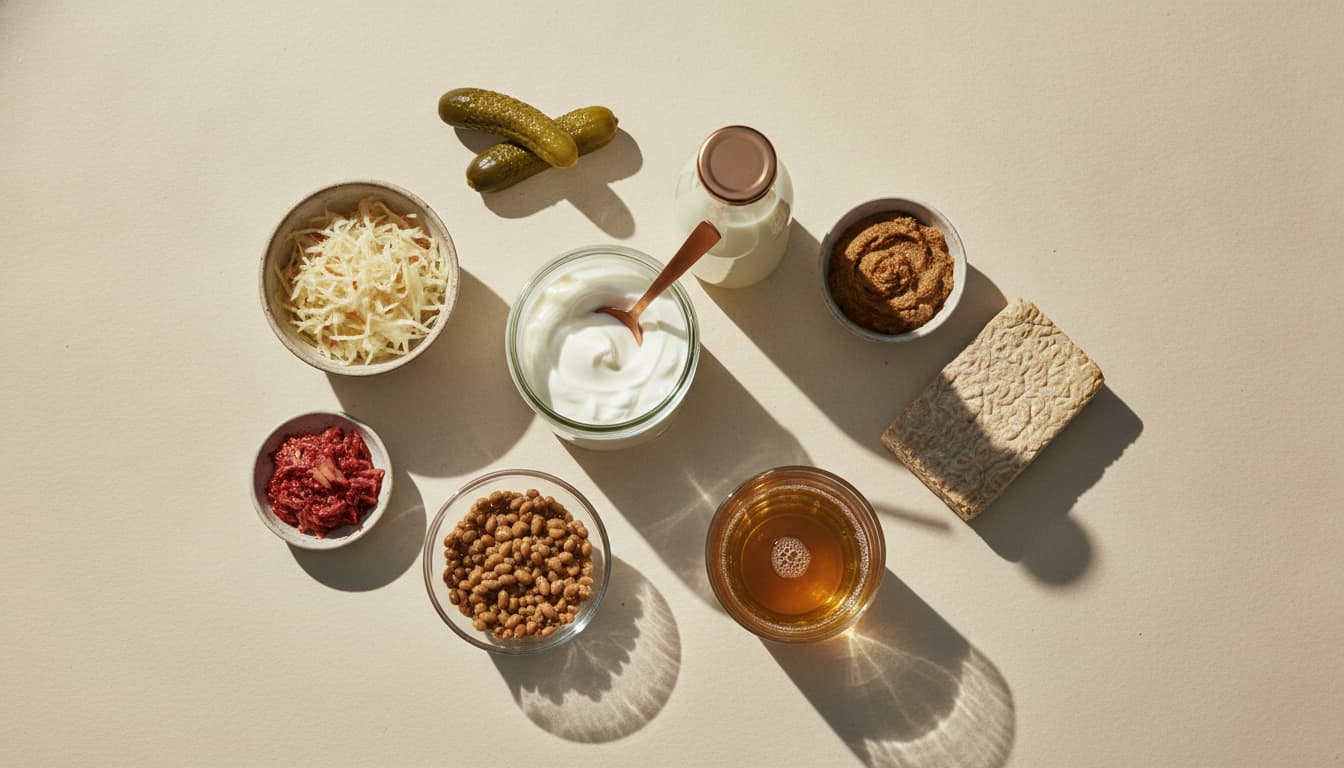
A probiotic food has to contain living microbes at the point you eat it, which rules out most shelf-stable and heat-treated fermented products. The foods that qualify, why yogurt and kefir lead, and why fermented does not always mean probiotic.
- 01
Yogurt and kefir with live and active cultures
Yogurt and kefir are the most reliable probiotic foods because they are refrigerated and can legally display a live and active cultures seal (ISAPP). Kefir is the stronger of the two, carrying a broader range of bacteria and yeasts than yogurt's typical two starter strains. The details that matter are choosing plain versions kept in the chilled section and avoiding heat-treated or shelf-stable products, which may say fermented but no longer contain living cultures. Both also supply protein and calcium.
- 02
Raw sauerkraut and kimchi (refrigerated, unpasteurized)
Fermented cabbage is an excellent probiotic source, but only the raw, unpasteurized kind sold in the refrigerated section, where the live bacteria survive (ISAPP). The canned or shelf-stable sauerkraut on the ambient aisle has been pasteurized, killing the microbes, so it is fermented but not probiotic. Kimchi adds a wider mix of vegetables and spices. Adding a forkful raw, after cooking rather than during, preserves the cultures and brings tangy flavor and fiber along with them.
- 03
Miso, tempeh, and natto
These traditional soy ferments carry live cultures when handled correctly: miso and natto retain them if not boiled, and tempeh is fermented with a live mold (ISAPP). The recurring rule applies, stirring miso into boiling soup kills most of the microbes, so it should be added off the heat. Beyond the probiotic angle, these foods are nutrient-dense complete proteins, and natto is also one of the richest known sources of vitamin K2, which is why it appears in our vitamin K ranking too.
- 04
Kombucha and traditionally brined pickles
Kombucha, fermented sweet tea, contains live bacteria and yeasts, and pickles fermented in salt brine (not vinegar) are genuinely probiotic (ISAPP). The distinction with pickles is decisive: most supermarket pickles are made with vinegar and were never fermented, so they contain no live cultures at all. Look for refrigerated, naturally fermented products with no vinegar in the ingredients. Kombucha can be high in sugar, so plain, lower-sugar versions are the better choice.
- 05
Why fermented does not always mean probiotic
This is the point that trips most people up. Many popular fermented foods are not probiotic because heat has killed the microbes: pasteurized sauerkraut, baked sourdough bread, most beer and wine, and boiled miso all fall here (ISAPP). Fermentation still adds value, better digestibility, fewer antinutrients, and beneficial byproducts, but it does not make a food probiotic once the cultures are dead. The single test is whether living microbes are present when you eat it, which almost always means the product is refrigerated and unpasteurized.
- 06
What the evidence does and does not support
Probiotic foods are a reasonable, low-risk habit, not a proven medicine. Food does not carry a guaranteed dose the way a CFU-labeled supplement does, and the strongest clinical evidence is strain-specific, tied to particular supplement strains in particular conditions (ISAPP). That said, research on a diverse, fermented-food-rich diet and the gut microbiome is promising, and one small trial found that fermented foods increased microbiome diversity. The balanced view is to enjoy live-culture foods for variety and to feed the microbes with prebiotic fiber, without overpromising.
How this was specified
- 01Inputs measured
- Retail price (dated) · label claim · Certificate of Analysis · third-party test (Informed Sport / NSF / ConsumerLab / Clean Label) · leucine per serving from COA, not marketing.
- 02Protocols tested
- Per-kg target from four literature ranges (IOM RDA, Phillips 2017, Morton 2018, ISSN). Brands scored against Moore 2015 leucine-per-dose threshold (~0.4 g/kg).
- 03Cost-basis verified
- $/gram of protein and $/gram of leucine at warehouse pricing (Costco), mail-order (Amazon), and DTC retail. Re-checked quarterly, flagged when drift exceeds 15%.
- 04Confidence level
- High on ranked order. Medium on absolute $/g (prices drift). Low on serving-size claims where COA is older than 18 months, flagged [VERIFY].
Every claim, cited.
The Larderlab Team builds evidence-led frameworks for eating, lifting, and stocking a kitchen. We cite every claim. We publish the spreadsheet when possible. We buy what we review at retail price. When new data lands, we revise with a dated note.
Next in this hub.
Foods High in Collagen: Why the Real List Is Shorter Than You Think
Collagen exists only in animal connective tissue, so no plant food contains any. Gelatin powder leads at 85.6 g of protein per 100 g, pork skin at 61.3 g. And the most-marketed source, bone broth, tested poorly against supplements.
8 min · rev 2026-08-24Foods High in Pantothenic Acid (Vitamin B5): The Densest Sources
The adequate intake is just 5 mg a day, and the vitamin's name literally means everywhere, because it is in almost all foods. The ranking, why deficiency essentially never happens, and why B5 supplements for acne and hair have thin evidence.
7 min · rev 2026-08-16Foods High in Chromium: The Sources, and Why the Data Is Thin
The adequate intake is just 35 mcg a day for men and 25 mcg for women, and broccoli, whole grains, meat, and nuts cover it. Why the food data is unusually unreliable, why deficiency is rare, and what the evidence really says about chromium for blood sugar.
7 min · rev 2026-08-16Get the Larderlab Macro Planner.
A Google Sheet that calculates your protein target, splits it across 3-5 meals, and ranks 20 protein sources by $/gram. Free. Copy-and-modify your own version.
By subscribing, you agree to our Privacy Policy. Unsubscribe anytime.