How much collagen per day, by the evidence
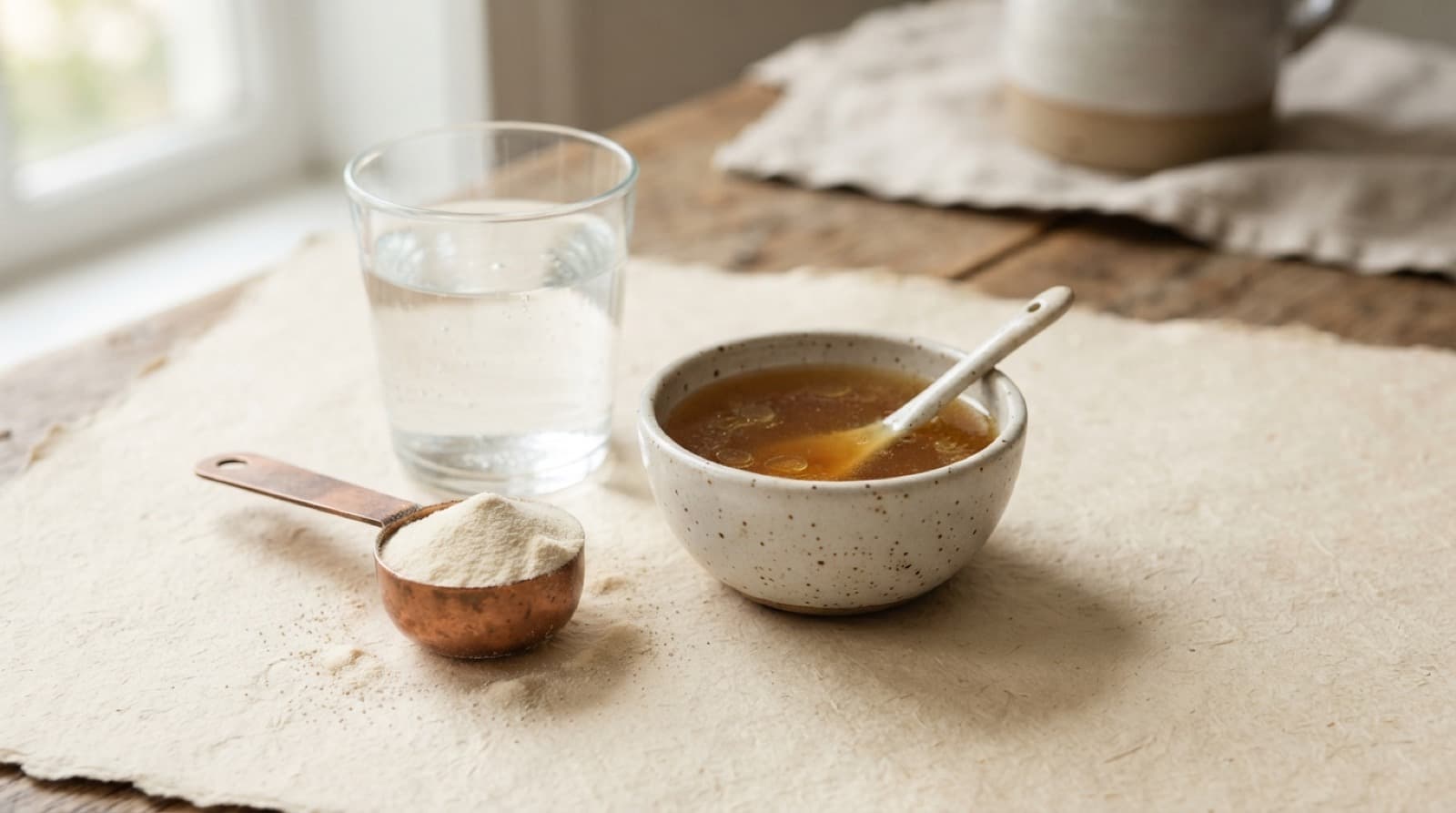
Skin trials used 2.5-10 g/day of hydrolyzed peptides; joint trials used ~10-40 g/day. The dose that matches each goal, why collagen does not count toward protein, and how to price it.
What people ask us next.
- How much collagen should I take per day?
- Match the dose to the goal. For skin (elasticity and hydration), positive trials used 2.5-10 g/day of hydrolyzed collagen peptides for 8-12 weeks (Pu et al. 2021, n=1,125). For joints and tendons, studied doses run ~10-40 g/day depending on preparation. A sensible all-purpose dose is 10 g/day. Effects are modest and fade if you stop, so treat it as a daily maintenance dose, not a short course.
- Is 10 grams of collagen a day enough?
- Yes, 10 g/day is a reasonable all-purpose dose. It sits at the top of the skin-trial range (2.5-10 g/day) and the bottom of the joint range (~10 g/day and up). Most commercial scoops are sized at 10-20 g for this reason. Going above ~15-20 g/day adds cost without clear added benefit, since the evidence does not show a clean reward for megadosing.
- Does collagen count toward my daily protein intake?
- No. Collagen is ~90% protein by weight but is an incomplete, low-DIAAS protein with no tryptophan and little leucine, so it does almost nothing for muscle protein synthesis. Counting a 10 g collagen scoop as 9 g of protein effectively shorts your real intake. Keep collagen separate and hit your protein target from complete sources; see our protein-per-day guidance.
- When is the best time to take collagen?
- For skin, timing barely matters: outcomes track total daily intake over 8-12 weeks, not the time of day, so take it whenever you will be consistent. The one timing signal is for tendon work, where ~15 g with ~50 mg vitamin C about an hour before loading exercise was the studied protocol (Shaw et al. 2017), because collagen synthesis peaks around the loading window.
- How long until collagen works, and does it last?
- Skin trials ran 8-12 weeks before measuring improvements in hydration and elasticity, so give it at least that long before judging. The effect is maintenance-dependent: it fades after you stop, because you are supplying substrate, not changing the tissue permanently. That is why the dose is framed as a daily ongoing amount rather than a finite course.
- What kind of collagen should I buy for that dose?
- For skin and joints, hydrolyzed collagen peptides (Types I and III, bovine or marine) are the studied form, dosed at the grams above. Do not confuse it with undenatured type II collagen, a different ingredient dosed at ~40 mg/day for joints. Unflavored bulk bovine peptides are cheapest at ~$0.03-0.04/g; our best collagen powder ranking sorts tested products by $/g of peptides.
Every claim, cited.
- [01]Pu SY, Huang YL, Pu CM, et al. 2023. Effects of oral collagen for skin anti-aging: a systematic review and meta-analysis. Nutrients 15(9):2080. 19 RCTs, n=1,125; skin hydration and elasticity improved at 2.5-10 g/day over 8-12 weeks.
- [02]Shaw G, Lee-Barthel A, Ross ML, et al. 2017. Vitamin C-enriched gelatin supplementation before intermittent activity augments collagen synthesis. Am J Clin Nutr 105(1):136-143. ~15 g collagen with vitamin C ~1 hour before loading exercise.
- [03]Bello AE, Oesser S. 2006. Collagen hydrolysate for the treatment of osteoarthritis and other joint disorders: a review of the literature. Curr Med Res Opin 22(11):2221-2232. Joint trials clustered around ~10 g/day.
- [04]USDA / DIAAS literature on collagen protein quality. Collagen is ~90% protein by weight but incomplete (no tryptophan, low leucine) and low DIAAS; does not count toward a muscle-protein target.
The Larderlab Team builds evidence-led frameworks for eating, lifting, and stocking a kitchen. We cite every claim. We publish the spreadsheet when possible. We buy what we review at retail price. When new data lands, we revise with a dated note.
Next in this hub.
What to Avoid When Taking Collagen: Five Caveats With Evidence Behind Them
Do not count it toward your protein target, do not judge it before 8 to 12 weeks, and if you form kidney stones, know that 30 g of gelatin raised urinary oxalate by 43 percent in a controlled study. The real caveats, and the myths.
8 min · rev 2026-08-24Foods High in Collagen: Why the Real List Is Shorter Than You Think
Collagen exists only in animal connective tissue, so no plant food contains any. Gelatin powder leads at 85.6 g of protein per 100 g, pork skin at 61.3 g. And the most-marketed source, bone broth, tested poorly against supplements.
8 min · rev 2026-08-24Ashwagandha Benefits: What the Trials Show, and the Liver Signal
Pooled across 12 trials in 1,002 people, stress fell with a standardised mean difference of 1.75 and anxiety by 1.55, but heterogeneity was above 83 percent and the certainty of evidence was rated low. The dose that was tested, and the hepatic case series.
8 min · rev 2026-08-24Get the Larderlab Macro Planner.
A Google Sheet that calculates your protein target, splits it across 3-5 meals, and ranks 20 protein sources by $/gram. Free. Copy-and-modify your own version.
By subscribing, you agree to our Privacy Policy. Unsubscribe anytime.