What to avoid when taking collagen, by the evidence
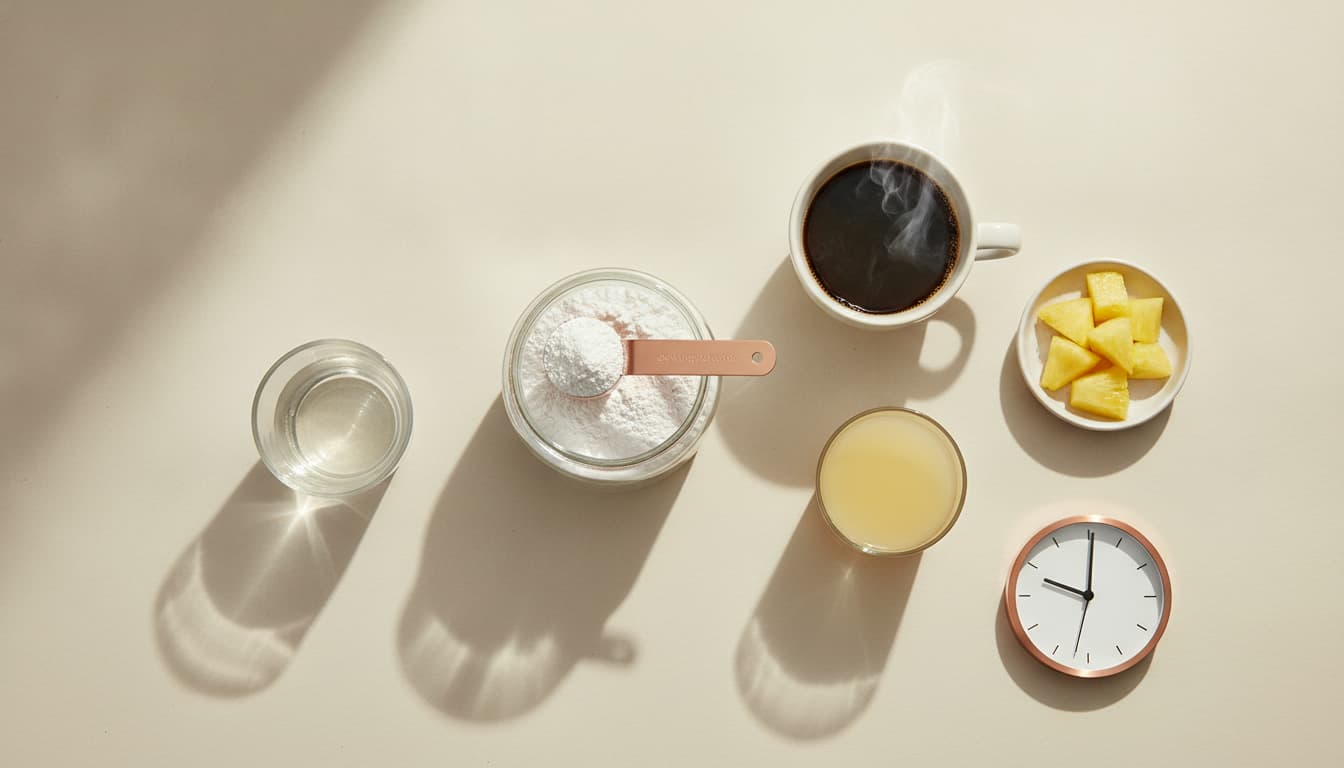
Do not count it toward your protein target, do not judge it before 8 to 12 weeks, and if you form kidney stones, know that 30 g of gelatin raised urinary oxalate by 43 percent in a controlled study. The real caveats, and the myths.
- 01
Avoid counting it toward your daily protein target
Collagen lacks tryptophan entirely and is unusually rich in glycine, proline, and hydroxyproline, which is why it scores poorly on protein quality scales. A modelling study examined how much collagen peptide can be added to a diet while maintaining indispensable amino acid balance and found a bounded amount can be incorporated without compromising it (Paul et al. 2019), which is a different claim from counting collagen grams as protein grams. Keep collagen outside the daily protein math, and log it separately so the protein number stays honest.
- 02
Avoid using it to replace complete protein at a meal
The same amino acid pattern that keeps collagen out of the protein total also disqualifies it as a substitute at a meal where muscle protein synthesis is the objective. Swapping 20 g of whey or dairy protein for 20 g of collagen peptides trades a complete, leucine-rich protein for one missing an indispensable amino acid. Collagen can sit alongside a complete protein source without any problem; the error is treating it as an equivalent, which turns an addition into a downgrade.
- 03
Avoid judging it before 8 to 12 weeks
The supporting trials run on a schedule. A systematic review and meta-analysis of 26 randomised controlled trials in 1,721 participants found hydrolysed collagen significantly improved skin hydration and elasticity (Pu et al. 2023), and a meta-analysis of 19 studies in 1,125 participants aged 20 to 70 found favourable results for hydration, elasticity, and wrinkles (de Miranda et al. 2021). Those trials typically ran 8 to 12 weeks at 2.5 to 10 g a day. Both reviews flagged risk of bias in the included studies, so the reasonable expectation is a modest real effect assessed at the right interval.
- 04
Kidney stone formers: avoid large doses without clinical input
Collagen and gelatin are rich in hydroxyproline, a precursor to glyoxylate and therefore to oxalate. A controlled metabolic study compared 30 g of gelatin against 30 g of whey protein on controlled oxalate diets and found urinary glycolate excretion 5.3-fold higher and urinary oxalate excretion 43 percent higher on gelatin, with significant changes at 5 and 10 g loads but not at 1 and 2 g (Knight et al. 2006). For most people this is a physiological detail. For a calcium oxalate stone former it is a reason to keep the dose modest and raise it with a clinician.
- 05
Avoid untested products, and check the allergen source
Dietary supplements are not pre-approved for safety, effectiveness, or label accuracy before they reach the market, which places verification on the buyer (FDA). For an animal-derived powder consumed daily in 10 g quantities, that means preferring products with third-party testing and reading the Supplement Facts panel rather than the front label. Source matters for allergy as well: marine collagen is a fish product and bovine collagen a beef one, and neither is interchangeable for someone with the corresponding allergy.
- 06
The vitamin C claim, corrected in both directions
Vitamin C is genuinely required as a cofactor for the prolyl and lysyl hydroxylase enzymes that stabilise the collagen triple helix, which is why scurvy is fundamentally a collagen-failure disease (NIH Office of Dietary Supplements). That dependency is real and also easily met: the RDA is 90 mg a day for men and 75 mg for women, covered by ordinary food. There is no evidence that megadosing vitamin C alongside a collagen supplement produces additional benefit, so the useful version of this advice is to not be deficient, not to add a second expensive supplement.
What people ask us next.
- What should you avoid when taking collagen?
- Five things with evidence behind them: counting collagen grams toward a daily protein target, since it lacks tryptophan and scores poorly for protein quality; replacing complete protein with it at a meal; judging the effect before 8 to 12 weeks, the duration used in the supporting trials; taking large daily doses if you form calcium oxalate kidney stones, without clinical input; and buying untested products, since supplements are not pre-approved for safety or label accuracy.
- Does collagen count toward my daily protein?
- It should not. Collagen lacks tryptophan entirely and its amino acid pattern scores poorly on protein quality scales, which is why a modelling study framed the question as how much collagen peptide can be added while keeping indispensable amino acid balance intact rather than as a straight protein substitution (Paul et al. 2019). Log it separately from the daily protein total. Counting it inflates the number in a way that matters most for anyone training and relying on that figure.
- Is collagen bad for kidney stones?
- It warrants caution at higher doses if you form calcium oxalate stones. Collagen and gelatin are rich in hydroxyproline, a precursor to glyoxylate and then oxalate. A controlled study comparing 30 g of gelatin against 30 g of whey on controlled oxalate diets found urinary glycolate 5.3-fold higher and urinary oxalate 43 percent higher on gelatin, with significant changes appearing at 5 and 10 g loads but not at 1 and 2 g (Knight et al. 2006). For non-stone-formers this is not a practical concern.
- How long before collagen works?
- Assess at 8 to 12 weeks, not before. That is the interval used in the trials that found benefit: a meta-analysis of 26 randomised controlled trials in 1,721 participants found improved skin hydration and elasticity (Pu et al. 2023), and one of 19 studies in 1,125 participants found favourable results for hydration, elasticity, and wrinkles (de Miranda et al. 2021), typically at 2.5 to 10 g a day over 8 to 12 weeks. Both reviews noted risk of bias, so expect a modest effect rather than a dramatic one.
- Do you need to take vitamin C with collagen?
- You need to not be deficient, which is different from needing to supplement. Vitamin C is a required cofactor for the prolyl and lysyl hydroxylase enzymes that stabilise the collagen triple helix, which is why scurvy is fundamentally a collagen-failure disease (NIH Office of Dietary Supplements). The RDA is 90 mg a day for men and 75 mg for women, amounts ordinary food covers easily. There is no evidence that adding high-dose vitamin C alongside collagen improves the outcome.
- Are there foods or drinks to avoid with collagen?
- No specific food interaction is established. Collagen peptides are digested like any protein, and there is no evidence that coffee, dairy, or acidic drinks interfere with them, despite the claim circulating widely. The caveats that do hold are about the amino acid accounting, the assessment interval, the oxalate load for stone formers, and product quality. Anything framed as a food to avoid alongside collagen should be treated as marketing until a mechanism and a trial are produced.
Every claim, cited.
- [01]Paul C, Leser S, Oesser S. 2019. Significant amounts of functional collagen peptides can be incorporated in the diet while maintaining indispensable amino acid balance. Nutrients 11(5). The basis for keeping collagen outside the protein total.
- [02]Knight J, Jiang J, Assimos DG, Holmes RP. 2006. Hydroxyproline ingestion and urinary oxalate and glycolate excretion. Kidney Int 70(11):1929-34. 30 g gelatin versus whey: urinary glycolate 5.3-fold higher, oxalate 43% higher; significant at 5 and 10 g loads, not 1 and 2 g.
- [03]Pu SY, Huang YL, Pu CM, Kang YN. 2023. Effects of oral collagen for skin anti-aging: a systematic review and meta-analysis. Nutrients 15(9). 26 RCTs, n=1,721; improved skin hydration and elasticity, with biases identified in the included trials.
- [04]de Miranda RB, Weimer P, Rossi RC. 2021. Effects of hydrolyzed collagen supplementation on skin aging: a systematic review and meta-analysis. Int J Dermatol 60(12):1449-1461. 19 studies, n=1,125 aged 20-70, 95% women.
- [05]NIH Office of Dietary Supplements: Vitamin C Fact Sheet for Health Professionals. RDA 90 mg/day men and 75 mg/day women; role as cofactor in collagen synthesis and the link to scurvy.
- [06]FDA: Questions and Answers on Dietary Supplements. Dietary supplements are not approved for safety, effectiveness, or label accuracy before marketing.
The Larderlab Team builds evidence-led frameworks for eating, lifting, and stocking a kitchen. We cite every claim. We publish the spreadsheet when possible. We buy what we review at retail price. When new data lands, we revise with a dated note.
Next in this hub.
Best Collagen Powder, Ranked by $/g (and Whether It Works)
Hydrolyzed collagen ranked by $/g of peptides, led by the honest evidence: modest skin/joint signal, and a low-DIAAS protein that doesn't count toward your protein target.
10 min · rev 2026-06-22Foods High in Collagen: Why the Real List Is Shorter Than You Think
Collagen exists only in animal connective tissue, so no plant food contains any. Gelatin powder leads at 85.6 g of protein per 100 g, pork skin at 61.3 g. And the most-marketed source, bone broth, tested poorly against supplements.
8 min · rev 2026-08-24How Much Collagen Per Day? The Studied Dose, by Goal
Skin trials used 2.5-10 g/day of hydrolyzed peptides; joint trials used ~10-40 g/day. The dose that matches each goal, why collagen does not count toward protein, and how to price it.
8 min · rev 2026-06-30Get the Larderlab Macro Planner.
A Google Sheet that calculates your protein target, splits it across 3-5 meals, and ranks 20 protein sources by $/gram. Free. Copy-and-modify your own version.
By subscribing, you agree to our Privacy Policy. Unsubscribe anytime.