What collagen is, and what it does in the body
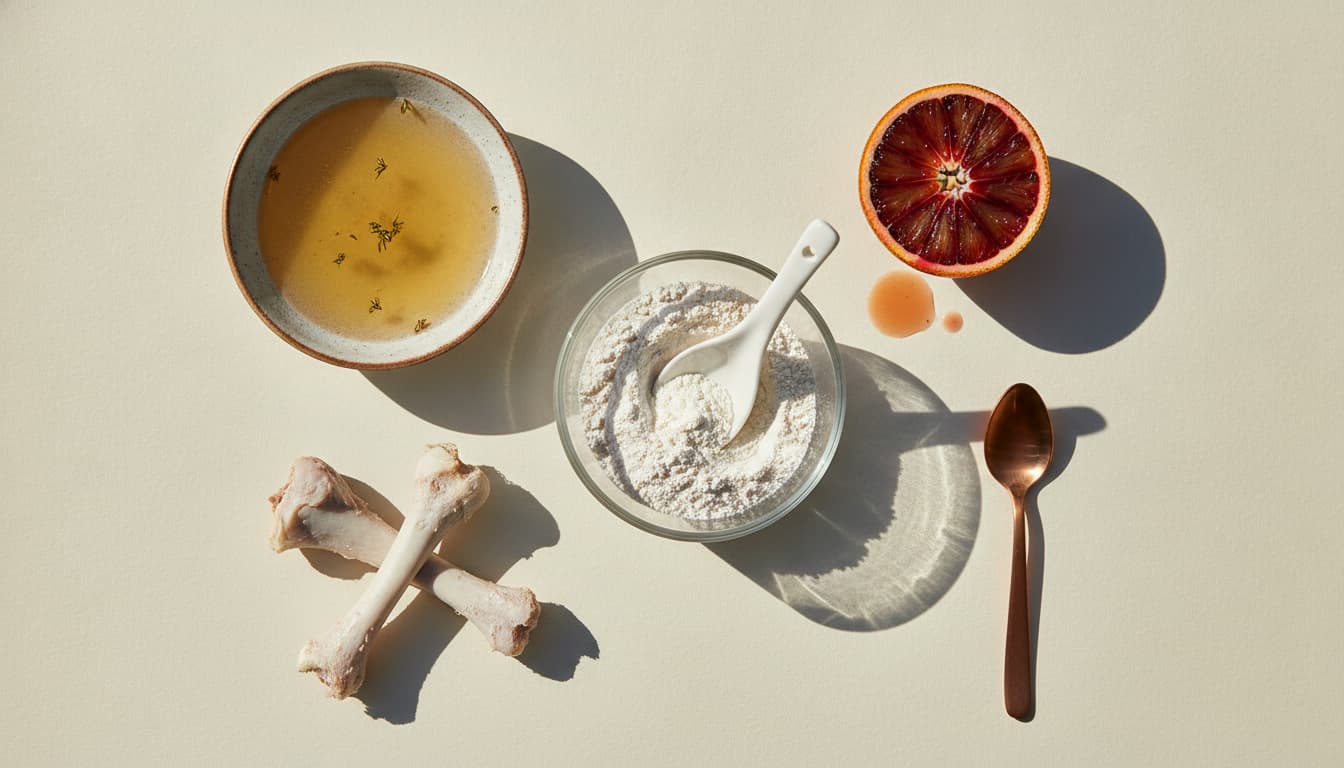
Collagen is the most abundant protein in the body, the scaffold of skin, tendons, bone, and cartilage. What it is, why supplements are hydrolyzed peptides, what the evidence shows, and why it does not count as muscle protein.
What people ask us next.
- What is collagen, in simple terms?
- Collagen is the body's most abundant protein, about 30% of your total protein, and its main structural fiber. It forms the scaffolding of skin, tendons, ligaments, bone, cartilage, and blood vessels, giving those tissues strength and shape. Structurally it is three protein chains wound into a triple helix, rich in the amino acids glycine, proline, and hydroxyproline (Shoulders & Raines 2009). Your body makes its own from dietary amino acids, using vitamin C as a required cofactor.
- What does collagen do in the body?
- It provides structure and tensile strength. Collagen is the load-bearing fiber in skin (firmness and elasticity), tendons and ligaments (connecting muscle to bone and bone to bone), the organic matrix of bone, cartilage (joint cushioning), and vessel walls. It is not an enzyme, hormone, or contractile protein; its role is scaffolding. Natural production declines slowly from the mid-20s, which is the change people try to offset with supplements.
- How is a collagen supplement different from the collagen in my body?
- Supplements are hydrolyzed collagen, meaning the protein has been enzymatically broken into small peptides so it dissolves and absorbs. You do not absorb it intact and send it to your skin. It is digested into amino acids plus some small hydroxyproline-containing peptides that reach the blood and may signal your own cells to make more collagen (Paul et al. 2019). So a supplement supplies building blocks and possible signals, not ready-made collagen fibers.
- Does collagen count as protein for building muscle?
- No. Although collagen is roughly 90% protein by weight, it is an incomplete protein: it lacks the essential amino acid tryptophan and is low in the others that drive muscle growth, so it scores poorly on protein-quality scales. Its grams should not be counted toward a muscle-building protein target. Keep collagen separate from your daily protein math and meet your muscle-protein needs from complete sources like whey, eggs, dairy, meat, or fish.
- Does collagen actually work for skin?
- Modestly, for hydration and elasticity. A 2023 systematic review and meta-analysis of 19 randomized trials (n=1,125) found oral collagen peptides improved skin hydration and elasticity at 2.5-10 g/day taken over 8-12 weeks (Pu et al. 2023). The effects are real but small, results take weeks, and much of the research is industry-funded, so treat it as a low-risk experiment rather than a certainty. See our collagen dosing guide for the amount by goal.
- Why is vitamin C linked to collagen?
- Because vitamin C is a required cofactor for the enzymes that stabilize the collagen triple helix during synthesis. Without enough vitamin C, the body cannot build stable collagen, which is exactly what causes scurvy: bleeding gums, poor wound healing, and fragile connective tissue. This is also why some collagen products add vitamin C, and why the vitamin matters for your own collagen production regardless of whether you supplement collagen itself.
Every claim, cited.
- [01]Pu SY, Huang YL, Pu CM, et al. 2023. Effects of Oral Collagen for Skin Anti-Aging: A Systematic Review and Meta-Analysis. Nutrients 15(9):2080. 19 RCTs, n=1,125; skin hydration and elasticity improved at 2.5-10 g/day over 8-12 weeks.
- [02]Shoulders MD, Raines RT. 2009. Collagen structure and stability. Annu Rev Biochem 78:929-958. Triple-helix structure; glycine-proline-hydroxyproline repeat; ~28 types.
- [03]Paul C, Leser S, Oesser S. 2019. Significant Amounts of Functional Collagen Peptides Can Be Incorporated in the Diet While Maintaining Indispensable Amino Acid Balance. Nutrients 11(5):1079. Hydroxyproline-containing peptides absorbed intact; collagen is low in tryptophan.
- [04]Leon-Lopez A, Morales-Penaloza A, Martinez-Juarez VM, et al. 2019. Hydrolyzed Collagen: Sources and Applications. Molecules 24(22):4031. Hydrolyzed collagen (collagen peptides) production, absorption, and uses.
The Larderlab Team builds evidence-led frameworks for eating, lifting, and stocking a kitchen. We cite every claim. We publish the spreadsheet when possible. We buy what we review at retail price. When new data lands, we revise with a dated note.
Next in this hub.
What to Avoid When Taking Collagen: Five Caveats With Evidence Behind Them
Do not count it toward your protein target, do not judge it before 8 to 12 weeks, and if you form kidney stones, know that 30 g of gelatin raised urinary oxalate by 43 percent in a controlled study. The real caveats, and the myths.
8 min · rev 2026-08-24Foods High in Collagen: Why the Real List Is Shorter Than You Think
Collagen exists only in animal connective tissue, so no plant food contains any. Gelatin powder leads at 85.6 g of protein per 100 g, pork skin at 61.3 g. And the most-marketed source, bone broth, tested poorly against supplements.
8 min · rev 2026-08-24Ashwagandha Benefits: What the Trials Show, and the Liver Signal
Pooled across 12 trials in 1,002 people, stress fell with a standardised mean difference of 1.75 and anxiety by 1.55, but heterogeneity was above 83 percent and the certainty of evidence was rated low. The dose that was tested, and the hepatic case series.
8 min · rev 2026-08-24Get the Larderlab Macro Planner.
A Google Sheet that calculates your protein target, splits it across 3-5 meals, and ranks 20 protein sources by $/gram. Free. Copy-and-modify your own version.
By subscribing, you agree to our Privacy Policy. Unsubscribe anytime.