Prebiotic foods, ranked by fermentable fiber
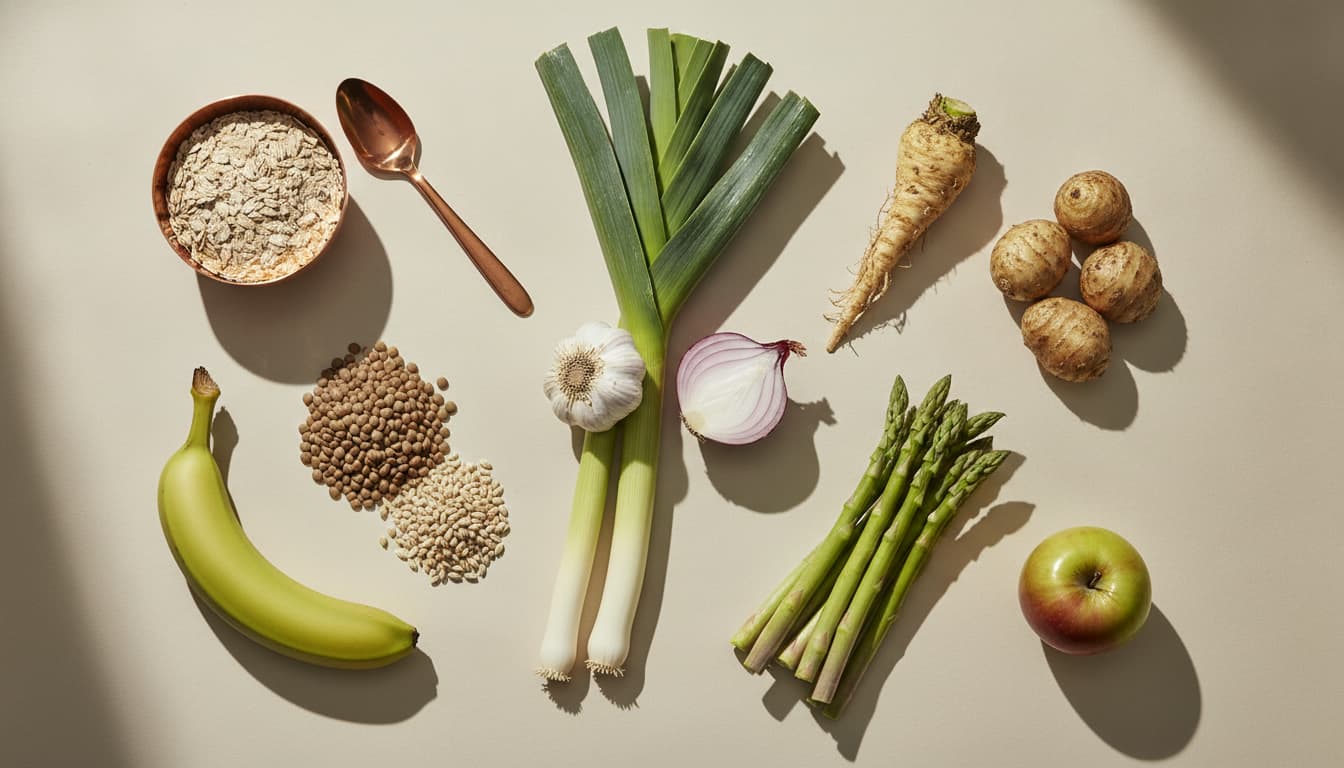
Prebiotics are the specific fibers your gut bacteria ferment, and chicory root, garlic, onion, leeks, and under-ripe bananas are the densest. The ranking, how prebiotics differ from fiber and probiotics, and why ramping up slowly matters.
- 01
Chicory root and Jerusalem artichoke: the densest sources
Chicory root is the most concentrated common prebiotic, so much so that it is the raw material for most inulin supplements and the added fiber in processed foods, and Jerusalem artichoke is close behind (ISAPP). Both are extremely rich in inulin. Few people eat chicory root directly, but it turns up as chicory fiber or inulin on ingredient lists, and Jerusalem artichokes (sunchokes) can be roasted like other root vegetables. Their density also means they are the fastest to cause gas if introduced abruptly.
- 02
Garlic, onion, and leeks
The allium family is the most practical everyday prebiotic source, rich in inulin and FOS, and eaten in almost every savory dish (ISAPP). Garlic and onion are particularly concentrated for their size, and leeks add volume. Because they are cooking staples rather than occasional foods, they quietly supply a meaningful share of daily prebiotic intake for anyone who cooks from scratch. Note that they are also high-FODMAP, so they are common triggers for people with IBS.
- 03
Asparagus, dandelion greens, and under-ripe bananas
Asparagus and dandelion greens are strong vegetable prebiotics, and bananas are a useful source with an important twist: the greener and less ripe the banana, the more resistant starch and prebiotic fiber it contains, which converts to sugar as it ripens (ISAPP). A slightly under-ripe banana is therefore the more prebiotic choice. These foods spread prebiotic intake across fruit and vegetables and are gentler starting points than concentrated chicory root.
- 04
Oats, barley, and whole grains
Whole oats and barley are rich in beta-glucan, a fermentable fiber with both prebiotic and cholesterol-lowering effects, and other whole grains contribute resistant starch and other fermentable fibers (ISAPP). Grains are volume providers rather than the most concentrated sources, but because they are eaten in substantial daily portions, they add up. A bowl of oats is one of the easiest and best-tolerated ways to raise prebiotic intake, and it pairs the fiber with steady-release carbohydrate.
- 05
Legumes and apples
Legumes, lentils, chickpeas, and beans, are excellent prebiotic sources, supplying resistant starch and GOS along with protein and general fiber, and apples contribute pectin, a fermentable fiber (ISAPP). Legumes are also classic gas producers precisely because their fibers are so fermentable, which is why they are best increased gradually. Together with grains they make plant-forward diets naturally rich in prebiotics, and they connect to the resistant starch and fiber themes covered separately on the site.
- 06
How to increase prebiotics without the bloating
The one real caution with prebiotics is that the same fermentation that produces beneficial short-chain fatty acids also produces gas, so increasing intake too fast reliably causes bloating, cramping, and flatulence (ISAPP). The fix is to ramp up gradually over a couple of weeks, spread prebiotic foods across meals, and drink enough water. People with irritable bowel syndrome are the genuine exception: many prebiotics overlap with high-FODMAP foods and can worsen IBS symptoms, so they may need a more cautious, individualized approach, ideally with a dietitian.
How this was specified
- 01Inputs measured
- Retail price (dated) · label claim · Certificate of Analysis · third-party test (Informed Sport / NSF / ConsumerLab / Clean Label) · leucine per serving from COA, not marketing.
- 02Protocols tested
- Per-kg target from four literature ranges (IOM RDA, Phillips 2017, Morton 2018, ISSN). Brands scored against Moore 2015 leucine-per-dose threshold (~0.4 g/kg).
- 03Cost-basis verified
- $/gram of protein and $/gram of leucine at warehouse pricing (Costco), mail-order (Amazon), and DTC retail. Re-checked quarterly, flagged when drift exceeds 15%.
- 04Confidence level
- High on ranked order. Medium on absolute $/g (prices drift). Low on serving-size claims where COA is older than 18 months, flagged [VERIFY].
Every claim, cited.
The Larderlab Team builds evidence-led frameworks for eating, lifting, and stocking a kitchen. We cite every claim. We publish the spreadsheet when possible. We buy what we review at retail price. When new data lands, we revise with a dated note.
Next in this hub.
Berberine Side Effects: Why the Gut Takes the Dose and the Liver Takes the Interaction
Absolute oral bioavailability measured 0.36 percent in rats, so the gut receives almost the whole dose and 34.5 percent of patients reported transient gastrointestinal events. Two weeks at 300 mg three times a day raised the CYP2D6 probe ratio ninefold.
14 min · rev 2026-09-05Foods High in Collagen: Why the Real List Is Shorter Than You Think
Collagen exists only in animal connective tissue, so no plant food contains any. Gelatin powder leads at 85.6 g of protein per 100 g, pork skin at 61.3 g. And the most-marketed source, bone broth, tested poorly against supplements.
8 min · rev 2026-08-24Foods High in Pantothenic Acid (Vitamin B5): The Densest Sources
The adequate intake is just 5 mg a day, and the vitamin's name literally means everywhere, because it is in almost all foods. The ranking, why deficiency essentially never happens, and why B5 supplements for acne and hair have thin evidence.
7 min · rev 2026-08-16Get the Larderlab Macro Planner.
A Google Sheet that calculates your protein target, splits it across 3-5 meals, and ranks 20 protein sources by $/gram. Free. Copy-and-modify your own version.
By subscribing, you agree to our Privacy Policy. Unsubscribe anytime.