Foods high in iodine, ranked by micrograms
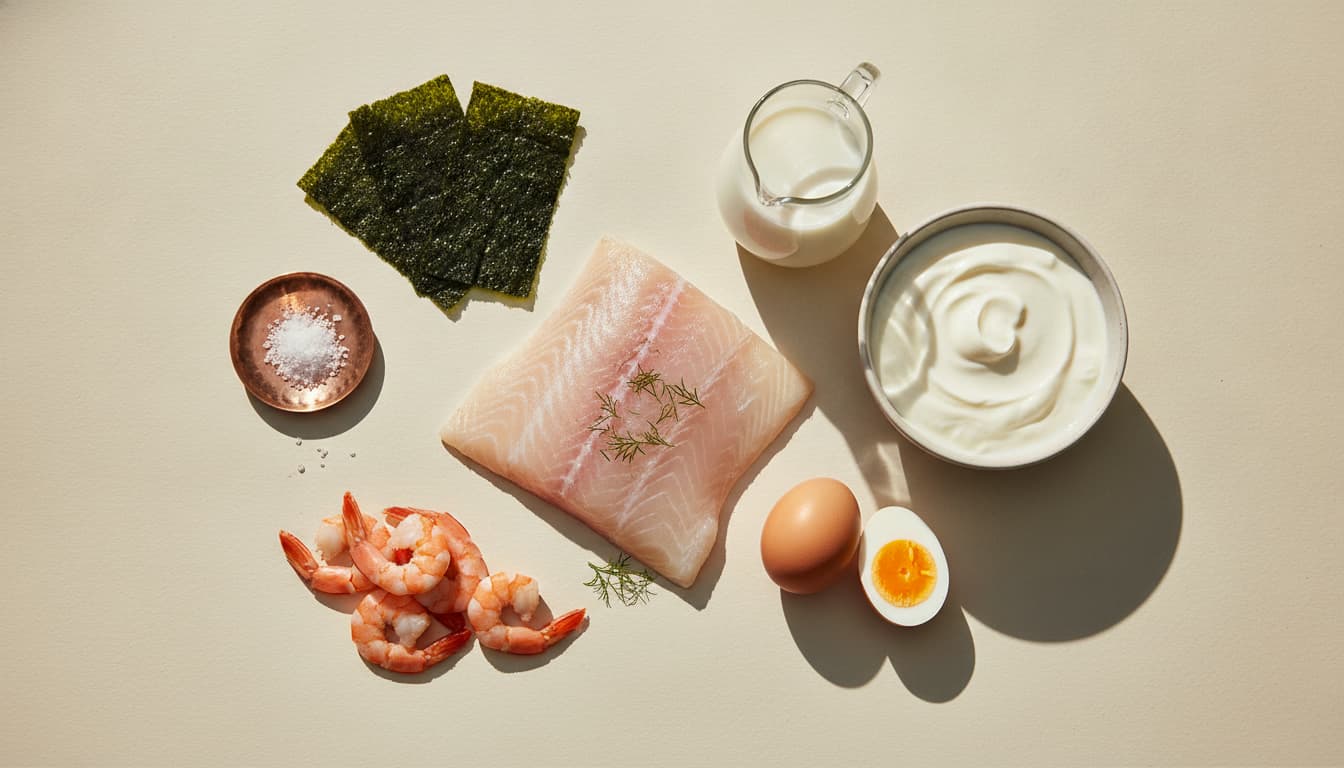
The daily iodine target is 150 mcg for adults, and seaweed, cod, dairy, and iodized salt are the richest sources. The mcg-per-serving ranking, why plants are usually low, and how iodized salt quietly does most of the work.
- 01
Seaweed: dense but dangerously variable
Seaweed is the single richest source and also the least predictable. A sheet of nori carries ~16-43 mcg, but kelp and kombu can hold several thousand micrograms per gram, enough to exceed the 1,100 mcg upper limit many times over in one serving (Zava & Zava 2011). Because content swings by species, harvest, and processing, seaweed is the source most likely to cause iodine excess and thyroid disruption. It is a powerful occasional food, especially nori, but kelp supplements and daily kombu are the classic route to overshooting.
- 02
Cod and white fish: ~99-110 mcg per 100 g
Cod is the standout reliable source, supplying ~99-110 mcg per 100 g, roughly two-thirds of the daily target in one modest fillet, with haddock and pollock similar (USDA; NIH ODS). Sea fish concentrate iodine from seawater, so lean white fish is a dependable way to hit the number without the variability of seaweed. It arrives with complete protein and, in oily fish, omega-3s, so a couple of fish meals a week cover iodine and several other nutrients at once.
- 03
Dairy: milk and yogurt, ~50-85 mcg per serving
A cup of cow's milk supplies ~50-60 mcg and a serving of plain yogurt ~75-85 mcg, making dairy one of the largest contributors to iodine intake in many diets (NIH ODS). The iodine does not come from the milk itself but from iodine-supplemented cattle feed and the iodine-based sanitizers used in milking, so levels vary by farm and season. For people who eat no fish, dairy is often the main dietary source, which is part of why dropping dairy without a plan can quietly cut iodine.
- 04
Iodized salt: the quiet workhorse, ~15-27 mcg per gram
Iodized table salt carries roughly 15-27 mcg of iodine per gram, so about half a teaspoon covers a large share of the daily target, and its introduction is the main reason iodine deficiency became rare in many countries (NIH ODS; WHO). The critical caveat: sea salt, kosher salt, and pink Himalayan salt are usually not iodized, and neither is the salt already in most processed food. A household that switched to trendy salt while eating little fish or dairy can lose its main iodine source without noticing.
- 05
Shrimp and other shellfish: ~35 mcg per 100 g
Shrimp supplies ~35 mcg per 100 g, with other shellfish in a similar range, making seafood beyond fish a useful contributor (USDA; NIH ODS). Like white fish, shellfish concentrate iodine from seawater, so they are a dependable marine source that also brings zinc, selenium, and protein. They are not as dense as cod, but they widen the set of meals that keep iodine topped up for people who eat a seafood-forward diet.
- 06
Eggs: ~24 mcg each, mostly in the yolk
One large egg provides ~24 mcg of iodine, about a sixth of the daily target, concentrated in the yolk (USDA; NIH ODS). As with dairy, the iodine reflects the hen's feed, so it varies. Eggs are a convenient everyday source for people who eat few marine foods, and two or three across a day add a meaningful share of the target. For lacto-ovo vegetarians who skip fish, eggs and dairy together become the backbone of iodine intake.
- 07
Why plants are low, and who is at risk
Fruits, vegetables, grains, and legumes are generally low in iodine unless grown in iodine-rich soil, which most is not, so plant-based diets rarely supply enough without iodized salt or a supplement (NIH ODS). The groups most likely to fall short are vegans, people who avoid both dairy and seafood, those who use only non-iodized specialty salt, and pregnant and breastfeeding people, whose needs rise to 220 and 290 mcg. For these groups a modest iodine source or a supplement providing about 150 mcg is the reliable fix.
How this was specified
- 01Inputs measured
- Retail price (dated) · label claim · Certificate of Analysis · third-party test (Informed Sport / NSF / ConsumerLab / Clean Label) · leucine per serving from COA, not marketing.
- 02Protocols tested
- Per-kg target from four literature ranges (IOM RDA, Phillips 2017, Morton 2018, ISSN). Brands scored against Moore 2015 leucine-per-dose threshold (~0.4 g/kg).
- 03Cost-basis verified
- $/gram of protein and $/gram of leucine at warehouse pricing (Costco), mail-order (Amazon), and DTC retail. Re-checked quarterly, flagged when drift exceeds 15%.
- 04Confidence level
- High on ranked order. Medium on absolute $/g (prices drift). Low on serving-size claims where COA is older than 18 months, flagged [VERIFY].
Every claim, cited.
- [01]National Institutes of Health, Office of Dietary Supplements. Iodine Fact Sheet for Health Professionals. RDA 150 mcg/day for adults (220 mcg pregnancy, 290 mcg lactation); upper limit 1,100 mcg/day; content of fish, dairy, eggs, and iodized salt.
- [02]US Department of Agriculture, Agricultural Research Service. FoodData Central. Iodine content of cod, shrimp, milk, yogurt, and eggs.
- [03]Zava TT, Zava DT. 2011. Assessment of Japanese iodine intake based on seaweed consumption in Japan. Thyroid Research 4:14. Extreme variability of iodine in seaweed, especially kelp and kombu.
- [04]World Health Organization. Guideline: fortification of food-grade salt with iodine for the prevention and control of iodine deficiency disorders. Iodized salt as the primary public-health strategy.
- [05]German Nutrition Society (DGE). Referenzwerte fuer die Naehrstoffzufuhr: Jod. Estimated adult intake value of 200 mcg/day; 230 mcg in pregnancy, 260 mcg during lactation.
The Larderlab Team builds evidence-led frameworks for eating, lifting, and stocking a kitchen. We cite every claim. We publish the spreadsheet when possible. We buy what we review at retail price. When new data lands, we revise with a dated note.
Next in this hub.
What to Avoid When Taking Collagen: Five Caveats With Evidence Behind Them
Do not count it toward your protein target, do not judge it before 8 to 12 weeks, and if you form kidney stones, know that 30 g of gelatin raised urinary oxalate by 43 percent in a controlled study. The real caveats, and the myths.
8 min · rev 2026-08-24Foods High in Collagen: Why the Real List Is Shorter Than You Think
Collagen exists only in animal connective tissue, so no plant food contains any. Gelatin powder leads at 85.6 g of protein per 100 g, pork skin at 61.3 g. And the most-marketed source, bone broth, tested poorly against supplements.
8 min · rev 2026-08-24Ashwagandha Benefits: What the Trials Show, and the Liver Signal
Pooled across 12 trials in 1,002 people, stress fell with a standardised mean difference of 1.75 and anxiety by 1.55, but heterogeneity was above 83 percent and the certainty of evidence was rated low. The dose that was tested, and the hepatic case series.
8 min · rev 2026-08-24Get the Larderlab Macro Planner.
A Google Sheet that calculates your protein target, splits it across 3-5 meals, and ranks 20 protein sources by $/gram. Free. Copy-and-modify your own version.
By subscribing, you agree to our Privacy Policy. Unsubscribe anytime.