How much water per day, by the evidence
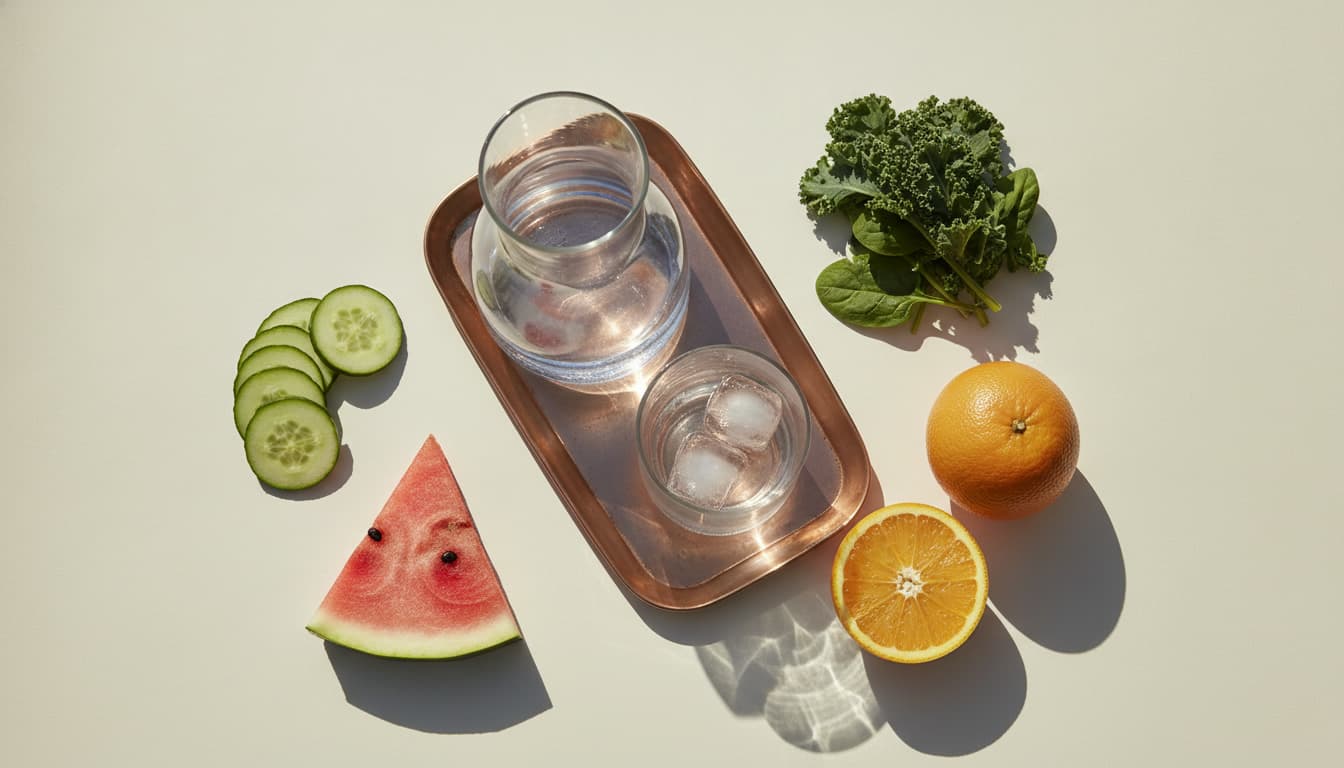
US guidance sets total water at ~3.7 L/day for men and ~2.7 L/day for women, EU guidance a little lower, and about 20% comes from food. The daily number, why the '8 glasses' rule has no basis, and why thirst and urine color beat counting.
- 01
Adult men: about 3.7 L total water per day (US)
The US Institute of Medicine sets the adequate intake for total water at ~3.7 L/day for adult men, meaning all beverages plus the water in food (IOM 2004). Since roughly 20% comes from food, that works out to about 3.0 L (~13 cups) from drinks. The European Food Safety Authority sets a lower ~2.5 L total for men (EFSA 2010). Neither is a rigid prescription; both are population averages that individual needs vary around, so the figure is a starting reference, not a daily quota to force.
- 02
Adult women: about 2.7 L total water per day (US)
The IOM sets ~2.7 L/day of total water for adult women, of which about 2.2 L (~9 cups) comes from drinks and the rest from food (IOM 2004). The EFSA figure is ~2.0 L total (EFSA 2010). Pregnancy raises the target modestly to ~3.0 L and lactation to ~3.8 L total, reflecting the water needed for amniotic fluid and milk production. As with men, the number is an average; a small, sedentary person in a cool climate genuinely needs less than the reference figure.
- 03
About 20% comes from food, not drinks
The total-water figures include the water in food, which supplies roughly 20% of intake (IOM 2004). Water-dense foods make this substantial: cucumber, lettuce, and watermelon are over 90% water, while soup, yogurt, fruit, and even bread and pasta contribute more. This is why the amount you need to drink is lower than the headline total-water number, and why people eating a lot of fruit and vegetables need fewer deliberate glasses. It also means a 'dry' diet of processed food shifts more of the burden onto beverages.
- 04
The '8 glasses a day' rule has no evidence basis
The '8x8' rule, eight 8-ounce glasses (~1.9 L), is not derived from research and undershoots the total-water guidelines for most adults while ignoring the water in food. It appears to trace to a 1945 recommendation that specified about 2.5 L but noted most of it comes from food, a caveat that got dropped in the retelling. There is no evidence that hitting a fixed glass count improves health in people who already drink to thirst. It survives because it is simple, not because it is right.
- 05
Thirst and urine color beat counting glasses
For healthy adults, the body regulates hydration well, and thirst is a reliable trigger to drink; there is no need to pre-empt it by forcing fluids to a number. The simplest objective check is urine color: pale straw indicates good hydration, while dark yellow signals you should drink more. Older adults are an exception, since the thirst response blunts with age, so they benefit from drinking on a light schedule rather than waiting for thirst. Chasing a fixed intake beyond thirst offers no proven benefit for most people.
- 06
When needs rise: heat, exercise, pregnancy, altitude
Fluid needs climb with anything that raises water loss. Heavy exercise and hot or humid conditions can push sweat losses to 1-2 L per hour, far beyond baseline, and outdoor workers face the same demand. High altitude increases losses through faster breathing and higher urine output. Pregnancy and lactation add a modest fixed increase. In these cases the reference numbers are floors, not targets, and heavy sweating shifts the problem toward replacing electrolytes as well as water, which our primer on what electrolytes are covers.
- 07
Overhydration is a real but narrow risk
Drinking far more water than the kidneys can excrete (roughly 0.8-1.0 L per hour) dilutes blood sodium and causes hyponatremia, which can be dangerous. In practice this is almost entirely confined to endurance events where athletes over-drink, and to certain medical conditions and medications, not to ordinary daily hydration. The lesson is not to fear water but to reject the idea that more is always better: for most people, drinking to thirst avoids both dehydration and the far rarer hazard of overhydration.
What people ask us next.
- How much water should I drink per day?
- US guidance sets total water at ~3.7 L/day for men and ~2.7 L/day for women, including the water in food (IOM 2004); EU guidance is lower at ~2.5 L and ~2.0 L (EFSA 2010). Since about 20% comes from food, that means roughly 3.0 L of drinks for men and 2.2 L for women under the US figures. These are population averages, not personal quotas. For most healthy adults, drinking to thirst and checking that urine is pale straw is a more reliable guide than hitting a fixed number.
- Is the '8 glasses a day' rule true?
- No. The '8x8' rule, eight 8-ounce glasses (~1.9 L), has no scientific basis and undershoots the total-water guidelines for most adults while ignoring the 20% of water that comes from food. It appears to be a misremembering of a 1945 recommendation that specified ~2.5 L but noted most of that comes from food. There is no evidence that forcing a fixed glass count improves health in people who already drink to thirst; it persists because it is easy to remember, not because it is correct.
- Does coffee and tea count toward my water intake?
- Yes. All fluids, including coffee, tea, milk, and juice, count toward total water intake. The common belief that caffeine is dehydrating is overstated: at habitual intakes the mild diuretic effect is offset by the water in the drink, so caffeinated beverages contribute net fluid (Killer et al. 2014). Water and unsweetened drinks are still preferable for reasons of sugar and calories, but they do not have to be plain water to count toward hydration.
- How do I know if I'm drinking enough water?
- The simplest check is urine color: pale straw indicates good hydration, while dark yellow means you should drink more. Thirst is also a reliable trigger in healthy adults, so there is usually no need to force fluids beyond it. Signs of inadequate intake include persistent dark urine, dry mouth, headache, and fatigue. Older adults are an exception, since the thirst response weakens with age, so they benefit from drinking on a light schedule rather than waiting to feel thirsty.
- Can you drink too much water?
- Yes, though it is rare. Drinking far more than the kidneys can excrete, roughly 0.8-1.0 L per hour, dilutes blood sodium and causes hyponatremia, which can be serious. This is almost entirely limited to endurance events where athletes over-drink, and to certain medical conditions and medications. For everyday drinking it is not a realistic concern. The takeaway is that more is not always better: drinking to thirst protects against both dehydration and the much rarer risk of overhydration.
- Do I need more water when I exercise or in hot weather?
- Yes, substantially. Heavy exercise and hot or humid conditions can push sweat losses to 1-2 L per hour, well beyond baseline needs, and outdoor work and high altitude raise losses too. In these cases the reference numbers become floors rather than targets. Heavy, prolonged sweating also loses sodium and other electrolytes, so replacing water alone is not enough during long sessions; our primer on what electrolytes are explains who genuinely needs electrolyte replacement rather than plain water.
Every claim, cited.
- [01]Institute of Medicine. 2004. Dietary Reference Intakes for Water, Potassium, Sodium, Chloride, and Sulfate. National Academies Press. Adequate total water intake ~3.7 L/day (men) and ~2.7 L/day (women); ~20% from food.
- [02]European Food Safety Authority. 2010. Scientific Opinion on Dietary Reference Values for Water. EFSA Journal 8(3):1459. Adequate total water intake ~2.5 L/day (men) and ~2.0 L/day (women).
- [03]Killer SC, Blannin AK, Jeukendrup AE. 2014. No evidence of dehydration with moderate daily coffee intake. PLoS ONE 9(1):e84154. Habitual coffee intake contributes to daily fluid needs comparably to water.
- [04]Valtin H. 2002. 'Drink at least eight glasses of water a day.' Really? Am J Physiol Regul Integr Comp Physiol 283(5):R993-R1004. No scientific basis for the 8x8 rule.
The Larderlab Team builds evidence-led frameworks for eating, lifting, and stocking a kitchen. We cite every claim. We publish the spreadsheet when possible. We buy what we review at retail price. When new data lands, we revise with a dated note.
Next in this hub.
How Much Fiber Per Day? The Number, by Age and Sex
The target is 14 g of fiber per 1,000 calories eaten, which works out to about 25 g/day for women and 38 g/day for men. The daily fiber number by age and sex, why most people hit only half of it, and how to close the gap from food.
8 min · rev 2026-07-04Does Avocado Have Protein? The USDA Number, and the Per-Calorie Math
USDA lists 2.0 g of protein per 100 g of raw avocado, at 160 kcal. That is 1.25 g of protein per 100 kcal, against 18.8 g per 100 kcal for roasted chicken breast. The numbers, and what avocado is actually dense in.
7 min · rev 2026-08-20How Much Protein Per Meal? The Per-Sitting Number, by the Evidence
The muscle-building response peaks at about 0.4 g of protein per kg of body weight per meal, roughly 25-40 g for most adults. The per-meal number, why splitting protein across the day beats one large dose, and how to hit it.
8 min · rev 2026-07-21Get the Larderlab Macro Planner.
A Google Sheet that calculates your protein target, splits it across 3-5 meals, and ranks 20 protein sources by $/gram. Free. Copy-and-modify your own version.
By subscribing, you agree to our Privacy Policy. Unsubscribe anytime.