How much protein is in an avocado, per gram and per calorie
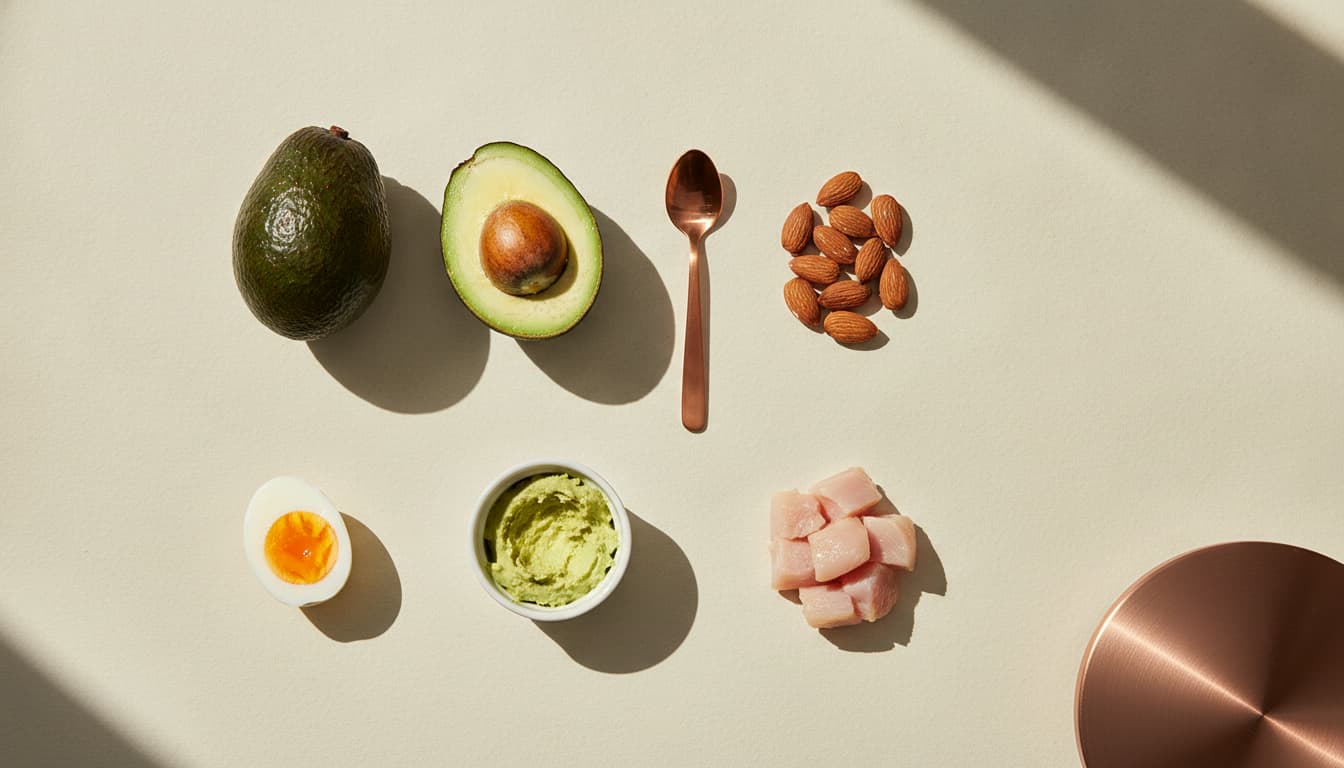
USDA lists 2.0 g of protein per 100 g of raw avocado, at 160 kcal. That is 1.25 g of protein per 100 kcal, against 18.8 g per 100 kcal for roasted chicken breast. The numbers, and what avocado is actually dense in.
- 01
The USDA number: 2.0 g protein per 100 g, at 160 kcal
USDA FoodData Central lists avocados raw, all commercial varieties, at 2.0 g of protein per 100 g, in a food supplying 160 kcal, 14.7 g of total fat, 8.53 g of carbohydrate of which 6.7 g is fiber, and 485 mg of potassium. A whole medium avocado yields roughly 200 g of edible flesh, which works out to about 4 g of protein and about 320 kcal. That is the entire factual answer; everything else is a matter of what those 4 g are worth relative to the 320 kcal they arrive with.
- 02
Per 100 kcal: 1.25 g, against 18.8 g for chicken breast
Absolute protein grams say little without the calories attached. Dividing protein by energy puts foods on a common axis, and avocado lands at 1.25 g of protein per 100 kcal. Roasted chicken breast, at 31 g protein and 165 kcal per 100 g (USDA), delivers 18.8 g per 100 kcal. A large egg, at 6.3 g protein and about 72 kcal, delivers 8.8 g per 100 kcal. Avocado therefore supplies roughly one fifteenth of the protein per calorie of chicken breast and about one seventh of an egg.
- 03
What a 30 g protein serving would cost in avocado
The clearest way to see the density gap is to run the requirement backwards. Hitting a single 30 g protein serving from avocado alone would take about 1.5 kg of flesh, which carries roughly 2,400 kcal and around 220 g of fat. The same 30 g comes from about 100 g of roasted chicken breast at 165 kcal, or five large eggs at about 360 kcal. This is not an argument against avocado; it is the arithmetic that settles whether it can function as a protein source, and it cannot.
- 04
Complete protein, but the completeness is not the useful fact
Avocado protein contains all nine indispensable amino acids, which makes it technically complete, and this appears often in marketing copy. It is accurate and close to irrelevant in practice. Completeness describes the amino acid pattern of the protein present, not the quantity of it, and 2 g per 100 g is too little for the pattern to matter to a daily target. The distinction is worth holding generally: protein quality metrics become meaningful only once the quantity is large enough to contribute.
- 05
What avocado is actually dense in: fiber, monounsaturated fat, potassium
The reasons to eat avocado are on other lines of the same USDA entry. It carries 6.7 g of fiber per 100 g, which is higher than most fruit; 14.7 g of total fat per 100 g, predominantly monounsaturated; and 485 mg of potassium per 100 g, substantial for a plant food. Those three together explain both the satiety effect and its usefulness in a diet where potassium intake is typically low relative to sodium. Judged as a fat and fiber food, it is dense. Judged as a protein food, it is not.
- 06
What this means when tracking macros
When avocado appears in a meal, the protein in that meal is coming from whatever it is paired with, and the avocado is contributing fat, fiber, potassium, and satiety. Logging it as a protein contribution inflates the daily figure by a rounding error while adding around 320 kcal per whole fruit, which is the more consequential number for anyone managing energy intake. The practical rule is to treat avocado in the fat column, count its calories honestly, and source the protein from the other component of the plate.
What people ask us next.
- Does avocado have protein?
- Yes, but very little relative to its calories. USDA lists raw avocado at 2.0 g of protein per 100 g in a food supplying 160 kcal, so a whole avocado of about 200 g of flesh provides roughly 4 g of protein and about 320 kcal. Expressed per 100 kcal that is 1.25 g of protein, against 18.8 g per 100 kcal for roasted chicken breast. Avocado is a fat and fiber food that happens to contain protein, not a protein source.
- How much protein is in one whole avocado?
- About 4 g. USDA lists 2.0 g of protein per 100 g of raw avocado, and a whole medium avocado yields roughly 200 g of edible flesh, giving about 4 g of protein alongside about 320 kcal, 29 g of fat, and 13 g of fiber. For comparison, a large egg supplies 6.3 g of protein for about 72 kcal, so one egg carries more protein than an entire avocado at roughly a fifth of the calories.
- Is avocado a good source of protein?
- No, and the per-calorie math shows why. Avocado delivers 1.25 g of protein per 100 kcal, against 18.8 g per 100 kcal for roasted chicken breast and 8.8 g per 100 kcal for a large egg. Reaching a single 30 g protein serving from avocado alone would take about 1.5 kg of flesh and roughly 2,400 kcal. It is a good source of monounsaturated fat, fiber, and potassium, which are the reasons to eat it.
- Is avocado protein a complete protein?
- Technically yes, and it matters less than it sounds. Avocado protein contains all nine indispensable amino acids, so it meets the definition of complete. But completeness describes the amino acid pattern of the protein present rather than how much protein is there, and 2 g per 100 g is too little to affect a daily target. Protein quality metrics only become useful once the quantity is large enough to contribute meaningfully.
- What is avocado actually high in?
- Fiber, monounsaturated fat, and potassium. USDA lists 6.7 g of fiber per 100 g, which is higher than most fruit, 14.7 g of total fat per 100 g that is predominantly monounsaturated, and 485 mg of potassium per 100 g, which is substantial for a plant food. Those three explain both the satiety effect and its value in diets where potassium intake runs low relative to sodium. The 160 kcal per 100 g is the trade-off to account for.
- Should I count avocado toward my daily protein target?
- Not meaningfully. At about 4 g per whole fruit it moves a daily protein figure by a rounding error while adding around 320 kcal, which is the number worth tracking. The better approach is to log avocado in the fat column, count its calories honestly, and source the protein from whatever it is served with. In an avocado toast breakfast, for instance, the protein is coming from the eggs, dairy, or bread, not the avocado.
Every claim, cited.
- [01]USDA FoodData Central: Avocados, raw, all commercial varieties (SR Legacy 171705). 2.0 g protein, 160 kcal, 14.7 g fat, 8.53 g carbohydrate, 6.7 g fiber, 485 mg potassium per 100 g.
- [02]USDA FoodData Central: Chicken, broilers or fryers, breast, meat only, cooked, roasted (SR Legacy 171477). 31.0 g protein, 165 kcal per 100 g, the per-calorie benchmark used here.
- [03]USDA FoodData Central: eggs, whole, cooked. A large egg supplies 6.3 g protein at about 72 kcal, the second per-calorie comparator.
- [04]NIH Office of Dietary Supplements: Potassium Fact Sheet for Health Professionals. Context for the 485 mg per 100 g potassium figure and typical intake shortfalls.
The Larderlab Team builds evidence-led frameworks for eating, lifting, and stocking a kitchen. We cite every claim. We publish the spreadsheet when possible. We buy what we review at retail price. When new data lands, we revise with a dated note.
Next in this hub.
How Much Protein Per Meal? The Per-Sitting Number, by the Evidence
The muscle-building response peaks at about 0.4 g of protein per kg of body weight per meal, roughly 25-40 g for most adults. The per-meal number, why splitting protein across the day beats one large dose, and how to hit it.
8 min · rev 2026-07-21How Much Protein in an Egg? By Size, Plus the $/g Math
A large egg has 6.3 g of protein (USDA): 3.6 g in the white, 2.7 g in the yolk. Protein by egg size, the cost-per-gram math, and how it ranks against other sources.
7 min · rev 2026-06-24How Much Protein Should I Eat a Day? The Number, by Goal
Sedentary adults need 0.8 g/kg/day (RDA); people who resistance train need 1.6 g/kg/day (Morton 2018). The daily protein number by goal, bodyweight, and meal split.
9 min · rev 2026-06-26Get the Larderlab Macro Planner.
A Google Sheet that calculates your protein target, splits it across 3-5 meals, and ranks 20 protein sources by $/gram. Free. Copy-and-modify your own version.
By subscribing, you agree to our Privacy Policy. Unsubscribe anytime.