How much fiber per day, by age and sex
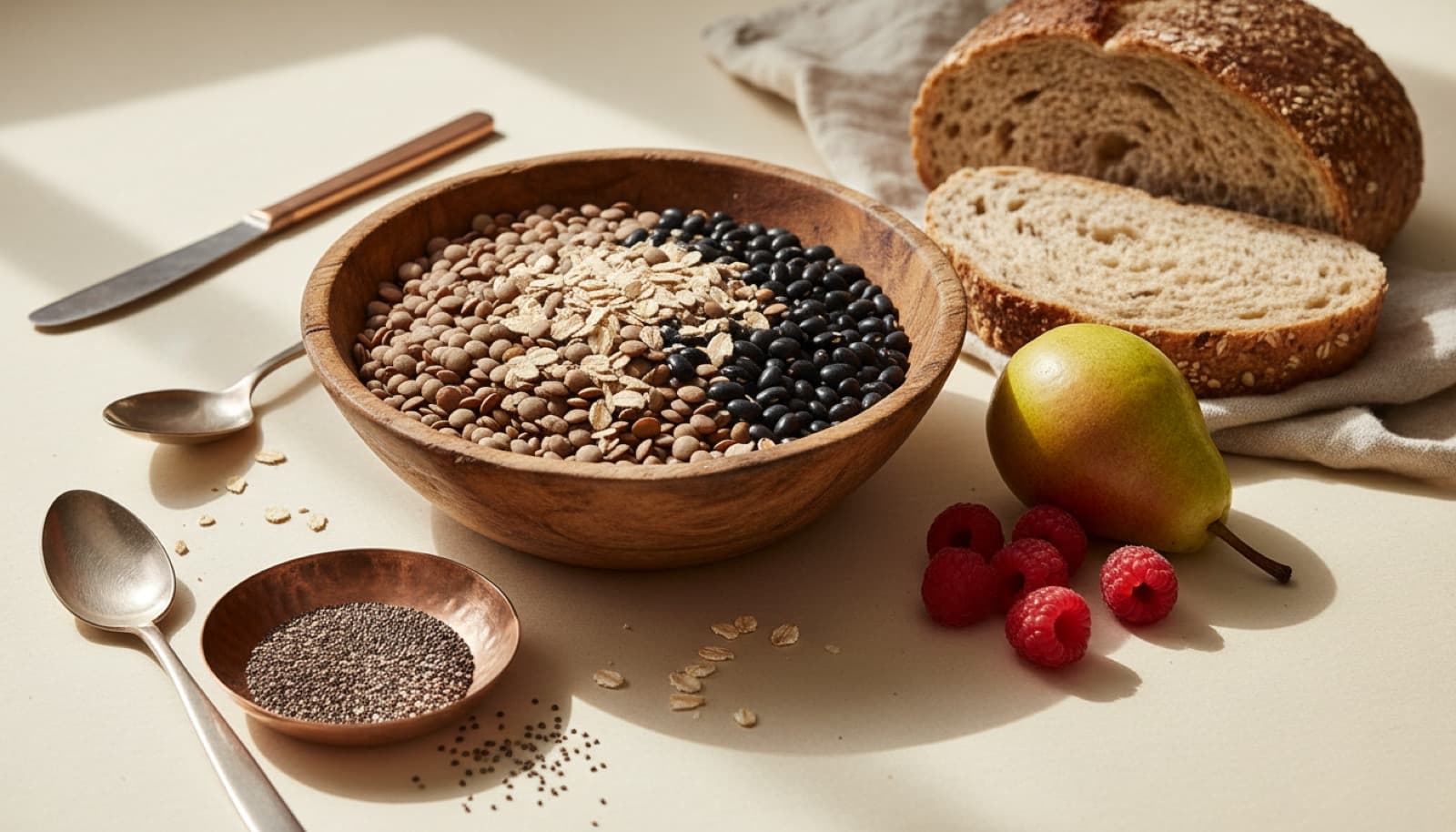
The target is 14 g of fiber per 1,000 calories eaten, which works out to about 25 g/day for women and 38 g/day for men. The daily fiber number by age and sex, why most people hit only half of it, and how to close the gap from food.
- 01
Adult women: about 25 g/day
The adequate intake for women aged 19-50 is 25 g/day, easing to 21 g/day after age 50 as calorie needs fall (IOM 2005; NIH). The number derives from the 14 g per 1,000 calories rule applied to typical female energy intake. Pregnancy raises it to ~28 g/day and lactation to ~29 g/day. Most women take in only ~13-15 g, so the realistic task is roughly doubling current intake, not fine-tuning it.
- 02
Adult men: about 38 g/day
The adequate intake for men aged 19-50 is 38 g/day, dropping to 30 g/day after age 50 (IOM 2005). The higher male figure reflects higher average calorie intake, not a different mechanism, since the underlying standard is 14 g per 1,000 calories for everyone. Men fall short at similar rates to women, averaging ~17-19 g/day, so hitting 38 g takes deliberate sources at every meal rather than a single high-fiber food.
- 03
The real standard is 14 g per 1,000 calories
The 25 and 38 g figures are shortcuts; the actual guideline is 14 g of fiber per 1,000 calories consumed (Dietary Guidelines 2020-2025). This is why an active person eating 3,000 calories should aim closer to 42 g, while someone eating 1,600 calories targets ~22 g. Anchoring to calories rather than a fixed gram number keeps the target honest across body sizes and activity levels, and explains why the same person's fiber goal changes when their intake does.
- 04
Children and teens: age plus 5 to age-based grams
The old 'age plus 5' rule (a 6-year-old aims for ~11 g) is a rough floor; the current AI is 19-25 g/day for children 4-8 and 26-31 g/day for teen boys, 22-26 g/day for teen girls (IOM 2005). The same 14 g per 1,000 calories logic applies. Children's shortfalls mirror adults', driven by refined grains and low vegetable intake, so the fix is the same: intact grains, fruit with skin, and legumes rather than fiber-fortified snack products.
- 05
Soluble vs insoluble: both, from food
Soluble fiber (oats, barley, beans, apples, psyllium) forms a gel that lowers LDL cholesterol ~5-10% at 5-10 g/day and blunts post-meal glucose (Brown et al. 1999). Insoluble fiber (wheat bran, whole grains, vegetable skins) adds bulk and speeds transit, easing constipation. Whole plant foods carry both, so there is no need to track a ratio. Chasing total fiber from varied plants captures both functions automatically, which is why single-type supplements are a backstop, not a strategy.
- 06
The densest everyday sources
Per USDA FoodData Central: 1 cup cooked black beans (~15 g), 1 cup cooked lentils (~15.6 g), 1 medium avocado (~10 g), 1 oz chia seeds (~10 g), 1 cup raspberries (~8 g), 1 medium pear with skin (~5.5 g), 1 cup cooked oats (~4 g). Legumes are the highest-yield everyday lever: a single cup of beans or lentils supplies more than half a woman's daily target. Stacking two legume servings plus fruit and an intact grain clears 25-38 g without any supplement.
- 07
Raise it slowly and drink water
Jumping from 15 g to 38 g in a day reliably causes gas, bloating, and cramping as gut bacteria adapt. Increase by ~5 g every few days over 2-3 weeks and raise fluid intake alongside, since fiber, especially the bulking insoluble kind, needs water to move and can worsen constipation without it. The adaptation is real: the discomfort fades as the microbiome shifts, but only if the ramp is gradual. This is the most common reason people abandon a higher-fiber diet.
What people ask us next.
- How much fiber should I eat per day?
- About 25 g/day for women and 38 g/day for men aged 19-50, dropping to 21 g and 30 g after age 50 (Institute of Medicine 2005). The underlying standard is 14 g of fiber per 1,000 calories consumed, so heavier eaters need more and lighter eaters need less. Most US adults take in only ~15 g/day, so for most people the task is closing a large gap rather than hitting an exact number.
- Is 30 grams of fiber a day enough?
- For most women, yes; for many men it is close but slightly under the 38 g target. 30 g/day sits comfortably in the range associated with the largest drops in heart disease, type 2 diabetes, and colorectal cancer risk in the 2019 Lancet meta-analysis (Reynolds et al. 2019), where benefits were strongest from 25-29 g/day upward. Since the average intake is ~15 g, reaching 30 g already captures most of the measurable benefit.
- How much fiber per day to lose weight?
- There is no separate weight-loss fiber target; the same 25-38 g/day applies. Fiber supports weight management indirectly by increasing satiety and slowing gastric emptying, so higher-fiber meals tend to reduce total calorie intake without deliberate restriction. In trials, simply aiming for 30 g/day produced weight loss comparable to more complex diets (Ma et al. 2015). The mechanism is fullness and food volume, not fat burning.
- Can I get enough fiber from food alone?
- Yes, and it is the preferred route. A day with 1 cup black beans (~15 g), 1 cup raspberries (~8 g), 1 pear with skin (~5.5 g), and 1 cup cooked oats (~4 g) already exceeds 32 g (USDA FoodData Central). Food fiber arrives with potassium, magnesium, and polyphenols that likely explain much of its benefit, which is why a supplement is a backstop for a stubborn gap rather than a substitute.
- What happens if I eat too much fiber?
- Very high intakes (well above 50-70 g/day) can cause bloating, gas, and cramping, and in some cases reduce absorption of minerals like zinc and iron if intake spikes suddenly. But this is uncommon, since almost no one over-consumes fiber; the near-universal problem is the opposite. The practical risk is raising intake too fast: increase by ~5 g every few days and drink more water to avoid the temporary discomfort.
- Is fiber a carb, and does it count toward my macros?
- Yes, fiber is a carbohydrate, but it is largely indigestible, so it contributes little usable energy. This is why 'net carbs' subtract fiber from total carbohydrate. When you set a daily carb target, fiber counts inside that number rather than as a separate macro. To see how fiber fits alongside your protein and fat targets for a full day, our macro calculator sets all three at once.
Every claim, cited.
- [01]Institute of Medicine. 2005. Dietary Reference Intakes for Energy, Carbohydrate, Fiber, Fat, Fatty Acids, Cholesterol, Protein, and Amino Acids. National Academies Press. Adequate intake set at 14 g fiber per 1,000 kcal; 25 g/day (women) and 38 g/day (men).
- [02]US Departments of Agriculture and Health and Human Services. Dietary Guidelines for Americans, 2020-2025. Fiber recommendation of 14 g per 1,000 calories; most Americans fall short.
- [03]Reynolds A, Mann J, Cummings J, et al. 2019. Carbohydrate quality and human health: a series of systematic reviews and meta-analyses. Lancet 393(10170):434-445. Each 8 g/day fiber increment linked to 5-27% lower disease risk; strongest benefits from 25-29 g/day.
- [04]Quagliani D, Felt-Gunderson P. 2017. Closing America's Fiber Intake Gap. Am J Lifestyle Med 11(1):80-85. Average US intake ~15 g/day; only ~5% meet the recommendation.
- [05]Brown L, Rosner B, Willett WW, Sacks FM. 1999. Cholesterol-lowering effects of dietary fiber: a meta-analysis. Am J Clin Nutr 69(1):30-42. Soluble fiber lowers LDL cholesterol at 5-10 g/day.
The Larderlab Team builds evidence-led frameworks for eating, lifting, and stocking a kitchen. We cite every claim. We publish the spreadsheet when possible. We buy what we review at retail price. When new data lands, we revise with a dated note.
Next in this hub.
How Much Water Per Day? The Number, by Sex and Guideline
US guidance sets total water at ~3.7 L/day for men and ~2.7 L/day for women, EU guidance a little lower, and about 20% comes from food. The daily number, why the '8 glasses' rule has no basis, and why thirst and urine color beat counting.
8 min · rev 2026-07-10Does Avocado Have Protein? The USDA Number, and the Per-Calorie Math
USDA lists 2.0 g of protein per 100 g of raw avocado, at 160 kcal. That is 1.25 g of protein per 100 kcal, against 18.8 g per 100 kcal for roasted chicken breast. The numbers, and what avocado is actually dense in.
7 min · rev 2026-08-20How Much Protein Per Meal? The Per-Sitting Number, by the Evidence
The muscle-building response peaks at about 0.4 g of protein per kg of body weight per meal, roughly 25-40 g for most adults. The per-meal number, why splitting protein across the day beats one large dose, and how to hit it.
8 min · rev 2026-07-21Get the Larderlab Macro Planner.
A Google Sheet that calculates your protein target, splits it across 3-5 meals, and ranks 20 protein sources by $/gram. Free. Copy-and-modify your own version.
By subscribing, you agree to our Privacy Policy. Unsubscribe anytime.