High-fiber foods, ranked by grams
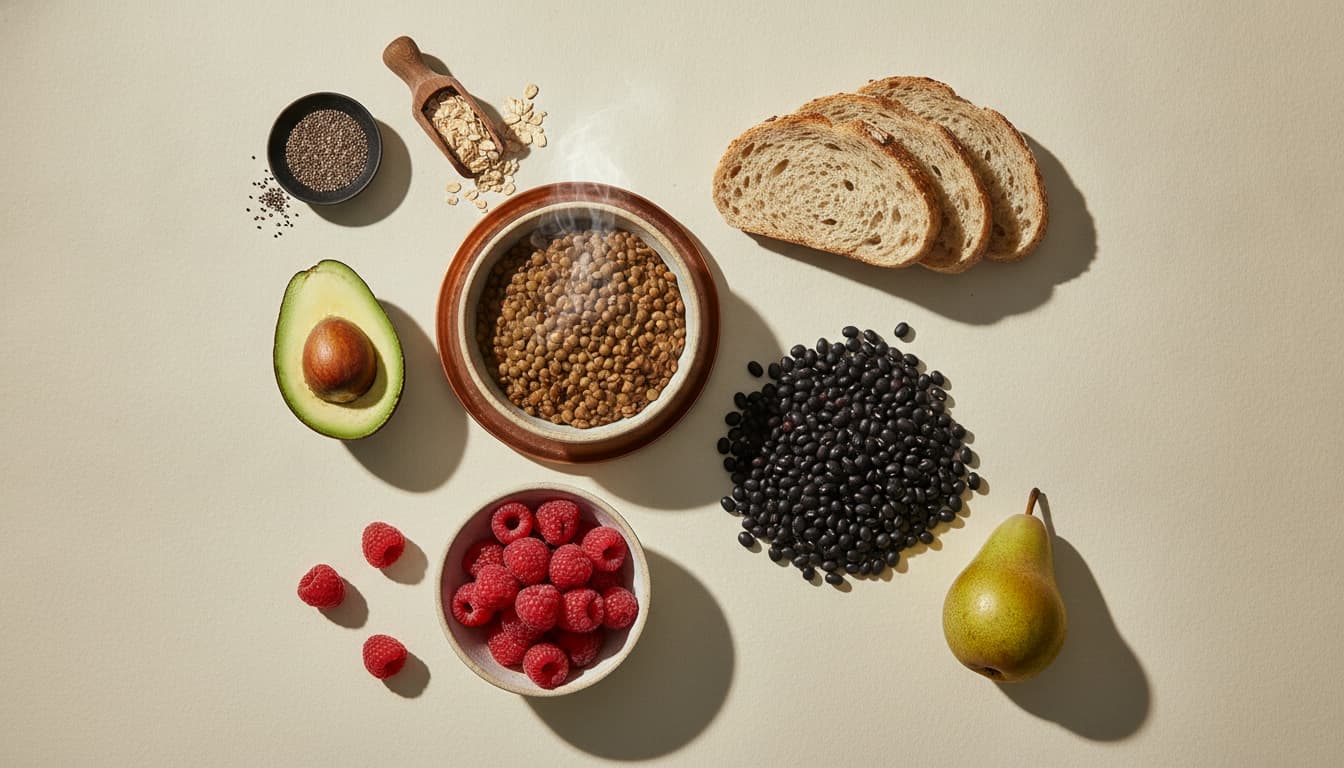
The target is ~25 g/day for women and 38 g for men, and beans, lentils, chia, avocado, and whole grains are the densest sources. The grams-per-serving ranking, why most people hit only half the number, and how to close the gap without bloating.
- 01
Beans and lentils: ~13-16 g per cup cooked
Legumes are the densest common source by a wide margin: a cup of cooked lentils supplies ~15 g, black beans ~15 g, and split peas ~16 g, a third to nearly half a full day in one serving (USDA FoodData Central). They carry a strong mix of soluble and insoluble fiber, stack plant protein and potassium alongside it, and are the cheapest route to a high-fiber day. A daily cup of beans or lentils is the single most effective move most people can make to close the gap.
- 02
Chia and flax seeds: ~8-10 g per ounce
Chia seeds supply ~10 g of fiber per ounce and ground flax ~8 g, mostly soluble fiber that forms a gel and feeds gut bacteria (USDA). A single ounce stirred into yogurt, oats, or a smoothie is one of the most concentrated fiber additions available, and it brings omega-3 ALA and protein along. Because the fiber is so dense, seeds are best added gradually and with enough water, or they can feel heavy.
- 03
Avocado: ~10 g per whole fruit
A whole avocado carries ~10 g of fiber, unusually high for something eaten as a fat source, with a good balance of soluble and insoluble types (USDA). It arrives with potassium and monounsaturated fat, so it does more per serving than most fruit. Half an avocado on toast or in a salad adds ~5 g without any sense of eating a 'fiber food,' which makes it one of the easier dense sources to work into meals.
- 04
Whole grains: barley, oats, and whole wheat, ~6-16 g per serving
A cup of cooked pearl barley leads the grains at ~6 g, oats supply ~4 g per cup cooked plus beta-glucan soluble fiber, and 100% whole-wheat products vary widely (USDA). The catch is the label: 'whole grain' and 'multigrain' claims do not guarantee fiber, and the Nutrition Facts number is the only reliable guide. Choosing intact or minimally processed grains over refined flour is where whole grains earn their place on the list.
- 05
Berries and fruit with structure: ~4-8 g per serving
A cup of raspberries supplies ~8 g of fiber and blackberries similar, the densest fruit by far, with pears (~5.5 g with skin), apples with skin (~4.5 g), and bananas lower but useful (USDA). The skin and seeds hold much of it, so peeling cuts the yield. Berries pair a high fiber load with a low sugar load relative to other fruit, which is why they are the fruit of choice for anyone watching both numbers at once.
- 06
Nuts and vegetables: ~3-8 g per serving
An ounce of almonds supplies ~3.5 g of fiber, a cup of cooked broccoli or Brussels sprouts ~5 g, a medium artichoke ~7 g, and a baked sweet potato with skin ~4 g (USDA). None tops the ranking alone, but they form the steady background that, stacked with a legume-based meal and a serving of seeds, clears the target. Eating vegetables with their skins and choosing denser options like artichokes and sprouts raises the daily total meaningfully.
How this was specified
- 01Inputs measured
- Retail price (dated) · label claim · Certificate of Analysis · third-party test (Informed Sport / NSF / ConsumerLab / Clean Label) · leucine per serving from COA, not marketing.
- 02Protocols tested
- Per-kg target from four literature ranges (IOM RDA, Phillips 2017, Morton 2018, ISSN). Brands scored against Moore 2015 leucine-per-dose threshold (~0.4 g/kg).
- 03Cost-basis verified
- $/gram of protein and $/gram of leucine at warehouse pricing (Costco), mail-order (Amazon), and DTC retail. Re-checked quarterly, flagged when drift exceeds 15%.
- 04Confidence level
- High on ranked order. Medium on absolute $/g (prices drift). Low on serving-size claims where COA is older than 18 months, flagged [VERIFY].
Every claim, cited.
- [01]US Department of Agriculture and US Department of Health and Human Services. Dietary Guidelines for Americans 2020-2025. Fiber target of 14 g per 1,000 calories; ~25 g/day (women) and 38 g/day (men).
- [02]US Department of Agriculture, Agricultural Research Service. FoodData Central. Fiber content of legumes, seeds, avocado, whole grains, berries, nuts, and vegetables.
- [03]National Institutes of Health, Office of Dietary Supplements and NIDDK. Fiber and average US intake (~15 g/day); soluble versus insoluble fiber and their roles.
- [04]Reynolds A, et al. 2019. Carbohydrate quality and human health: a series of systematic reviews and meta-analyses. Lancet 393(10170):434-445. Higher fiber intake and reduced risk of cardiovascular disease and type 2 diabetes.
The Larderlab Team builds evidence-led frameworks for eating, lifting, and stocking a kitchen. We cite every claim. We publish the spreadsheet when possible. We buy what we review at retail price. When new data lands, we revise with a dated note.
Next in this hub.
Foods High in Zinc: The Densest Sources, by Milligrams
The daily zinc target is 11 mg for men and 8 mg for women, and oysters, beef, pumpkin seeds, and legumes are the densest sources. The mg-per-serving ranking, why plant zinc absorbs worse, and how to hit the number from food.
8 min · rev 2026-07-06Foods High in Vitamin C: The Densest Sources, by Milligrams
The daily target is 90 mg for men and 75 mg for women, and one guava, one red bell pepper, or a cup of strawberries clears it in a single serving. The mg-per-serving ranking, why oranges are not the top source, and how cooking cuts the number.
8 min · rev 2026-07-10Foods High in Lysine: The Densest Sources, by Grams
Lysine is the essential amino acid that cereals run short on, which is why the meat-and-legume story matters. The per-serving ranking, why grain-heavy plant diets need beans to balance, and what the evidence really says about lysine for cold sores.
8 min · rev 2026-08-07Get the Larderlab Macro Planner.
A Google Sheet that calculates your protein target, splits it across 3-5 meals, and ranks 20 protein sources by $/gram. Free. Copy-and-modify your own version.
By subscribing, you agree to our Privacy Policy. Unsubscribe anytime.