Foods high in vitamin C, ranked by milligrams
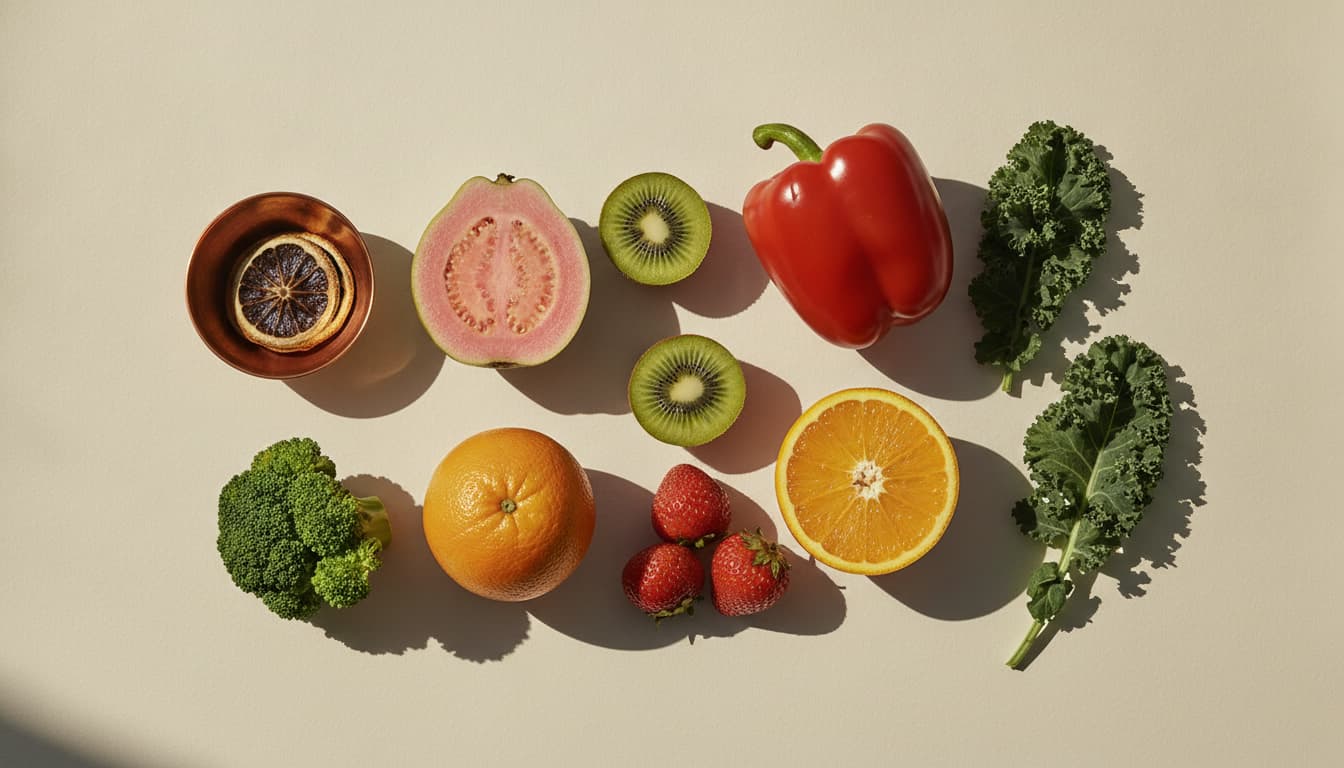
The daily target is 90 mg for men and 75 mg for women, and one guava, one red bell pepper, or a cup of strawberries clears it in a single serving. The mg-per-serving ranking, why oranges are not the top source, and how cooking cuts the number.
- 01
Guava: ~125 mg per fruit
Guava is the densest common source, carrying roughly 125 mg of vitamin C in a single fruit, well above the daily target on its own (USDA FoodData Central). It also delivers fiber, potassium, and folate. Guava is underrated precisely because it is overshadowed by citrus in the popular imagination; where it is available fresh, one fruit is the single most efficient way to cover a full day's vitamin C, and it doubles as a high-fiber snack.
- 02
Red bell pepper: ~95-150 mg per pepper
A whole red bell pepper supplies roughly 95-150 mg of vitamin C depending on size, more than an orange, and half a cup raw already delivers ~95 mg (USDA). Red and yellow peppers outrank green because ripening concentrates the vitamin. The key caveat is preparation: peppers are usually eaten raw or lightly cooked, which preserves most of the heat-labile vitamin, making them one of the most reliable savory sources for people who do not eat much fruit.
- 03
Kiwi: ~64 mg per fruit
One kiwi carries ~64 mg of vitamin C, so two clear the daily target, and they add fiber, potassium, and vitamin K (USDA). Kiwi is eaten raw, so none of the vitamin is lost to cooking. It travels and stores well, which makes it a practical everyday source alongside strawberries and citrus. Gold kiwi varieties can carry even more, sometimes over 100 mg per fruit, though the common green kiwi is already a top-tier source.
- 04
Citrus: orange ~70 mg, grapefruit ~85 mg
A medium orange supplies ~70 mg of vitamin C and half a grapefruit ~40-45 mg, so citrus comfortably covers the daily target but does not lead the ranking (USDA). Its advantages are availability, keeping quality, and being eaten raw. Whole fruit beats juice: the juicing process and storage degrade some vitamin C, and the whole fruit keeps its fiber. Citrus earns its reputation on convenience and consistency rather than on being the single densest source.
- 05
Strawberries and other berries: ~85 mg per cup
A cup of strawberries carries ~85 mg of vitamin C, more than an orange, with useful fiber and polyphenols (USDA). Other berries add smaller amounts. Berries are eaten raw, so the vitamin survives intact, and they freeze well without major losses, making frozen berries a reliable off-season source. A cup stirred into yogurt or oats is a low-effort way to cover most of a day's requirement from a single ingredient.
- 06
Cruciferous vegetables: broccoli, Brussels sprouts, kale, ~50-80 mg
Half a cup of cooked broccoli supplies ~50 mg of vitamin C, Brussels sprouts ~48 mg, and a cup of raw kale ~80 mg, so a serving of any of them covers most of the daily target (USDA). These are the leading savory sources for people who eat few fruits. Because they are usually cooked, method matters: steaming or microwaving preserves far more vitamin C than boiling, which leaches the water-soluble vitamin into the discarded water.
- 07
Why cooking and storage cut the number
Vitamin C is the most fragile common vitamin: it degrades with heat, light, air, and prolonged storage, and dissolves into cooking water. Boiling vegetables can lose 30-50% of the content, while steaming, microwaving, stir-frying, or eating raw preserves most of it (studies collated by NIH). Cutting produce long before eating and holding it warm also erodes the vitamin. The practical rules are simple: favor raw or briefly cooked sources, keep cut fruit cold and eat it soon, and do not discard the water from lightly steamed vegetables.
How this was specified
- 01Inputs measured
- Retail price (dated) · label claim · Certificate of Analysis · third-party test (Informed Sport / NSF / ConsumerLab / Clean Label) · leucine per serving from COA, not marketing.
- 02Protocols tested
- Per-kg target from four literature ranges (IOM RDA, Phillips 2017, Morton 2018, ISSN). Brands scored against Moore 2015 leucine-per-dose threshold (~0.4 g/kg).
- 03Cost-basis verified
- $/gram of protein and $/gram of leucine at warehouse pricing (Costco), mail-order (Amazon), and DTC retail. Re-checked quarterly, flagged when drift exceeds 15%.
- 04Confidence level
- High on ranked order. Medium on absolute $/g (prices drift). Low on serving-size claims where COA is older than 18 months, flagged [VERIFY].
Every claim, cited.
- [01]National Institutes of Health, Office of Dietary Supplements. Vitamin C Fact Sheet for Health Professionals. RDA 90 mg/day (men), 75 mg/day (women); extra 35 mg for smokers; upper limit 2,000 mg/day.
- [02]US Department of Agriculture, Agricultural Research Service. FoodData Central. Vitamin C content of guava, bell peppers, kiwi, citrus, strawberries, and cruciferous vegetables.
- [03]Institute of Medicine. 2000. Dietary Reference Intakes for Vitamin C, Vitamin E, Selenium, and Carotenoids. National Academies Press. Basis for the vitamin C RDA and tolerable upper intake level.
- [04]Lee S, Choi Y, Jeong HS, Lee J, Sung J. 2018. Effect of different cooking methods on the content of vitamins in vegetables. Food Sci Biotechnol 27(2):333-342. Boiling causes the largest vitamin C losses; steaming preserves more.
The Larderlab Team builds evidence-led frameworks for eating, lifting, and stocking a kitchen. We cite every claim. We publish the spreadsheet when possible. We buy what we review at retail price. When new data lands, we revise with a dated note.
Next in this hub.
Foods High in Zinc: The Densest Sources, by Milligrams
The daily zinc target is 11 mg for men and 8 mg for women, and oysters, beef, pumpkin seeds, and legumes are the densest sources. The mg-per-serving ranking, why plant zinc absorbs worse, and how to hit the number from food.
8 min · rev 2026-07-06Foods High in Thiamin (Vitamin B1): The Densest Sources, by Milligrams
The RDA is 1.2 mg a day for men and 1.1 mg for women, and pork, fortified grains, legumes, and sunflower seeds cover it easily. The mg-per-serving ranking, why refined grains are fortified for a reason, and who is actually at risk of deficiency.
7 min · rev 2026-08-14Foods High in Riboflavin (Vitamin B2): The Densest Sources, by Milligrams
The RDA is 1.3 mg a day for men and 1.1 mg for women, and dairy, eggs, organ meats, and fortified cereals cover it easily. The mg-per-serving ranking, why milk in clear bottles loses it, and why bright yellow urine is nothing to worry about.
7 min · rev 2026-08-14Get the Larderlab Macro Planner.
A Google Sheet that calculates your protein target, splits it across 3-5 meals, and ranks 20 protein sources by $/gram. Free. Copy-and-modify your own version.
By subscribing, you agree to our Privacy Policy. Unsubscribe anytime.