Foods high in lysine, ranked by grams
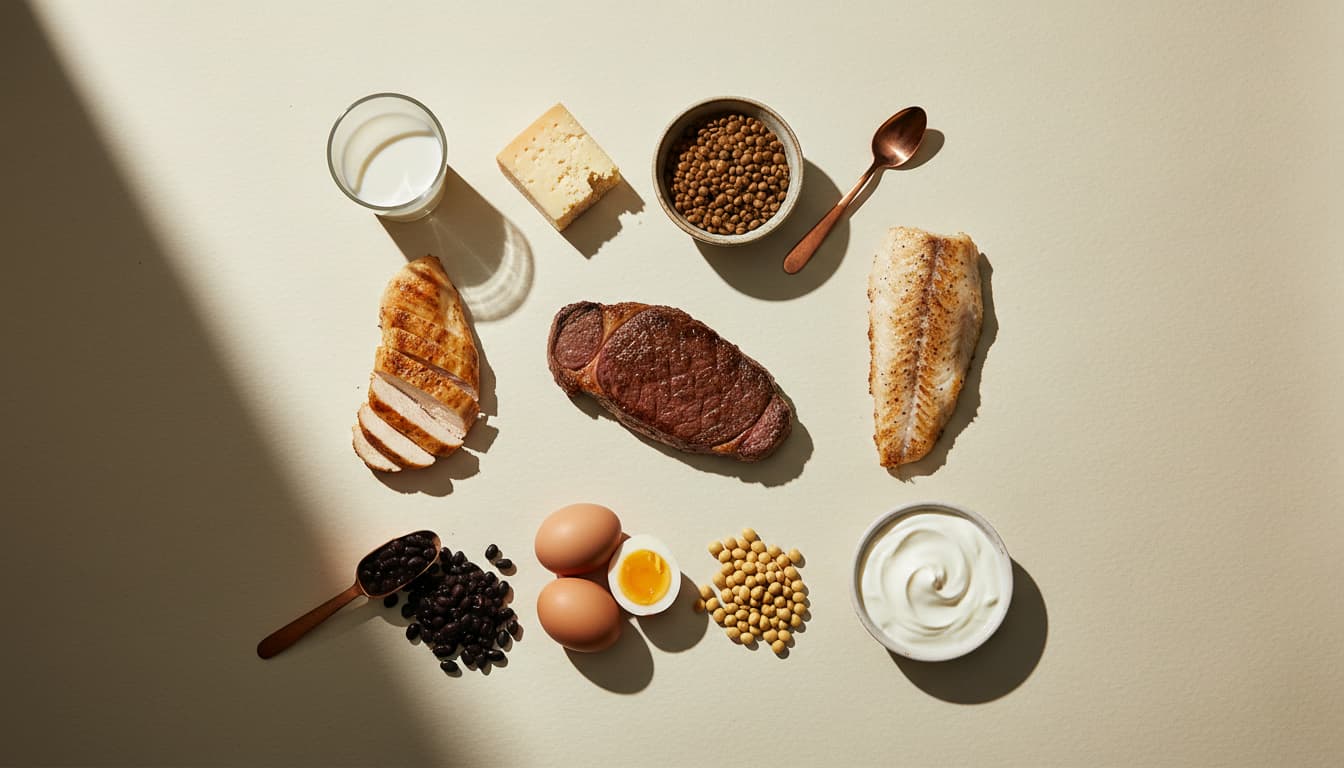
Lysine is the essential amino acid that cereals run short on, which is why the meat-and-legume story matters. The per-serving ranking, why grain-heavy plant diets need beans to balance, and what the evidence really says about lysine for cold sores.
- 01
Meat, poultry, and fish: ~2-3 g per serving
A serving of beef, chicken, pork, or fish supplies roughly 2 to 3 g of lysine, clearing the daily requirement in a single portion (USDA FoodData Central). Animal proteins are complete and lysine-rich by nature, which is why lysine is never a concern on a diet that includes meat or fish. These are the same lean proteins that top our protein rankings, and for lysine specifically they are the effortless baseline against which the plant sources are judged.
- 02
Hard cheese, dairy, and eggs
Dairy and eggs are dense lysine sources: hard cheeses like Parmesan are very high per 100 grams, cottage cheese and milk contribute well per serving, and eggs supply a solid amount in a complete-protein package (USDA). For lacto-ovo vegetarians, dairy and eggs are the easiest way to secure lysine without relying entirely on legumes, and they pair the amino acid with calcium and, in eggs, choline. This is why vegetarians who eat dairy and eggs rarely have any lysine gap.
- 03
Soy: tofu, tempeh, edamame, and soy milk
Soy is the standout plant source, a complete protein that is genuinely lysine-rich rather than lysine-limited like most plants (USDA FoodData Central). A serving of tofu, tempeh, or edamame provides a substantial share of the daily requirement, which is why soy is the anchor of well-planned vegan diets. For anyone eating little animal protein, making soy a regular feature is the single most effective move for lysine, and it sidesteps the grain-legume balancing act on its own.
- 04
Lentils, beans, and other legumes
Lentils, black beans, kidney beans, and chickpeas are the classic lysine-rich legumes, each supplying a good share of the daily need per cooked cup (USDA). Their importance is structural: because grains are low in lysine and legumes are high in it, a plant diet that includes legumes daily automatically balances the amino acid profile. This is the biochemistry behind rice and beans, dal and rice, and every other traditional grain-legume pairing around the world.
- 05
Why grains, nuts, and seeds run low
Cereals, wheat, rice, corn, oats, are relatively low in lysine, which is their limiting amino acid, and nuts and seeds, despite being protein-rich, are also comparatively low (National Academies; USDA). This is exactly why a plant-based diet built on bread, rice, and nut butters without legumes is the realistic case where lysine can fall short. The fix is not exotic: adding beans, lentils, or soy to a grain-centric diet closes the gap, and it need not happen in the same meal.
- 06
Lysine for cold sores: what the evidence shows
The popular use of lysine supplements to prevent or shorten cold sores rests on the idea that lysine competes with arginine, an amino acid the herpes simplex virus needs, and there is some laboratory rationale for this (Mayo Clinic). But human trials are small, inconsistent, and mostly low in quality, so the evidence is weak and no firm conclusion can be drawn. Lysine supplements are generally low-risk, but they should be seen as unproven rather than established, and they are a separate matter from getting enough lysine in the diet.
How this was specified
- 01Inputs measured
- Retail price (dated) · label claim · Certificate of Analysis · third-party test (Informed Sport / NSF / ConsumerLab / Clean Label) · leucine per serving from COA, not marketing.
- 02Protocols tested
- Per-kg target from four literature ranges (IOM RDA, Phillips 2017, Morton 2018, ISSN). Brands scored against Moore 2015 leucine-per-dose threshold (~0.4 g/kg).
- 03Cost-basis verified
- $/gram of protein and $/gram of leucine at warehouse pricing (Costco), mail-order (Amazon), and DTC retail. Re-checked quarterly, flagged when drift exceeds 15%.
- 04Confidence level
- High on ranked order. Medium on absolute $/g (prices drift). Low on serving-size claims where COA is older than 18 months, flagged [VERIFY].
Every claim, cited.
The Larderlab Team builds evidence-led frameworks for eating, lifting, and stocking a kitchen. We cite every claim. We publish the spreadsheet when possible. We buy what we review at retail price. When new data lands, we revise with a dated note.
Next in this hub.
Foods High in Pantothenic Acid (Vitamin B5): The Densest Sources
The adequate intake is just 5 mg a day, and the vitamin's name literally means everywhere, because it is in almost all foods. The ranking, why deficiency essentially never happens, and why B5 supplements for acne and hair have thin evidence.
7 min · rev 2026-08-16Foods High in Thiamin (Vitamin B1): The Densest Sources, by Milligrams
The RDA is 1.2 mg a day for men and 1.1 mg for women, and pork, fortified grains, legumes, and sunflower seeds cover it easily. The mg-per-serving ranking, why refined grains are fortified for a reason, and who is actually at risk of deficiency.
7 min · rev 2026-08-14Foods High in Riboflavin (Vitamin B2): The Densest Sources, by Milligrams
The RDA is 1.3 mg a day for men and 1.1 mg for women, and dairy, eggs, organ meats, and fortified cereals cover it easily. The mg-per-serving ranking, why milk in clear bottles loses it, and why bright yellow urine is nothing to worry about.
7 min · rev 2026-08-14Get the Larderlab Macro Planner.
A Google Sheet that calculates your protein target, splits it across 3-5 meals, and ranks 20 protein sources by $/gram. Free. Copy-and-modify your own version.
By subscribing, you agree to our Privacy Policy. Unsubscribe anytime.