Healthy fats, ranked by whole-food source
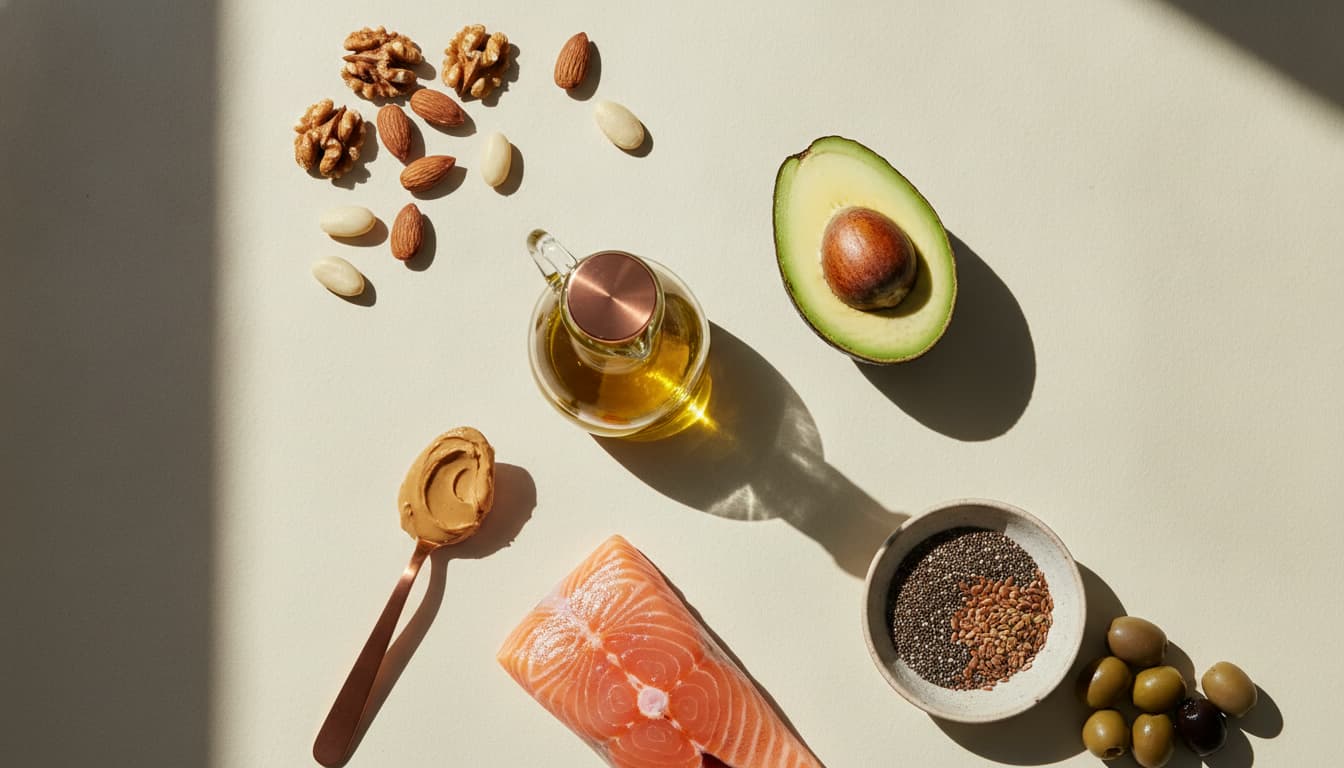
Most fat in a good diet should be unsaturated, and olive oil, avocado, nuts, seeds, and oily fish are the densest whole-food sources. The fat-per-serving numbers, what mono- and polyunsaturated mean, and how much fat per day.
- 01
Extra-virgin olive oil: ~14 g/tbsp, ~73% monounsaturated
Olive oil is the anchor fat of the most-studied healthy diet. A tablespoon carries ~14 g of fat, of which roughly 73% is monounsaturated oleic acid, plus polyphenol antioxidants in the extra-virgin grade (USDA). In PREDIMED, a Mediterranean diet with added extra-virgin olive oil cut cardiovascular events versus a low-fat diet (Estruch et al. 2018). Used as the main dressing and cooking fat in place of butter, it is the simplest single change toward an unsaturated-fat pattern. It is calorie-dense, so it is a fat to use deliberately, not pour freely.
- 02
Avocado: ~15 g of fat per half, mostly MUFA
Half a medium avocado supplies ~15 g of fat, about two-thirds of it monounsaturated, along with fiber, potassium, and folate (USDA). Unlike oil, it comes packaged with ~5 g of fiber per half, so it fills more per calorie. Trials substituting avocado for other fats show favorable effects on LDL and satiety. As a whole food it is a better vehicle for monounsaturated fat than oil, and it works as a spread that displaces butter or a topping that adds fat without refined carbohydrate.
- 03
Nuts: almonds ~14 g and walnuts ~18 g per ounce
A one-ounce serving of nuts delivers ~14 g of fat for almonds and ~18 g for walnuts, mostly unsaturated, with walnuts uniquely rich in the plant omega-3 ALA (USDA). PREDIMED's nut arm cut cardiovascular events, and large cohort studies link regular nut intake to lower mortality. Nuts bundle their fat with protein, fiber, magnesium, and vitamin E, so a daily handful is one of the most evidence-backed healthy-fat habits. Portion awareness helps because they are calorie-dense, but the whole-food matrix blunts how much of that energy is absorbed.
- 04
Oily fish: salmon, sardines, mackerel for EPA and DHA
Salmon, sardines, mackerel, and herring are the only significant food sources of the long-chain omega-3s EPA and DHA, which the body makes only poorly from plant ALA (USDA; NIH ODS). A 3 oz serving of salmon supplies ~1.5-2 g of EPA plus DHA, and two servings of oily fish a week is the standard recommendation for cardiovascular and neural benefit. This is the one healthy-fat category plants cannot replace, which is why oily fish sit at the center of the list rather than as an option, and sardines add calcium and selenium alongside.
- 05
Seeds: flax, chia, and sunflower, ~9-14 g/oz
Seeds concentrate unsaturated fat with fiber: an ounce of chia carries ~9 g of fat and flax ~12 g, both dominated by the omega-3 ALA, while sunflower seeds (~14 g/oz) lean toward omega-6 and vitamin E (USDA). Ground flax is more usable than whole, since the intact seed passes through largely undigested. Seeds are a low-cost way to add plant omega-3 and fiber to yogurt, oats, or salads, though ALA is a weak substitute for the EPA and DHA in fish, so they complement oily fish rather than replace it.
- 06
Olives and nut butters: whole-food fat in usable form
Olives carry the same monounsaturated profile as their oil in whole-food form (~15 g of fat per half cup) with fiber and antioxidants, and unsweetened nut butters deliver the fat of nuts in a spreadable form that displaces butter or refined spreads (USDA). The caveats are salt on olives and added sugar or palm oil in cheaper nut butters, so the label matters; a jar whose only ingredient is nuts is the honest version. Both are practical ways to build unsaturated fat into everyday meals without measuring oil.
- 07
What to limit: saturated and trans fat
The other side of the equation is keeping saturated fat modest, under about 10% of calories, or 6% for people actively lowering LDL, since it raises LDL cholesterol (US Dietary Guidelines; American Heart Association). The main sources are fatty and processed meat, butter, and full-fat dairy, plus tropical oils like coconut. Trans fat from partially hydrogenated oil has no safe level and is now largely removed from the food supply. The evidence-led move is not to fear fat but to swap saturated for unsaturated, which is exactly what choosing these whole-food sources does.
How this was specified
- 01Inputs measured
- Retail price (dated) · label claim · Certificate of Analysis · third-party test (Informed Sport / NSF / ConsumerLab / Clean Label) · leucine per serving from COA, not marketing.
- 02Protocols tested
- Per-kg target from four literature ranges (IOM RDA, Phillips 2017, Morton 2018, ISSN). Brands scored against Moore 2015 leucine-per-dose threshold (~0.4 g/kg).
- 03Cost-basis verified
- $/gram of protein and $/gram of leucine at warehouse pricing (Costco), mail-order (Amazon), and DTC retail. Re-checked quarterly, flagged when drift exceeds 15%.
- 04Confidence level
- High on ranked order. Medium on absolute $/g (prices drift). Low on serving-size claims where COA is older than 18 months, flagged [VERIFY].
Every claim, cited.
- [01]Estruch R et al. 2018. Primary Prevention of Cardiovascular Disease with a Mediterranean Diet Supplemented with Extra-Virgin Olive Oil or Nuts. N Engl J Med 378:e34. PREDIMED trial.
- [02]Hooper L et al. 2020. Reduction in saturated fat intake for cardiovascular disease. Cochrane Database of Systematic Reviews. Replacing saturated with polyunsaturated fat reduces cardiovascular events.
- [03]US Department of Agriculture and US Department of Health and Human Services. Dietary Guidelines for Americans, 2020-2025. Total fat 20-35% of calories; saturated fat under 10%.
- [04]Sacks FM et al. 2017. Dietary Fats and Cardiovascular Disease: A Presidential Advisory From the American Heart Association. Circulation 136(3):e1-e23.
- [05]US Department of Agriculture, Agricultural Research Service. FoodData Central. Fat content and fatty-acid profile of olive oil, avocado, nuts, seeds, and oily fish.
The Larderlab Team builds evidence-led frameworks for eating, lifting, and stocking a kitchen. We cite every claim. We publish the spreadsheet when possible. We buy what we review at retail price. When new data lands, we revise with a dated note.
Next in this hub.
Foods High in Glutathione: Why You Cannot Really Eat Your Way to More
Glutathione is the body's own master antioxidant, but the glutathione in food is largely broken down before absorption. The foods that contain it, why the sulfur-amino-acid precursors matter more, and what the evidence says about boosting your own levels.
8 min · rev 2026-08-14Foods High in Lectins: The Real Risk, and Why Cooking Solves It
Lectins are proteins in beans, grains, and nightshades, and raw kidney beans really can make you sick, but cooking destroys them. The ranking, why the anti-lectin diet overstates the danger, and why most high-lectin foods are among the healthiest.
8 min · rev 2026-08-13Foods High in Nitrates: The Vegetables That Boost Nitric Oxide
Dietary nitrates from vegetables convert to nitric oxide, which relaxes blood vessels and can lower blood pressure and aid exercise. The ranking led by beetroot and leafy greens, why vegetable nitrates are healthy while processed-meat nitrates are not, and what the beet-juice evidence shows.
8 min · rev 2026-08-12Get the Larderlab Macro Planner.
A Google Sheet that calculates your protein target, splits it across 3-5 meals, and ranks 20 protein sources by $/gram. Free. Copy-and-modify your own version.
By subscribing, you agree to our Privacy Policy. Unsubscribe anytime.