Foods high in nitrates, ranked and explained
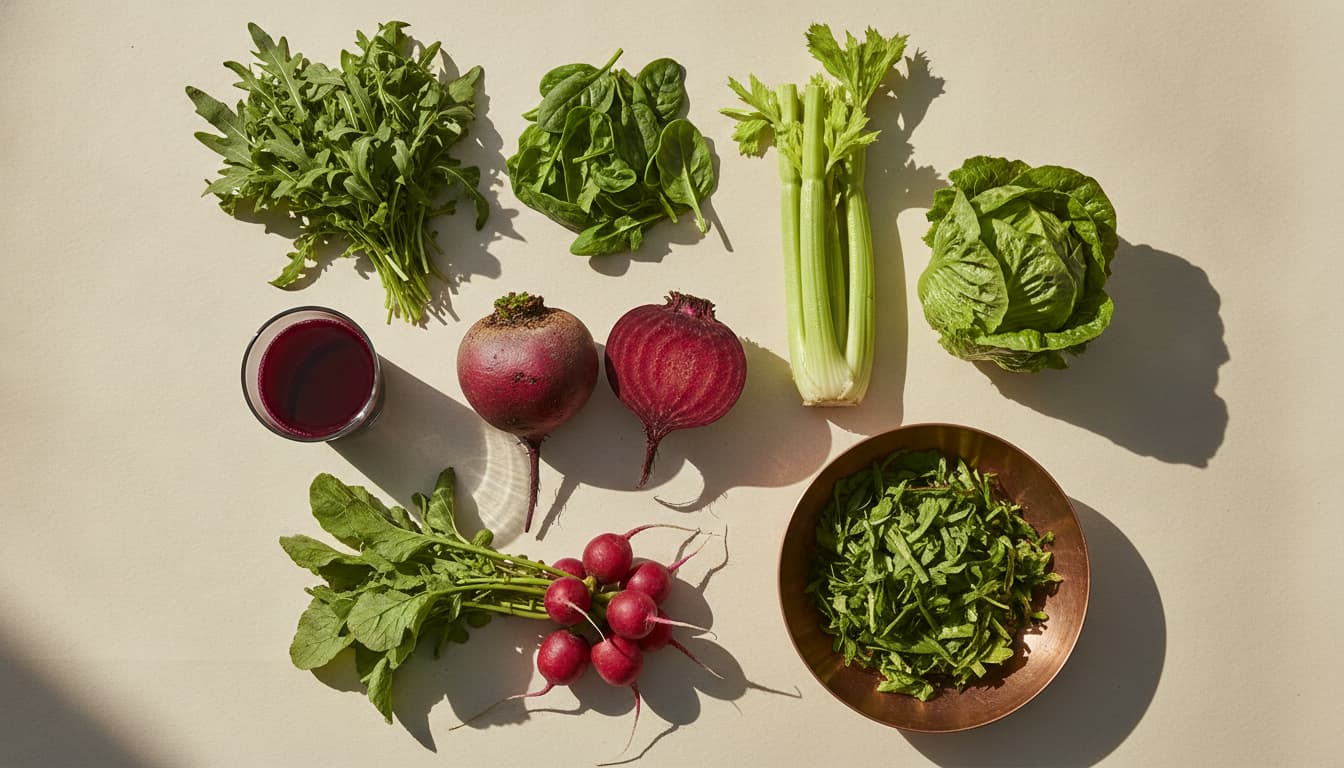
Dietary nitrates from vegetables convert to nitric oxide, which relaxes blood vessels and can lower blood pressure and aid exercise. The ranking led by beetroot and leafy greens, why vegetable nitrates are healthy while processed-meat nitrates are not, and what the beet-juice evidence shows.
- 01
Arugula and dark leafy greens: the richest sources
Arugula (rocket) is among the very highest nitrate foods, with spinach, lettuce, and other dark leafy greens close behind (nutrition literature). These greens deliver large amounts of nitrate in a normal serving, feeding the nitrate-nitric oxide pathway that supports blood vessel function. They also come packaged with antioxidants like vitamin C that help steer the nitrate toward beneficial nitric oxide, and they bring potassium, folate, and vitamin K along, which is why leafy greens sit at the top of so many heart-health rankings.
- 02
Beetroot and beet juice: the most studied
Beetroot is the food most associated with dietary nitrate, and beet juice is the form used in most studies because it concentrates the nitrate into an easy, repeatable dose (British Heart Foundation). This is why beet juice became a popular supplement for blood pressure and endurance exercise. Whole beets provide the nitrate more slowly along with fiber and other nutrients. Both are effective sources, and beetroot is the practical choice for anyone wanting to target the nitrate pathway deliberately.
- 03
Celery, lettuce, and rhubarb
Celery, lettuce, and rhubarb are further high-nitrate vegetables that broaden the range of sources beyond greens and beets (nutrition literature). Interestingly, celery is sometimes used as a natural source of nitrate in uncured meats, which is worth knowing because it means so-called nitrate-free processed meats often still contain nitrate, just from a vegetable source. As whole vegetables, these contribute steadily to nitrate intake within a varied diet.
- 04
How nitrate becomes nitric oxide
The reason these foods matter is the nitrate-nitrite-nitric oxide pathway: bacteria on the tongue convert some dietary nitrate to nitrite, which the body then converts to nitric oxide, a molecule that relaxes and widens blood vessels (nutrition literature). A practical implication is that antibacterial mouthwash can blunt this pathway by killing the tongue bacteria, which some studies link to a smaller blood-pressure benefit from nitrate. This is the mechanism behind the modest cardiovascular effects of beetroot and greens.
- 05
The blood-pressure and exercise evidence
The best-supported benefit is a modest drop in blood pressure: meta-analyses of beetroot juice and other nitrate sources show small but real reductions in systolic pressure (British Heart Foundation). There is also reasonable evidence that nitrate, usually as beet juice, can improve endurance performance by lowering the oxygen cost of exercise, which is why it is a popular sports supplement. The effects are modest rather than dramatic, and they support, rather than replace, the broader benefits of a vegetable-rich diet.
- 06
Vegetable nitrates vs processed-meat nitrites
The crucial distinction is that vegetable nitrates and processed-meat nitrites are judged very differently. In vegetables, nitrate comes with antioxidants that steer it toward beneficial nitric oxide. In cured and processed meats, added nitrite can react with amino acids under high heat to form nitrosamines, compounds linked to colorectal cancer, part of why processed meat is classified as carcinogenic (British Heart Foundation; IARC). So nitrate from spinach and beets is considered healthy, while nitrite from bacon and hot dogs is a genuine concern, a case where food context changes everything.
How this was specified
- 01Inputs measured
- Retail price (dated) · label claim · Certificate of Analysis · third-party test (Informed Sport / NSF / ConsumerLab / Clean Label) · leucine per serving from COA, not marketing.
- 02Protocols tested
- Per-kg target from four literature ranges (IOM RDA, Phillips 2017, Morton 2018, ISSN). Brands scored against Moore 2015 leucine-per-dose threshold (~0.4 g/kg).
- 03Cost-basis verified
- $/gram of protein and $/gram of leucine at warehouse pricing (Costco), mail-order (Amazon), and DTC retail. Re-checked quarterly, flagged when drift exceeds 15%.
- 04Confidence level
- High on ranked order. Medium on absolute $/g (prices drift). Low on serving-size claims where COA is older than 18 months, flagged [VERIFY].
Every claim, cited.
The Larderlab Team builds evidence-led frameworks for eating, lifting, and stocking a kitchen. We cite every claim. We publish the spreadsheet when possible. We buy what we review at retail price. When new data lands, we revise with a dated note.
Next in this hub.
Foods High in Glutathione: Why You Cannot Really Eat Your Way to More
Glutathione is the body's own master antioxidant, but the glutathione in food is largely broken down before absorption. The foods that contain it, why the sulfur-amino-acid precursors matter more, and what the evidence says about boosting your own levels.
8 min · rev 2026-08-14Foods High in Lectins: The Real Risk, and Why Cooking Solves It
Lectins are proteins in beans, grains, and nightshades, and raw kidney beans really can make you sick, but cooking destroys them. The ranking, why the anti-lectin diet overstates the danger, and why most high-lectin foods are among the healthiest.
8 min · rev 2026-08-13Foods High in Cholesterol: Which Ones Actually Matter for Your Heart
Dietary cholesterol turned out to have far less effect on blood cholesterol than saturated fat does, which is why the old 300 mg limit was dropped. The ranking of high-cholesterol foods, why eggs and shrimp are not the problem they were made out to be, and what actually raises LDL.
8 min · rev 2026-08-11Get the Larderlab Macro Planner.
A Google Sheet that calculates your protein target, splits it across 3-5 meals, and ranks 20 protein sources by $/gram. Free. Copy-and-modify your own version.
By subscribing, you agree to our Privacy Policy. Unsubscribe anytime.