Foods high in vitamin D, ranked by IU per serving
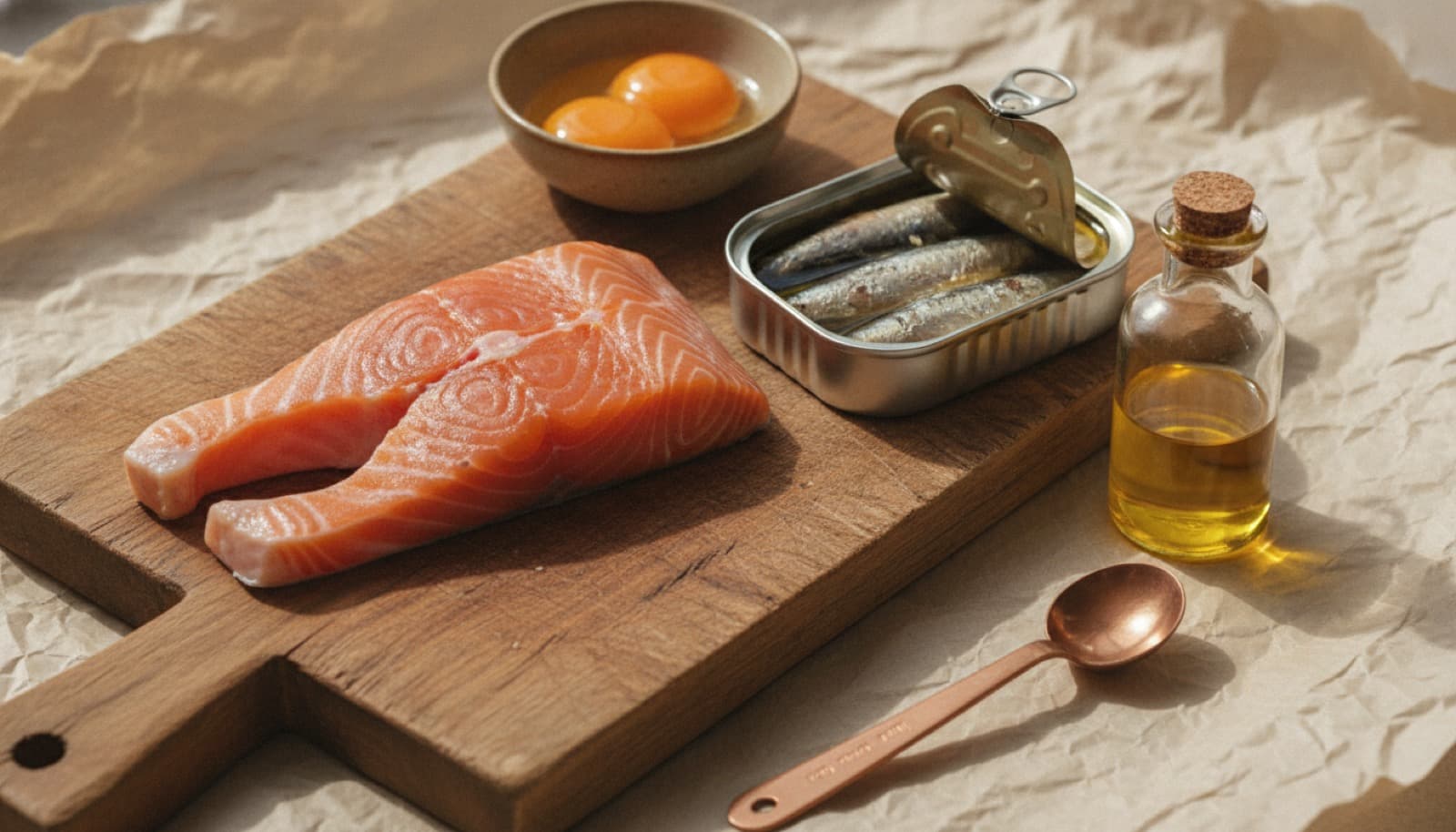
Salmon (~570 IU), trout (~645 IU), and sardines (~180 IU) per serving lead; UV mushrooms and fortified milk fill the gaps. The per-serving ranking, and why food rarely covers the daily target alone.
- 01
Rainbow trout: ~645 IU per 100 g
The densest common food source: ~645 IU of vitamin D per 100 g cooked (USDA), enough to cover the 600 IU/day adult RDA in a single serving. Farmed trout is widely available and low mercury. Like all the fish on this list, the vitamin D comes packaged with EPA+DHA omega-3 and protein, so it does double duty. One or two servings a week is the single most effective dietary move for vitamin D.
- 02
Salmon (farmed or wild): ~570 IU per 100 g
A 100 g serving of farmed Atlantic salmon supplies ~570 IU (USDA), nearly a full day's RDA; wild salmon can run higher still in some analyses. Very low mercury (~0.022 ppm, FDA), so it is the default oily fish for vitamin D as well as omega-3. Two servings a week keep a meaningful baseline of dietary vitamin D and clear the general-health omega-3 target at the same time.
- 03
Canned sardines: ~180 IU per serving
A standard can of sardines supplies roughly ~180 IU of vitamin D (USDA), lower than fresh fatty fish but shelf-stable, cheap, and among the lowest mercury of any fish. The edible bones also add calcium, the mineral vitamin D exists partly to help absorb. A useful supporting source rather than a standalone: it takes several cans to match one salmon serving on vitamin D alone.
- 04
UV-exposed mushrooms: highly variable
Mushrooms are the one meaningful plant source, but only when exposed to UV light, which converts ergosterol to vitamin D2. UV-treated mushrooms (labeled as such) can deliver several hundred IU per serving, while ordinary dark-grown supermarket mushrooms supply almost none. D2 also raises blood levels less effectively than the D3 in fish (Tripkovic et al. 2012). Check the label for UV treatment; without it, do not count mushrooms as a vitamin D source.
- 05
Egg yolks: ~44 IU per large egg
One large egg yolk supplies ~44 IU of vitamin D (USDA), all of it in the yolk, so whites contribute nothing. Pasture-raised or vitamin D-enriched eggs can run higher. Eggs are a convenient minor contributor: three eggs add ~130 IU, useful as part of a day's intake but far short of the RDA on their own. A steady breakfast source rather than a primary one.
- 06
Fortified milk, plant milk, and cereal
Most naturally low-vitamin-D foods reach the diet through fortification. A cup of fortified cow's or soy milk adds ~100-120 IU, fortified orange juice similar, and fortified breakfast cereals ~40-80 IU per serving (USDA; product-dependent). These are small, reliable top-ups rather than big hitters, and amounts vary by brand, so read the label. Stacking a few fortified foods across a day can add a few hundred IU toward the target.
- 07
Cod liver oil: ~450 IU per teaspoon
A traditional concentrated source: one teaspoon of cod liver oil supplies ~450 IU of vitamin D along with vitamin A and EPA+DHA (USDA). Because it also carries a large dose of preformed vitamin A, it sits between a food and a supplement and should not be taken in large amounts without accounting for that vitamin A load. Useful in modest, measured doses, not by the tablespoon.
- 08
Why food rarely covers the target alone
Add it up and the problem is clear: outside of eating fatty fish several times a week, the everyday diet struggles to reach even 600 IU/day, and the 1,000-2,000 IU/day maintenance range clinicians commonly use is out of reach from food. Skin synthesis from sun fills the gap in summer but stalls in winter and at higher latitudes. This is why vitamin D is the general-population supplement with the strongest case; compare tested D3 products on $/1000 IU in our best vitamin D supplement ranking, and set your number in our daily vitamin D guide.
How this was specified
- 01Inputs measured
- Retail price (dated) · label claim · Certificate of Analysis · third-party test (Informed Sport / NSF / ConsumerLab / Clean Label) · leucine per serving from COA, not marketing.
- 02Protocols tested
- Per-kg target from four literature ranges (IOM RDA, Phillips 2017, Morton 2018, ISSN). Brands scored against Moore 2015 leucine-per-dose threshold (~0.4 g/kg).
- 03Cost-basis verified
- $/gram of protein and $/gram of leucine at warehouse pricing (Costco), mail-order (Amazon), and DTC retail. Re-checked quarterly, flagged when drift exceeds 15%.
- 04Confidence level
- High on ranked order. Medium on absolute $/g (prices drift). Low on serving-size claims where COA is older than 18 months, flagged [VERIFY].
Every claim, cited.
- [01]NIH Office of Dietary Supplements. Vitamin D Fact Sheet for Health Professionals. Food sources, RDA 600 IU/day (adults <=70), 800 IU/day (71+); few foods naturally contain vitamin D.
- [02]USDA FoodData Central. Vitamin D per serving: rainbow trout ~645 IU/100 g, salmon ~570 IU/100 g, sardines ~180 IU/serving, egg yolk ~44 IU, cod liver oil ~450 IU/tsp, fortified milk ~100-120 IU/cup.
- [03]Institute of Medicine. 2011. Dietary Reference Intakes for Calcium and Vitamin D. National Academies Press. RDA 600 IU/day (1-70), 800 IU/day (71+); UL 4000 IU/day.
- [04]Tripkovic L, Lambert H, Hart K, et al. 2012. Comparison of vitamin D2 and D3 supplementation in raising serum 25-hydroxyvitamin D status: a systematic review and meta-analysis. Am J Clin Nutr 95(6):1357-1364. D3 raises blood levels more effectively than D2.
The Larderlab Team builds evidence-led frameworks for eating, lifting, and stocking a kitchen. We cite every claim. We publish the spreadsheet when possible. We buy what we review at retail price. When new data lands, we revise with a dated note.
Next in this hub.
Foods High in Pantothenic Acid (Vitamin B5): The Densest Sources
The adequate intake is just 5 mg a day, and the vitamin's name literally means everywhere, because it is in almost all foods. The ranking, why deficiency essentially never happens, and why B5 supplements for acne and hair have thin evidence.
7 min · rev 2026-08-16Foods High in Thiamin (Vitamin B1): The Densest Sources, by Milligrams
The RDA is 1.2 mg a day for men and 1.1 mg for women, and pork, fortified grains, legumes, and sunflower seeds cover it easily. The mg-per-serving ranking, why refined grains are fortified for a reason, and who is actually at risk of deficiency.
7 min · rev 2026-08-14Foods High in Riboflavin (Vitamin B2): The Densest Sources, by Milligrams
The RDA is 1.3 mg a day for men and 1.1 mg for women, and dairy, eggs, organ meats, and fortified cereals cover it easily. The mg-per-serving ranking, why milk in clear bottles loses it, and why bright yellow urine is nothing to worry about.
7 min · rev 2026-08-14Get the Larderlab Macro Planner.
A Google Sheet that calculates your protein target, splits it across 3-5 meals, and ranks 20 protein sources by $/gram. Free. Copy-and-modify your own version.
By subscribing, you agree to our Privacy Policy. Unsubscribe anytime.