Foods high in riboflavin, ranked by milligrams
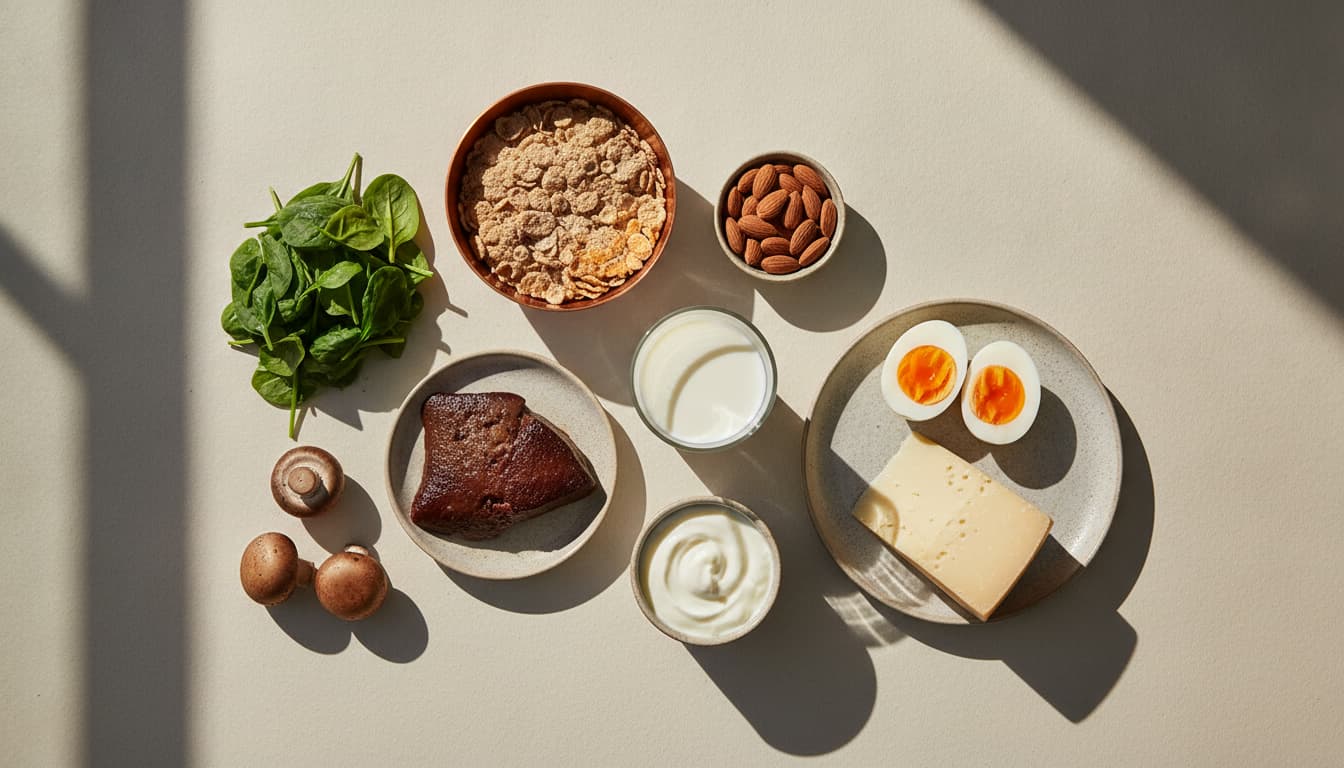
The RDA is 1.3 mg a day for men and 1.1 mg for women, and dairy, eggs, organ meats, and fortified cereals cover it easily. The mg-per-serving ranking, why milk in clear bottles loses it, and why bright yellow urine is nothing to worry about.
- 01
Beef liver: ~2.9 mg per 3 oz, the densest source
Beef liver is the single richest source of riboflavin at roughly 2.9 mg per 3 oz, more than twice a full day's target in one small serving, consistent with its across-the-board density in B vitamins (USDA FoodData Central; NIH ODS). It is eaten in small amounts and is an acquired taste, but for anyone who eats it, riboflavin is covered many times over. For everyone else, dairy and eggs lower on this list reach the modest target just as easily across a day.
- 02
Milk, yogurt, and cheese: the everyday leaders
Dairy is the source that actually supplies most people's riboflavin: a cup of milk provides around 0.3 to 0.4 mg, with yogurt and cheese contributing well (NIH ODS). Because dairy is consumed in quantity, it is the leading dietary contributor in many countries. It also pairs riboflavin with calcium and protein. The one caveat is packaging: riboflavin is light-sensitive, so milk stored in clear containers under bright light loses some of it, which is why opaque cartons are preferred.
- 03
Eggs and lean meats
Eggs are a reliable riboflavin source, with the vitamin present in both white and yolk, and lean meats and poultry contribute steadily across meals (USDA). Neither is a standout like liver, but eaten in normal portions they form a dependable part of daily intake. Along with dairy, eggs are a major reason that omnivores rarely fall short of riboflavin, and they bring complete protein and, in eggs, choline alongside.
- 04
Fortified cereals and enriched grains
Fortified breakfast cereals and enriched breads and grains have riboflavin added, and a single bowl of fortified cereal can supply a full day's target (NIH ODS). As with the other B vitamins, this fortification is a quiet public-health tool that keeps deficiency rare, and it is especially important for people who eat little or no dairy. Checking the label shows how much a given cereal provides, which is often a large share of the RDA.
- 05
Almonds, mushrooms, and spinach
Among plant foods, almonds carry ~0.3 mg of riboflavin per ounce, and mushrooms and cooked spinach contribute useful amounts (USDA FoodData Central). These are the sources that matter most for vegans, who cannot rely on dairy and eggs, though even then a combination of fortified foods, almonds, mushrooms, and greens reaches the target. As with the other B vitamins, almonds quietly stack riboflavin with vitamin E and magnesium.
- 06
Light sensitivity and the yellow-urine effect
Two quirks define riboflavin. First, it is destroyed by light while being stable to heat, which is why milk moved from clear glass bottles to opaque cartons, since sunlight degrades the riboflavin in milk (NIH ODS). Second, high doses turn urine bright yellow because the body absorbs only a limited amount and excretes the rest, a completely harmless cosmetic effect often noticed after a B-complex supplement. Neither is a health concern, and riboflavin has no established upper limit.
How this was specified
- 01Inputs measured
- Retail price (dated) · label claim · Certificate of Analysis · third-party test (Informed Sport / NSF / ConsumerLab / Clean Label) · leucine per serving from COA, not marketing.
- 02Protocols tested
- Per-kg target from four literature ranges (IOM RDA, Phillips 2017, Morton 2018, ISSN). Brands scored against Moore 2015 leucine-per-dose threshold (~0.4 g/kg).
- 03Cost-basis verified
- $/gram of protein and $/gram of leucine at warehouse pricing (Costco), mail-order (Amazon), and DTC retail. Re-checked quarterly, flagged when drift exceeds 15%.
- 04Confidence level
- High on ranked order. Medium on absolute $/g (prices drift). Low on serving-size claims where COA is older than 18 months, flagged [VERIFY].
Every claim, cited.
The Larderlab Team builds evidence-led frameworks for eating, lifting, and stocking a kitchen. We cite every claim. We publish the spreadsheet when possible. We buy what we review at retail price. When new data lands, we revise with a dated note.
Next in this hub.
Foods High in Thiamin (Vitamin B1): The Densest Sources, by Milligrams
The RDA is 1.2 mg a day for men and 1.1 mg for women, and pork, fortified grains, legumes, and sunflower seeds cover it easily. The mg-per-serving ranking, why refined grains are fortified for a reason, and who is actually at risk of deficiency.
7 min · rev 2026-08-14Foods High in Vitamin E: The Densest Sources, by Milligrams
The RDA is 15 mg of alpha-tocopherol a day, and a single ounce of sunflower seeds or almonds covers roughly half of it. The mg-per-serving ranking, why the oils and nuts dominate, and why deficiency is rare but supplements can backfire.
8 min · rev 2026-08-06Foods High in Vitamin B6: The Densest Sources, by Milligrams
The RDA is 1.3 mg a day for most adults, and chickpeas, tuna, salmon, and chicken breast each cover a third to half of it per serving. The mg-per-serving ranking, why the vitamin is spread across animal and plant foods, and why the supplement upper limit matters.
8 min · rev 2026-08-06Get the Larderlab Macro Planner.
A Google Sheet that calculates your protein target, splits it across 3-5 meals, and ranks 20 protein sources by $/gram. Free. Copy-and-modify your own version.
By subscribing, you agree to our Privacy Policy. Unsubscribe anytime.