Foods high in purines, ranked by gout risk
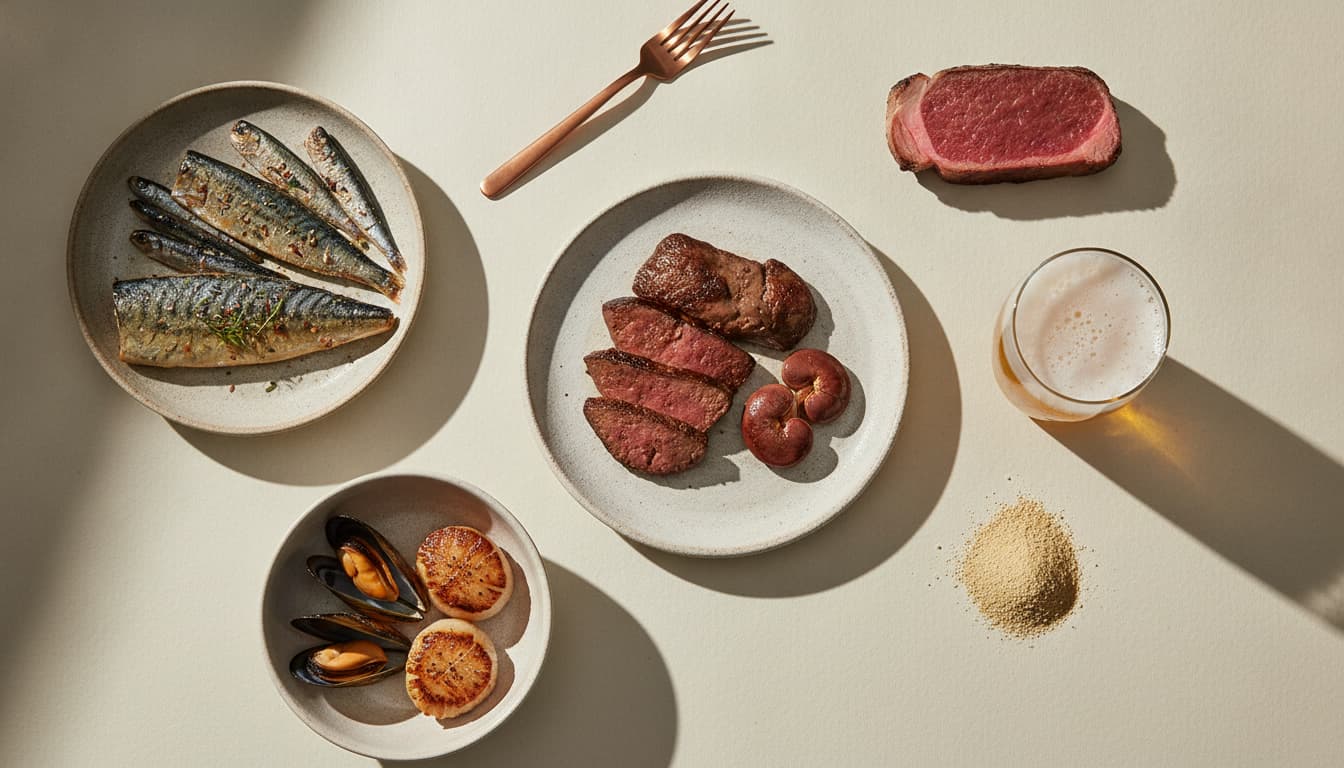
Purines break down into uric acid, and for people with gout the highest-risk foods are organ meats, certain seafood, and alcohol, especially beer. The ranking, why vegetable purines behave differently, and why sugar and drinks matter as much as meat.
- 01
Organ meats: liver, kidney, and sweetbreads
Organ meats are the most purine-dense foods and the clearest ones for gout-prone people to limit, with liver, kidney, and sweetbreads (thymus and pancreas) at the top (American College of Rheumatology). Their purine content is high enough that even modest portions can meaningfully raise uric acid in susceptible people. This is one place where the old low-purine advice still holds firmly. For someone with gout, organ meats are the single most worthwhile category to cut, more so than ordinary muscle meat.
- 02
High-purine seafood: anchovies, sardines, mussels, scallops
A specific set of seafood is high-risk: anchovies, sardines, herring, mackerel, mussels, and scallops are all purine-dense and linked to raised gout risk (Arthritis Foundation). This creates a genuine tension, because some of these are the same oily fish prized for omega-3s. For people with gout, the practical compromise is to favor lower-purine fish and keep the high-purine ones occasional, rather than eliminating fish entirely, since the cardiovascular benefits of fish still matter.
- 03
Alcohol, especially beer
Alcohol is one of the strongest dietary drivers of gout, and beer is the worst offender because it delivers purines from brewer's yeast and also impairs the kidneys' ability to excrete uric acid (American College of Rheumatology). Spirits raise risk too, mainly through the excretion effect, while moderate wine appears relatively neutral in studies. For anyone with gout, cutting back on beer in particular is one of the highest-impact dietary changes, often more effective than obsessing over meat portions.
- 04
Red meat and most fish: moderate
Ordinary red meat, beef, pork, and lamb, and most fish and poultry are moderate purine contributors: worth keeping in reasonable portions for gout-prone people but not eliminating (Arthritis Foundation). The distinction from organ meats and high-purine seafood matters, a normal serving of steak or chicken is far lower risk than liver or sardines. Moderation rather than avoidance is the guidance here, and total quantity matters more than cutting any single normal meat entirely.
- 05
The surprises: vegetables safe, sugar risky
Two findings overturned old gout advice. First, purine-rich vegetables, spinach, asparagus, mushrooms, cauliflower, and legumes, do not raise gout risk in large studies despite their purine content, so they no longer need to be restricted (Health Professionals Follow-up Study). Second, fructose and sugar-sweetened drinks raise uric acid and gout risk substantially, through a mechanism independent of purines, making soda and fruit juice an underappreciated trigger. This is why the modern gout diet targets sugary drinks while freely allowing vegetables and legumes.
- 06
The protective foods: dairy, coffee, water
Not everything raises risk; several foods lower it. Low-fat dairy is associated with reduced uric acid and gout risk, coffee (both caffeinated and decaf) is linked to lower risk in regular drinkers, and vitamin C modestly lowers uric acid (American College of Rheumatology). Staying well hydrated helps the kidneys excrete uric acid. So the gout diet is not only about restriction: adding dairy, coffee, vegetables, and water is as much a part of it as limiting organ meats, beer, and sugary drinks.
How this was specified
- 01Inputs measured
- Retail price (dated) · label claim · Certificate of Analysis · third-party test (Informed Sport / NSF / ConsumerLab / Clean Label) · leucine per serving from COA, not marketing.
- 02Protocols tested
- Per-kg target from four literature ranges (IOM RDA, Phillips 2017, Morton 2018, ISSN). Brands scored against Moore 2015 leucine-per-dose threshold (~0.4 g/kg).
- 03Cost-basis verified
- $/gram of protein and $/gram of leucine at warehouse pricing (Costco), mail-order (Amazon), and DTC retail. Re-checked quarterly, flagged when drift exceeds 15%.
- 04Confidence level
- High on ranked order. Medium on absolute $/g (prices drift). Low on serving-size claims where COA is older than 18 months, flagged [VERIFY].
Every claim, cited.
The Larderlab Team builds evidence-led frameworks for eating, lifting, and stocking a kitchen. We cite every claim. We publish the spreadsheet when possible. We buy what we review at retail price. When new data lands, we revise with a dated note.
Next in this hub.
Foods High in Cholesterol: Which Ones Actually Matter for Your Heart
Dietary cholesterol turned out to have far less effect on blood cholesterol than saturated fat does, which is why the old 300 mg limit was dropped. The ranking of high-cholesterol foods, why eggs and shrimp are not the problem they were made out to be, and what actually raises LDL.
8 min · rev 2026-08-11Foods High in Glutathione: Why You Cannot Really Eat Your Way to More
Glutathione is the body's own master antioxidant, but the glutathione in food is largely broken down before absorption. The foods that contain it, why the sulfur-amino-acid precursors matter more, and what the evidence says about boosting your own levels.
8 min · rev 2026-08-14Foods High in Lectins: The Real Risk, and Why Cooking Solves It
Lectins are proteins in beans, grains, and nightshades, and raw kidney beans really can make you sick, but cooking destroys them. The ranking, why the anti-lectin diet overstates the danger, and why most high-lectin foods are among the healthiest.
8 min · rev 2026-08-13Get the Larderlab Macro Planner.
A Google Sheet that calculates your protein target, splits it across 3-5 meals, and ranks 20 protein sources by $/gram. Free. Copy-and-modify your own version.
By subscribing, you agree to our Privacy Policy. Unsubscribe anytime.