Foods high in cholesterol, and what the science now says
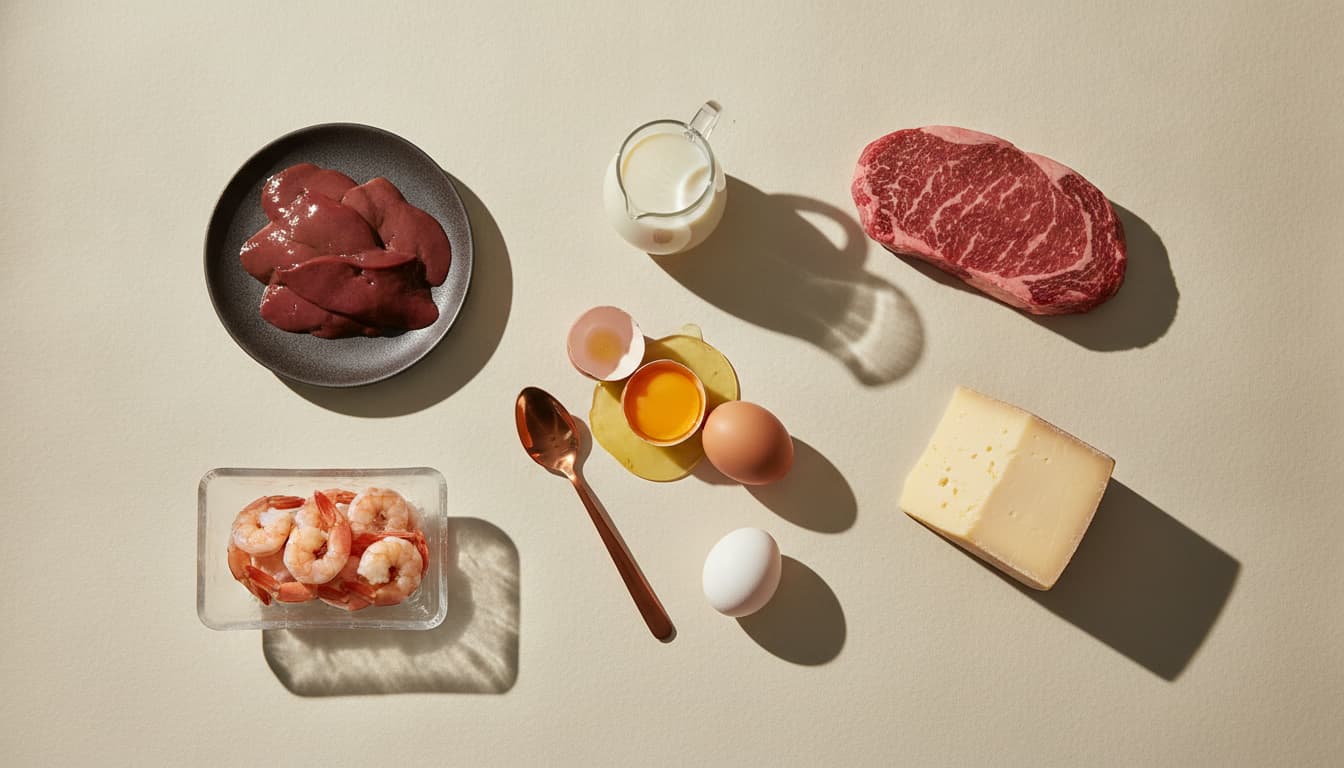
Dietary cholesterol turned out to have far less effect on blood cholesterol than saturated fat does, which is why the old 300 mg limit was dropped. The ranking of high-cholesterol foods, why eggs and shrimp are not the problem they were made out to be, and what actually raises LDL.
- 01
Organ meats: liver and the top of the list
Organ meats are the most cholesterol-dense foods, with liver carrying 300 mg or more per 3 oz, well above a whole day's old limit in one serving (USDA FoodData Central). Unlike some other high-cholesterol foods, organ meats also come with saturated fat, so they are a genuine consideration for people managing LDL. That said, they are eaten infrequently and are exceptionally nutrient-dense, rich in B vitamins, iron, and vitamin A, so the guidance is moderation rather than avoidance for most people.
- 02
Egg yolk: ~186 mg per egg, and why it was rehabilitated
A large egg carries about 186 mg of cholesterol, almost all in the yolk, which once made eggs the poster food for dietary cholesterol (USDA; American Heart Association). But large studies find that for most people an egg a day is not linked to higher heart disease risk, because egg yolk is relatively low in saturated fat and dietary cholesterol has a modest effect on blood cholesterol. Eggs are also a source of high-quality protein, choline, and lutein, which is why current guidance treats them as fine in moderation.
- 03
Shrimp and shellfish: high cholesterol, low saturated fat
Shrimp is the clearest example of why the cholesterol number alone is misleading: a 3 oz serving carries about 166 mg of cholesterol but very little saturated fat, so it has little effect on LDL (American Heart Association). Other shellfish behave similarly. This is the food that most cleanly separates the old thinking from the new: judged by cholesterol content it looks risky, but judged by its actual effect on blood lipids it is a lean, heart-neutral protein, which is why it is no longer restricted the way it once was.
- 04
Full-fat dairy, cheese, and butter
Full-fat dairy, cheese, and especially butter carry both cholesterol and significant saturated fat, and it is the saturated fat that matters more for LDL (American Heart Association). This is why these foods do warrant moderation for people managing blood cholesterol, not because of their cholesterol content but because of their saturated fat. Choosing lower-fat dairy or using butter sparingly targets the component that actually raises LDL, whereas cutting a low-saturated-fat, higher-cholesterol food like shrimp accomplishes little.
- 05
Fatty and processed meats
Fatty cuts of red meat and processed meats like sausage and bacon combine cholesterol with saturated fat and, in processed forms, other cardiovascular risks, making them a more meaningful concern than their cholesterol number alone suggests (American Heart Association). As with dairy, the saturated fat is the driver. Leaner cuts and poultry are lower in saturated fat and so gentler on LDL, which is why the heart-health advice centers on the type and processing of meat, not just its cholesterol content.
- 06
The real driver of LDL: saturated and trans fat
The reframing that matters is this: the foods that reliably raise harmful LDL cholesterol are those high in saturated fat, fatty and processed meats, butter, full-fat dairy, and those with trans fats, not simply the foods highest in cholesterol (2015-2020 Dietary Guidelines; American Heart Association). This is why the US dropped its 300 mg cholesterol limit and why eggs and shrimp were rehabilitated. A minority of hyper-responders and people with diabetes are more sensitive to dietary cholesterol, so moderation still applies, but the primary lever for most people is saturated fat.
How this was specified
- 01Inputs measured
- Retail price (dated) · label claim · Certificate of Analysis · third-party test (Informed Sport / NSF / ConsumerLab / Clean Label) · leucine per serving from COA, not marketing.
- 02Protocols tested
- Per-kg target from four literature ranges (IOM RDA, Phillips 2017, Morton 2018, ISSN). Brands scored against Moore 2015 leucine-per-dose threshold (~0.4 g/kg).
- 03Cost-basis verified
- $/gram of protein and $/gram of leucine at warehouse pricing (Costco), mail-order (Amazon), and DTC retail. Re-checked quarterly, flagged when drift exceeds 15%.
- 04Confidence level
- High on ranked order. Medium on absolute $/g (prices drift). Low on serving-size claims where COA is older than 18 months, flagged [VERIFY].
Every claim, cited.
The Larderlab Team builds evidence-led frameworks for eating, lifting, and stocking a kitchen. We cite every claim. We publish the spreadsheet when possible. We buy what we review at retail price. When new data lands, we revise with a dated note.
Next in this hub.
Foods High in Purines: The Ones That Actually Raise Uric Acid
Purines break down into uric acid, and for people with gout the highest-risk foods are organ meats, certain seafood, and alcohol, especially beer. The ranking, why vegetable purines behave differently, and why sugar and drinks matter as much as meat.
8 min · rev 2026-08-11Foods High in Glutathione: Why You Cannot Really Eat Your Way to More
Glutathione is the body's own master antioxidant, but the glutathione in food is largely broken down before absorption. The foods that contain it, why the sulfur-amino-acid precursors matter more, and what the evidence says about boosting your own levels.
8 min · rev 2026-08-14Foods High in Lectins: The Real Risk, and Why Cooking Solves It
Lectins are proteins in beans, grains, and nightshades, and raw kidney beans really can make you sick, but cooking destroys them. The ranking, why the anti-lectin diet overstates the danger, and why most high-lectin foods are among the healthiest.
8 min · rev 2026-08-13Get the Larderlab Macro Planner.
A Google Sheet that calculates your protein target, splits it across 3-5 meals, and ranks 20 protein sources by $/gram. Free. Copy-and-modify your own version.
By subscribing, you agree to our Privacy Policy. Unsubscribe anytime.