Foods high in potassium, ranked by milligrams
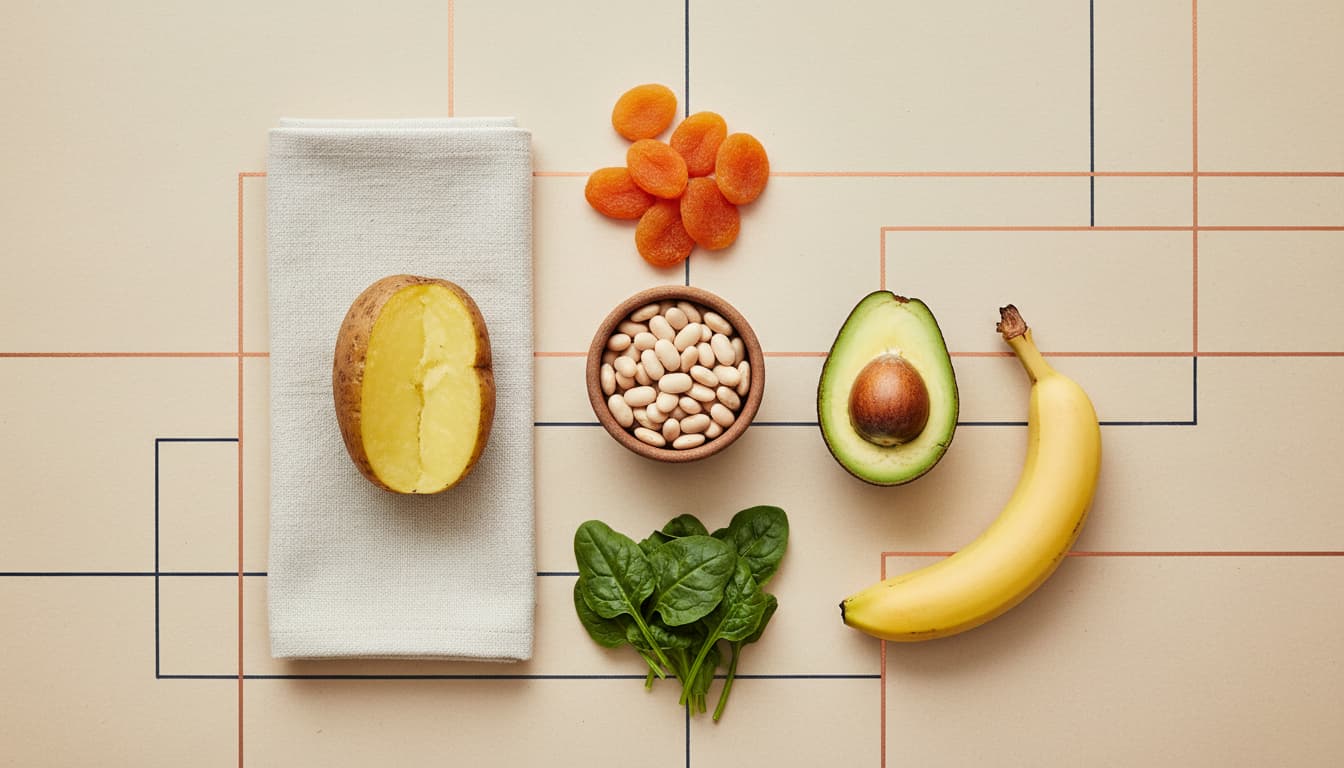
The adequate intake is 3,400 mg/day for men and 2,600 mg for women, and white beans, potatoes, dried apricots, and leafy greens beat the famous banana per serving. The mg-per-serving ranking, why most adults fall short, and how boiling leaches it out.
- 01
White beans and other legumes: ~1,190 mg per cup
A cup of canned white beans is the densest common source at ~1,190 mg, roughly a third of a man's daily target in one serving, with kidney beans, black beans, and soybeans close behind (USDA FoodData Central). Legumes stack fiber, plant protein, and magnesium alongside the potassium, so they do more per serving than almost any other food here. They are also the cheapest route to a high potassium day, which is why a bean habit quietly covers several targets at once.
- 02
Potatoes and sweet potatoes: ~540-940 mg each
A medium baked potato eaten with the skin supplies ~940 mg and a medium sweet potato ~540 mg (USDA). The skin holds a large share, so peeling cuts the yield. The bigger lever is cooking method: because potassium is water-soluble, boiling leaches it into the water, while baking, roasting, or microwaving keeps most of it intact. A skin-on baked potato is one of the highest-potassium single foods most people eat.
- 03
Dried apricots and dried fruit: ~755 mg per half cup
Half a cup of dried apricots carries ~755 mg, with raisins, prunes, and dates also concentrated (USDA). Drying removes water and concentrates minerals, so a small handful delivers what a much larger serving of fresh fruit would. The trade-off is that drying concentrates sugar too, so dried fruit is a potent top-up in modest portions rather than a food to eat by the bowlful.
- 04
Cooked leafy greens: ~420-650 mg per half cup
Cooked beet greens lead at ~650 mg per half cup, with cooked spinach ~420 mg and Swiss chard close behind (USDA). Cooking wilts a large raw volume into a compact serving, so cooked greens are far denser per bite than a raw salad. They arrive with magnesium, folate, and vitamin K, and steaming rather than boiling preserves the most potassium.
- 05
Fish and shellfish: ~300-500 mg per serving
A 3 oz serving of salmon, halibut, or tuna supplies ~300-500 mg of potassium alongside complete protein and, in oily fish, omega-3s (USDA). Clams and other shellfish are similar. Fish is not the densest source per serving, but it stacks potassium onto protein and healthy fats, so a fish-forward meal covers several nutrients at once without any single one dominating the plate.
- 06
Yogurt and milk: ~375-625 mg per serving
An 8 oz serving of plain yogurt supplies ~575-625 mg and a cup of milk ~360-380 mg (USDA). Dairy is an easy, well-absorbed background source that also carries calcium and protein. Plain, unsweetened versions are the better choice, since the potassium is identical while flavored versions add sugar. A daily bowl of yogurt is a low-effort way to add several hundred milligrams.
- 07
Bananas, avocados, and fruit: ~420-975 mg per serving
The banana's fame outruns its ranking: one medium banana carries ~420 mg, useful but mid-pack (USDA). A whole avocado (~975 mg), a cup of orange juice (~496 mg), a cup of cantaloupe, and tomato products all match or beat it. Fruit's advantage is convenience and no cooking losses, so it is the easiest between-meal top-up even though it rarely tops the density ranking.
How this was specified
- 01Inputs measured
- Retail price (dated) · label claim · Certificate of Analysis · third-party test (Informed Sport / NSF / ConsumerLab / Clean Label) · leucine per serving from COA, not marketing.
- 02Protocols tested
- Per-kg target from four literature ranges (IOM RDA, Phillips 2017, Morton 2018, ISSN). Brands scored against Moore 2015 leucine-per-dose threshold (~0.4 g/kg).
- 03Cost-basis verified
- $/gram of protein and $/gram of leucine at warehouse pricing (Costco), mail-order (Amazon), and DTC retail. Re-checked quarterly, flagged when drift exceeds 15%.
- 04Confidence level
- High on ranked order. Medium on absolute $/g (prices drift). Low on serving-size claims where COA is older than 18 months, flagged [VERIFY].
Every claim, cited.
- [01]National Institutes of Health, Office of Dietary Supplements. Potassium Fact Sheet for Health Professionals. Adequate intake 3,400 mg/day (men) and 2,600 mg/day (women); role in blood pressure and sodium balance.
- [02]US Department of Agriculture, Agricultural Research Service. FoodData Central. Potassium content of beans, potatoes, dried fruit, leafy greens, dairy, fish, and fruit.
- [03]National Academies of Sciences, Engineering, and Medicine. 2019. Dietary Reference Intakes for Sodium and Potassium. National Academies Press. Revised adequate intake values for potassium.
- [04]US Food and Drug Administration. Daily Value on the Nutrition and Supplement Facts Labels. Potassium Daily Value of 4,700 mg.
The Larderlab Team builds evidence-led frameworks for eating, lifting, and stocking a kitchen. We cite every claim. We publish the spreadsheet when possible. We buy what we review at retail price. When new data lands, we revise with a dated note.
Next in this hub.
Foods High in Thiamin (Vitamin B1): The Densest Sources, by Milligrams
The RDA is 1.2 mg a day for men and 1.1 mg for women, and pork, fortified grains, legumes, and sunflower seeds cover it easily. The mg-per-serving ranking, why refined grains are fortified for a reason, and who is actually at risk of deficiency.
7 min · rev 2026-08-14Foods High in Riboflavin (Vitamin B2): The Densest Sources, by Milligrams
The RDA is 1.3 mg a day for men and 1.1 mg for women, and dairy, eggs, organ meats, and fortified cereals cover it easily. The mg-per-serving ranking, why milk in clear bottles loses it, and why bright yellow urine is nothing to worry about.
7 min · rev 2026-08-14Foods High in Lutein: The Densest Sources for Eye Health, by Milligrams
Lutein and its partner zeaxanthin are the carotenoids that concentrate in the retina, and cooked greens like kale and spinach top the list. The mg-per-serving ranking, why egg yolk punches above its weight, and what the AREDS2 eye-health evidence actually shows.
8 min · rev 2026-08-13Get the Larderlab Macro Planner.
A Google Sheet that calculates your protein target, splits it across 3-5 meals, and ranks 20 protein sources by $/gram. Free. Copy-and-modify your own version.
By subscribing, you agree to our Privacy Policy. Unsubscribe anytime.