Foods high in lutein, ranked by milligrams
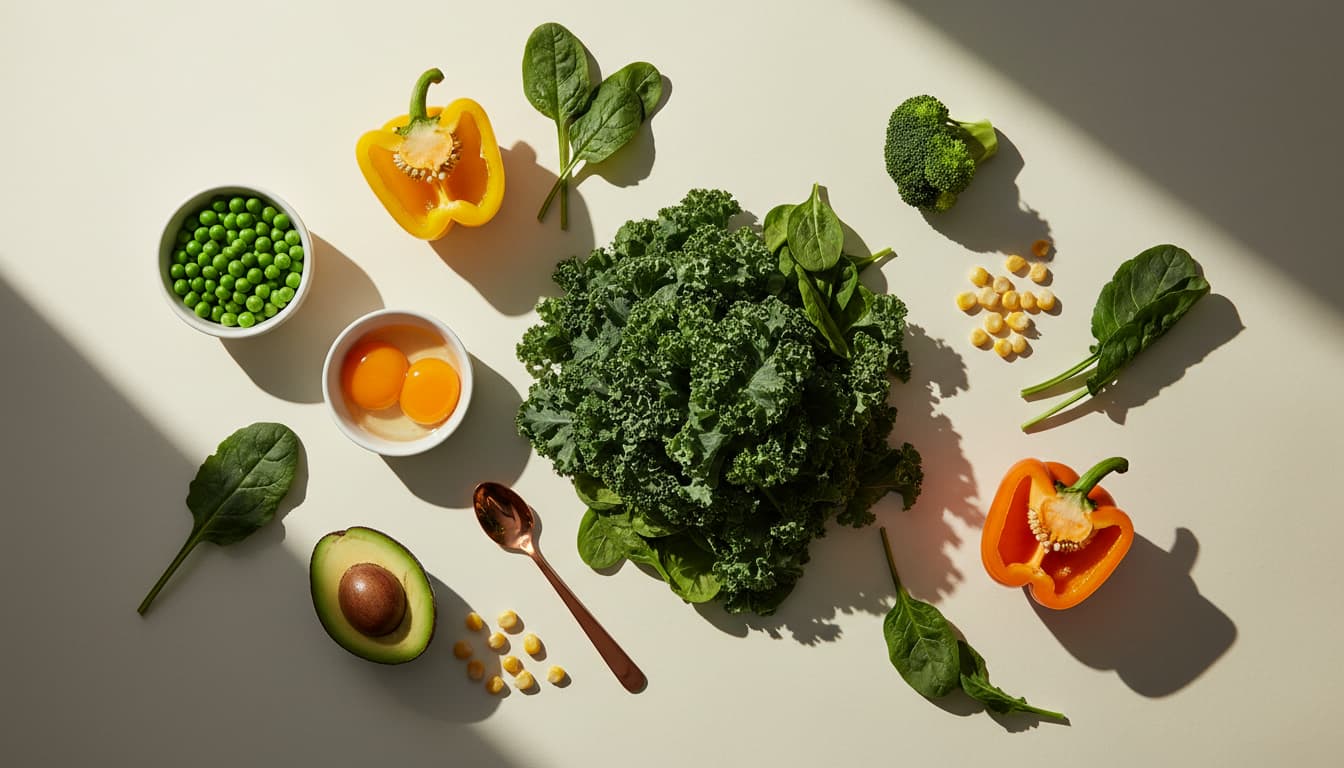
Lutein and its partner zeaxanthin are the carotenoids that concentrate in the retina, and cooked greens like kale and spinach top the list. The mg-per-serving ranking, why egg yolk punches above its weight, and what the AREDS2 eye-health evidence actually shows.
- 01
Cooked kale and spinach: ~6-12 mg per half cup
Cooked kale and spinach are by far the densest lutein sources, carrying roughly 6 to 12 mg per half cup, which alone meets the 6 to 10 mg intake associated with eye-health benefits (USDA FoodData Central). Cooking matters the way it does for other nutrients in greens: heat wilts a large raw volume into a compact serving, concentrating the lutein per portion. Eaten with a little fat, since lutein is fat-soluble, more of it is absorbed, which makes sauteed greens the single most effective food source.
- 02
Collard and turnip greens
Collard and turnip greens sit right alongside kale and spinach, supplying several milligrams of lutein per cooked serving (USDA). Like the other dark leafy greens, they concentrate the pigment when cooked and deliver it best with some dietary fat. They also stack lutein with vitamin K, folate, and calcium, so a habit of cooked greens quietly covers several targets at once, the recurring theme of leafy vegetables across this site.
- 03
Corn, green peas, and broccoli
After the leafy greens, the amounts drop sharply: corn, green peas, broccoli, and Brussels sprouts each carry roughly a milligram or so of lutein per serving (USDA FoodData Central). Corn is also a source of zeaxanthin, lutein's partner pigment. None of these rivals greens, but they broaden the range of foods contributing to intake and are easy everyday additions, especially for people who do not eat leafy greens often.
- 04
Orange pepper, pistachios, and other produce
Orange bell pepper is a notable source of zeaxanthin specifically, and pistachios are the leading nut source of lutein, each contributing modest amounts (USDA). These foods round out the list and add variety, and pistachios come with the usual nut package of healthy fats, which aids absorption of the fat-soluble pigment. They are useful contributors rather than primary sources, best thought of as complements to a base of cooked greens.
- 05
Egg yolk: low amount, high absorption
Egg yolk contains far less lutein than greens by weight, but it earns a place through bioavailability: because the pigment is dissolved in the yolk's fat, the body absorbs it much more efficiently than lutein from vegetables (American Optometric Association; USDA). Studies show a couple of eggs a day can raise blood and macular lutein effectively. This illustrates the key principle, since lutein is fat-soluble, the fat it comes with matters as much as the raw milligram count.
- 06
What the AREDS2 eye-health evidence shows
The most-cited clinical evidence is the large AREDS2 trial, which found that adding lutein and zeaxanthin to a supplement formula modestly slowed progression to advanced age-related macular degeneration in people already at high risk, and that they were a safer replacement for beta-carotene, which raised lung cancer risk in smokers (NIH). This is a specific benefit for people with existing macular degeneration, not proof that supplements prevent eye disease in healthy people, for whom a dietary habit of cooked greens is the evidence-aligned approach.
How this was specified
- 01Inputs measured
- Retail price (dated) · label claim · Certificate of Analysis · third-party test (Informed Sport / NSF / ConsumerLab / Clean Label) · leucine per serving from COA, not marketing.
- 02Protocols tested
- Per-kg target from four literature ranges (IOM RDA, Phillips 2017, Morton 2018, ISSN). Brands scored against Moore 2015 leucine-per-dose threshold (~0.4 g/kg).
- 03Cost-basis verified
- $/gram of protein and $/gram of leucine at warehouse pricing (Costco), mail-order (Amazon), and DTC retail. Re-checked quarterly, flagged when drift exceeds 15%.
- 04Confidence level
- High on ranked order. Medium on absolute $/g (prices drift). Low on serving-size claims where COA is older than 18 months, flagged [VERIFY].
Every claim, cited.
The Larderlab Team builds evidence-led frameworks for eating, lifting, and stocking a kitchen. We cite every claim. We publish the spreadsheet when possible. We buy what we review at retail price. When new data lands, we revise with a dated note.
Next in this hub.
Foods High in Thiamin (Vitamin B1): The Densest Sources, by Milligrams
The RDA is 1.2 mg a day for men and 1.1 mg for women, and pork, fortified grains, legumes, and sunflower seeds cover it easily. The mg-per-serving ranking, why refined grains are fortified for a reason, and who is actually at risk of deficiency.
7 min · rev 2026-08-14Foods High in Riboflavin (Vitamin B2): The Densest Sources, by Milligrams
The RDA is 1.3 mg a day for men and 1.1 mg for women, and dairy, eggs, organ meats, and fortified cereals cover it easily. The mg-per-serving ranking, why milk in clear bottles loses it, and why bright yellow urine is nothing to worry about.
7 min · rev 2026-08-14Foods High in Phosphorus: The Densest Sources, by Milligrams
The RDA is 700 mg a day, and dairy, meat, fish, nuts, and beans all supply it in quantity. The mg-per-serving ranking, why the phosphate additives in processed food matter more than the natural kind, and who actually needs to limit it.
8 min · rev 2026-08-07Get the Larderlab Macro Planner.
A Google Sheet that calculates your protein target, splits it across 3-5 meals, and ranks 20 protein sources by $/gram. Free. Copy-and-modify your own version.
By subscribing, you agree to our Privacy Policy. Unsubscribe anytime.