Foods high in oxalates, ranked by milligrams
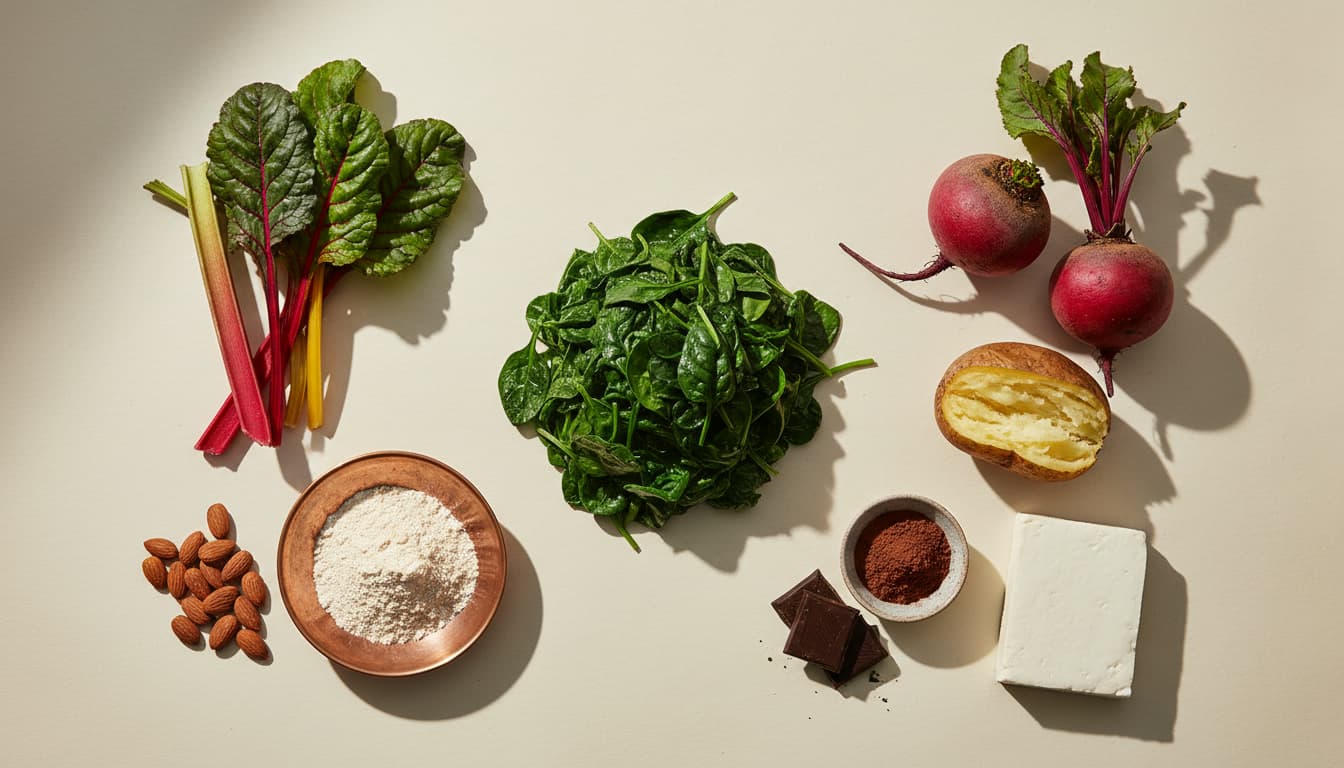
Spinach is the outlier at roughly 700 mg per cooked half cup, followed by rhubarb, Swiss chard, almonds, and beets. The mg-per-serving ranking, why boiling and a little calcium cut absorption, and who actually needs to care about oxalate.
- 01
Spinach: ~700+ mg per cooked half cup, the outlier
Cooked spinach is the single densest oxalate source by a wide margin, carrying roughly 700 mg or more in a half cup, which is more than ten times a stone-former's entire daily allowance in one side dish (Harvard T.H. Chan School of Public Health; USDA). Raw spinach is nearly as extreme once you account for how much fits in a large salad. This is the one food where the amount genuinely matters for anyone prone to calcium-oxalate stones, and it is why spinach is the first thing a kidney-stone clinic asks about. For everyone else spinach stays an excellent food, dense in iron, folate, and vitamin K, and the sensible move is not to avoid it but to boil it and pair it with a calcium source rather than eating large raw quantities daily.
- 02
Rhubarb, Swiss chard, and beet greens: several hundred mg per serving
The other very-high plants cluster just behind spinach: stewed rhubarb, cooked Swiss chard, and beet greens each land in the several-hundred-milligram range per serving, with rhubarb and chard among the most oxalate-dense foods measured (USDA; Massey oxalate database). Rhubarb is a special case, its leaves contain enough oxalic acid to be toxic and are never eaten, while the stalks people cook are lower but still high. For a stone-former these are foods to treat like spinach, boiled and portioned, not raw and daily. Their nutrient density is real, so the goal is moderation and preparation rather than a ban.
- 03
Almonds, peanuts, and cashews: ~110-120 mg per ounce
Nuts are the densest non-leafy source: an ounce of almonds carries ~122 mg of oxalate, peanuts ~113 mg, and cashews are close behind, so a handful is not trivial and almond flour concentrates it further per serving because so many nuts go into it (USDA). This matters most for anyone who has swapped wheat flour for almond flour on a low-carb or gluten-free plan and is eating it in large daily amounts. The fix for stone-formers is portion size and pairing with calcium, not elimination, since nuts also deliver magnesium, healthy fats, and plant protein that most diets are short on.
- 04
Beets, potatoes, and sweet potatoes: ~30-100 mg per serving
The dense root and tuber group runs from a baked potato with skin at ~97 mg, through beets at ~75 mg per half cup, to sweet potatoes lower at ~28-40 mg per cup (USDA; Harvard). These are the foods that quietly add up because portions are large and they appear at many meals. Most of a potato's oxalate sits in and just under the skin, so peeling lowers it, though at the cost of fiber and potassium. For the average eater these numbers are unremarkable; for a stone-former they are worth counting alongside the leafy greens rather than assuming only spinach matters.
- 05
Cocoa, dark chocolate, wheat bran, and buckwheat
Cocoa is genuinely oxalate-rich, so cocoa powder, dark chocolate, and unsweetened baking chocolate all contribute meaningfully per serving, and among grains wheat bran and buckwheat are the standouts while refined grains are low (USDA; Massey database). This is the band that surprises people, because chocolate and bran cereal rarely come to mind as oxalate foods the way spinach does. The amounts are moderate rather than spinach-level, so for most people they are a background contribution, but for a stone-former on a strict count they belong on the list, especially if dark chocolate or a bran cereal is a daily habit.
- 06
Soy foods and legumes: tofu, tempeh, and some beans
Soy foods carry a fair amount of oxalate, with tofu and tempeh in the moderate-to-high band and soy milk lower, and among legumes navy beans and other dried beans contribute usefully (USDA). This is worth knowing for plant-based eaters who lean on tofu and beans as protein staples, because several servings a day add up. Calcium-set tofu is a helpful case, since the added calcium partly binds its own oxalate in the gut. As with the rest of the list, the practical answer for stone-formers is pairing legumes with a calcium source and keeping portions reasonable rather than dropping a whole protein category.
- 07
The real fix: calcium, boiling, and water, not avoidance
The most important item on this list is not a food but a method, because oxalate only causes stones when it reaches the kidney unbound to calcium. Eating a calcium source in the same meal lets the calcium trap the oxalate in the gut so the pair leaves in the stool, which is why the National Kidney Foundation tells stone-formers to keep calcium intake normal at 1,000-1,200 mg a day and specifically not to cut it. Boiling greens and discarding the water removes 30 to almost 90 percent of their soluble oxalate, far more than steaming (Chai and Liebman 2005). Drinking enough water to keep urine dilute matters more than any single food. Done together, these let most people keep high-oxalate foods on the menu.
How this was specified
- 01Inputs measured
- Retail price (dated) · label claim · Certificate of Analysis · third-party test (Informed Sport / NSF / ConsumerLab / Clean Label) · leucine per serving from COA, not marketing.
- 02Protocols tested
- Per-kg target from four literature ranges (IOM RDA, Phillips 2017, Morton 2018, ISSN). Brands scored against Moore 2015 leucine-per-dose threshold (~0.4 g/kg).
- 03Cost-basis verified
- $/gram of protein and $/gram of leucine at warehouse pricing (Costco), mail-order (Amazon), and DTC retail. Re-checked quarterly, flagged when drift exceeds 15%.
- 04Confidence level
- High on ranked order. Medium on absolute $/g (prices drift). Low on serving-size claims where COA is older than 18 months, flagged [VERIFY].
Every claim, cited.
- [01]National Kidney Foundation. Oxalate and Kidney Stones; Diet and Kidney Stones. Low-oxalate target under ~50 mg/day for stone-formers, the calcium-pairing strategy, and the advice not to restrict dietary calcium.
- [02]Harvard T.H. Chan School of Public Health, The Nutrition Source. Oxalate content of common foods, with spinach as the highest single source.
- [03]US Department of Agriculture, Agricultural Research Service. FoodData Central. Oxalate content of spinach, rhubarb, chard, almonds, peanuts, beets, potatoes, cocoa, wheat bran, and soy foods.
- [04]Chai W, Liebman M. 2005. Effect of different cooking methods on vegetable oxalate content. Journal of Agricultural and Food Chemistry 53(8):3027-3030. Boiling removes 30-87% of soluble oxalate versus far less for steaming.
- [05]Holmes RP, Goodman HO, Assimos DG. 2001. Contribution of dietary oxalate to urinary oxalate excretion. Kidney International 59(1):270-276. Diet contributes roughly 10-15% of urinary oxalate in most people.
The Larderlab Team builds evidence-led frameworks for eating, lifting, and stocking a kitchen. We cite every claim. We publish the spreadsheet when possible. We buy what we review at retail price. When new data lands, we revise with a dated note.
Next in this hub.
Foods High in Polyphenols: The Densest Sources, by Milligrams
Polyphenols are plant compounds measured in milligrams per 100 grams, and spices, cocoa, berries, coffee, and tea top the charts. The density ranking, why coffee is most people's biggest single source, and why the benefit tracks whole foods rather than extract pills.
8 min · rev 2026-08-10Foods High in Thiamin (Vitamin B1): The Densest Sources, by Milligrams
The RDA is 1.2 mg a day for men and 1.1 mg for women, and pork, fortified grains, legumes, and sunflower seeds cover it easily. The mg-per-serving ranking, why refined grains are fortified for a reason, and who is actually at risk of deficiency.
7 min · rev 2026-08-14Foods High in Riboflavin (Vitamin B2): The Densest Sources, by Milligrams
The RDA is 1.3 mg a day for men and 1.1 mg for women, and dairy, eggs, organ meats, and fortified cereals cover it easily. The mg-per-serving ranking, why milk in clear bottles loses it, and why bright yellow urine is nothing to worry about.
7 min · rev 2026-08-14Get the Larderlab Macro Planner.
A Google Sheet that calculates your protein target, splits it across 3-5 meals, and ranks 20 protein sources by $/gram. Free. Copy-and-modify your own version.
By subscribing, you agree to our Privacy Policy. Unsubscribe anytime.