Iron-rich foods, ranked by milligrams
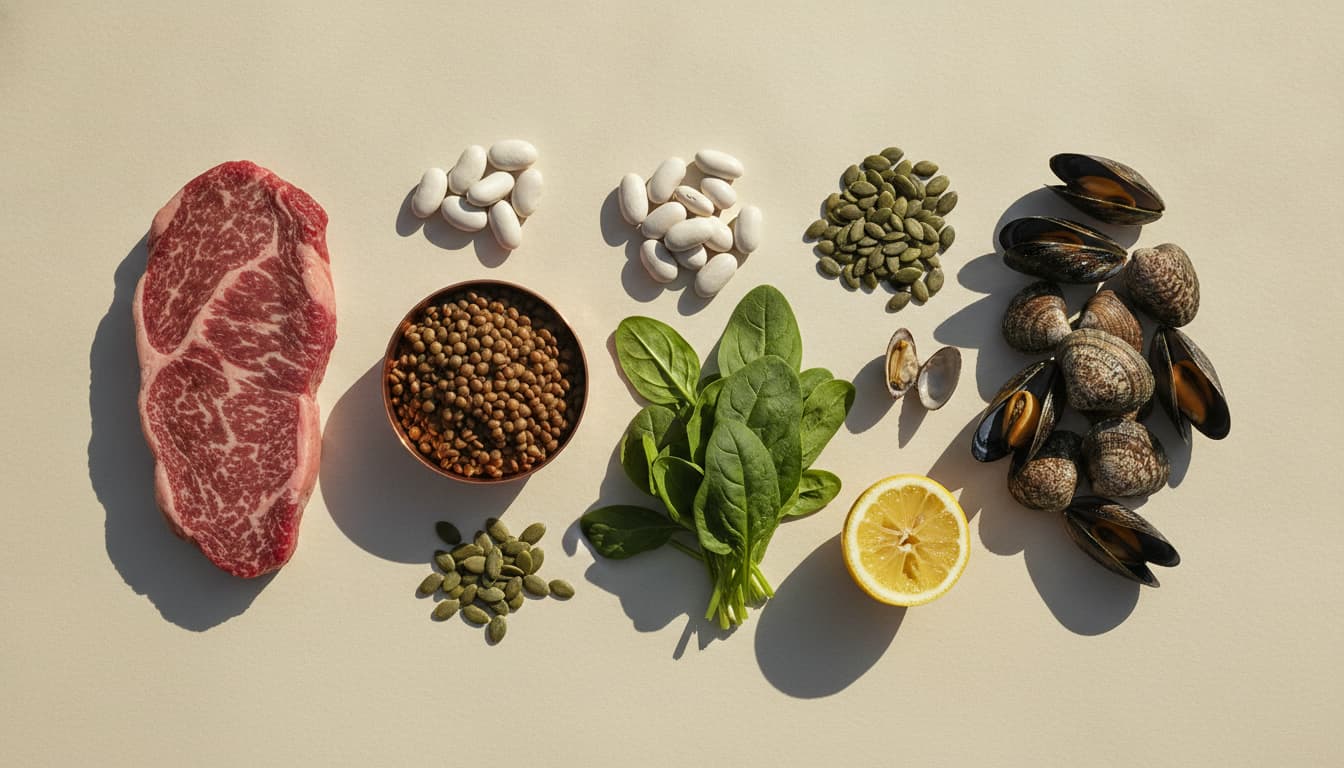
The RDA is 8 mg/day for men and 18 mg for women aged 19-50, and clams, liver, and fortified cereal top the list, but heme iron from meat absorbs far better than the non-heme iron in beans and spinach. The mg-per-serving ranking, why absorption matters more than the label, and how vitamin C changes the math.
- 01
Clams, oysters, and mussels: ~8-24 mg per 3 oz
Cooked clams are the single densest source by a wide margin at ~24 mg per 3 oz, several times the male target in one serving, with mussels (~6 mg) and oysters (~8 mg per 100 g) close behind (USDA FoodData Central). Crucially this is heme iron, absorbed at 15-35% regardless of the rest of the meal, so the usable dose is far higher than the milligram figure alone suggests. Shellfish also carry B12, zinc, and selenium, so a serving a few times a month meaningfully raises average iron status without any supplement.
- 02
Liver and organ meats: ~5-11 mg per 3 oz
Chicken liver leads at ~11 mg per 3 oz and beef liver supplies ~5 mg, both as well-absorbed heme iron alongside a very high dose of B12, folate, and preformed vitamin A (USDA). Organ meats are the most nutrient-dense common food for iron, which is why they were a traditional remedy for anemia. The vitamin A load is the one caveat: it is high enough that pregnant women are advised to limit liver, so it is a powerful occasional food rather than a daily staple.
- 03
Fortified breakfast cereals: up to ~18 mg per serving
Many fortified cereals are formulated to 100% of the Daily Value, up to ~18 mg of iron per serving, added as ferrous or electrolytic iron (USDA). The catch is that this is non-heme iron absorbed at the low end, often further blunted by the calcium in the milk poured over it, which competes for uptake. Eaten with a glass of orange juice rather than milk, and away from coffee, a fortified cereal becomes a genuinely useful iron source, especially for vegetarians who cannot rely on heme sources.
- 04
Legumes: white beans, lentils, and chickpeas, ~4.7-8 mg per cup
Canned white beans lead the legumes at ~8 mg per cup, with cooked lentils (~6.6 mg) and chickpeas (~4.7 mg) close behind, making them the backbone of plant-based iron (USDA). The iron is non-heme and bound by phytates, so absorption is modest, but the fix is well established: pairing legumes with a vitamin C source such as tomatoes, peppers, or citrus can roughly double uptake. Soaking and sprouting dried legumes reduces phytate further, and legumes double as low-cost protein, so they do several jobs at once.
- 05
Red meat: beef and lamb, ~2-3 mg per 3 oz
A 3 oz serving of beef or lamb supplies ~2-3 mg of iron, less than the plant sources above on paper but far more in practice, because it is heme iron absorbed at 15-35% (USDA). Red meat also enhances the absorption of any non-heme iron eaten in the same meal, the so-called meat factor, so a modest portion of beef alongside beans lifts the iron yield of the whole plate. It arrives with zinc, B12, and complete protein, which is why regular meat eaters rarely fall short on iron.
- 06
Spinach and cooked leafy greens: ~4-6.4 mg per cup
Cooked spinach carries ~6.4 mg of iron per cup and Swiss chard and beet greens are similar, which reads impressively but overstates the usable dose (USDA). The iron is non-heme and greens are high in oxalates, which bind iron and lower absorption, so the Popeye reputation outruns the biology. Greens are still worth eating for the iron, but the yield rises sharply when they are cooked to shrink the volume and served with a squeeze of lemon or another vitamin C source rather than relied on alone.
- 07
Tofu, pumpkin seeds, and dark chocolate: ~2.5-3.4 mg per serving
Firm tofu supplies ~3 mg per half cup, pumpkin seeds ~2.5 mg per ounce, and an ounce of dark chocolate ~3.3 mg, giving plant-based eaters several concentrated top-ups (USDA). All are non-heme, so the vitamin C pairing rule applies, but they stack well across a day and the same pumpkin seeds lead the magnesium-rich foods list too. Their value is convenience: a handful of seeds and a block of tofu built into meals add several milligrams before any main dish, which is how a plant-based day reaches the target.
How this was specified
- 01Inputs measured
- Retail price (dated) · label claim · Certificate of Analysis · third-party test (Informed Sport / NSF / ConsumerLab / Clean Label) · leucine per serving from COA, not marketing.
- 02Protocols tested
- Per-kg target from four literature ranges (IOM RDA, Phillips 2017, Morton 2018, ISSN). Brands scored against Moore 2015 leucine-per-dose threshold (~0.4 g/kg).
- 03Cost-basis verified
- $/gram of protein and $/gram of leucine at warehouse pricing (Costco), mail-order (Amazon), and DTC retail. Re-checked quarterly, flagged when drift exceeds 15%.
- 04Confidence level
- High on ranked order. Medium on absolute $/g (prices drift). Low on serving-size claims where COA is older than 18 months, flagged [VERIFY].
Every claim, cited.
- [01]National Institutes of Health, Office of Dietary Supplements. Iron Fact Sheet for Health Professionals. RDA 8 mg/day (men and women 51+), 18 mg/day (women 19-50), 27 mg/day (pregnancy); upper limit 45 mg/day; heme vs non-heme absorption.
- [02]US Department of Agriculture, Agricultural Research Service. FoodData Central. Iron content of clams, liver, fortified cereals, legumes, red meat, leafy greens, tofu, and seeds.
- [03]Hurrell R, Egli I. 2010. Iron bioavailability and dietary reference values. Am J Clin Nutr 91(5):1461S-1467S. Heme absorption 15-35% vs non-heme 2-20%; enhancement by vitamin C and inhibition by phytate, polyphenols, and calcium.
- [04]US Food and Drug Administration. Daily Value on the Nutrition and Supplement Facts Labels. Iron Daily Value of 18 mg.
The Larderlab Team builds evidence-led frameworks for eating, lifting, and stocking a kitchen. We cite every claim. We publish the spreadsheet when possible. We buy what we review at retail price. When new data lands, we revise with a dated note.
Next in this hub.
Calcium-Rich Foods: The Densest Sources, by Milligrams
The RDA is 1,000 mg/day for most adults and 1,200 mg after 50, and dairy, canned fish with bones, calcium-set tofu, and low-oxalate greens are the densest sources. The mg-per-serving ranking, why spinach barely counts, and how to hit the number without a supplement.
8 min · rev 2026-07-09Foods High in Thiamin (Vitamin B1): The Densest Sources, by Milligrams
The RDA is 1.2 mg a day for men and 1.1 mg for women, and pork, fortified grains, legumes, and sunflower seeds cover it easily. The mg-per-serving ranking, why refined grains are fortified for a reason, and who is actually at risk of deficiency.
7 min · rev 2026-08-14Foods High in Riboflavin (Vitamin B2): The Densest Sources, by Milligrams
The RDA is 1.3 mg a day for men and 1.1 mg for women, and dairy, eggs, organ meats, and fortified cereals cover it easily. The mg-per-serving ranking, why milk in clear bottles loses it, and why bright yellow urine is nothing to worry about.
7 min · rev 2026-08-14Get the Larderlab Macro Planner.
A Google Sheet that calculates your protein target, splits it across 3-5 meals, and ranks 20 protein sources by $/gram. Free. Copy-and-modify your own version.
By subscribing, you agree to our Privacy Policy. Unsubscribe anytime.