Calcium-rich foods, ranked by milligrams
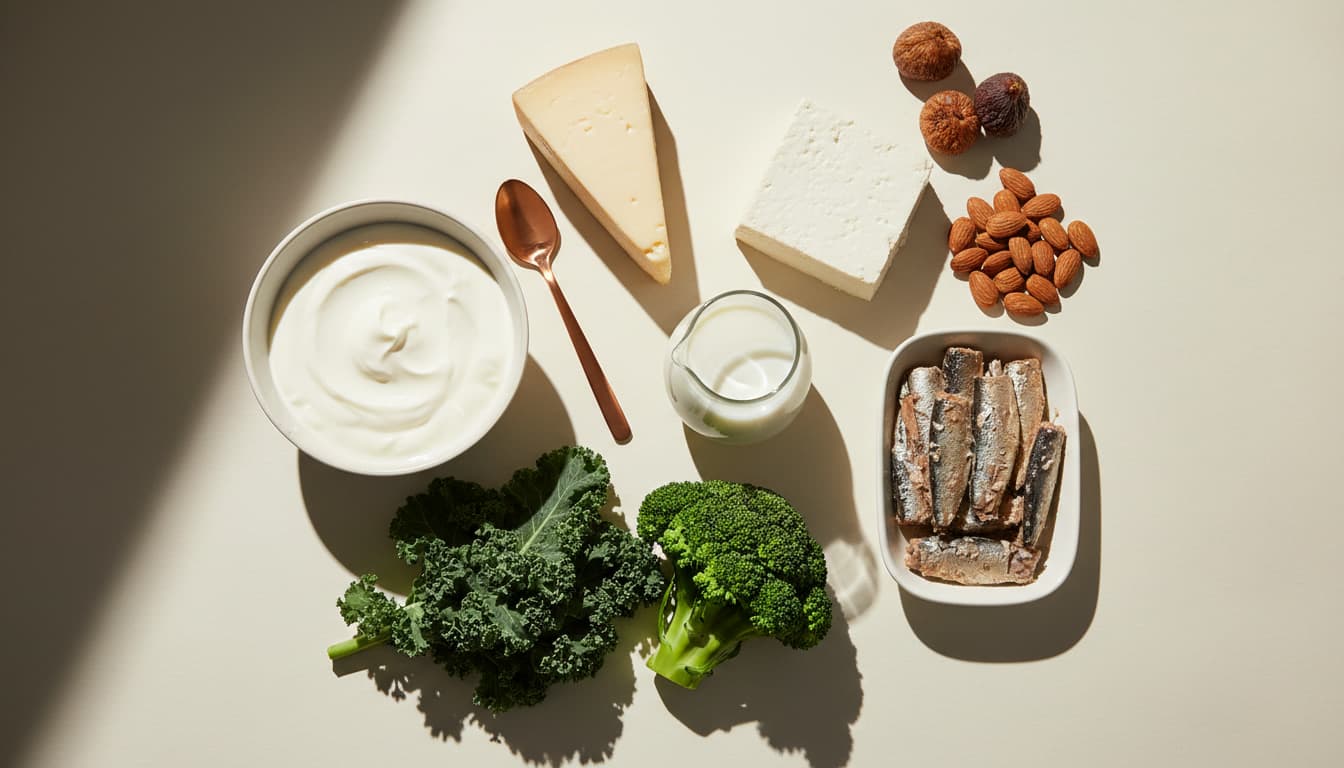
The RDA is 1,000 mg/day for most adults and 1,200 mg after 50, and dairy, canned fish with bones, calcium-set tofu, and low-oxalate greens are the densest sources. The mg-per-serving ranking, why spinach barely counts, and how to hit the number without a supplement.
- 01
Dairy: milk, yogurt, and cheese, ~200-450 mg per serving
Dairy is the densest everyday source and the most reliably absorbed: a cup of milk supplies ~300 mg, a cup of plain yogurt ~300-450 mg, and 1.5 oz of hard cheese such as cheddar or parmesan ~300-330 mg (USDA FoodData Central). The body absorbs roughly 30% of it, and the calcium arrives with protein, phosphorus, and, in fortified milk, vitamin D. Three servings a day essentially guarantee the target, which is why calcium deficiency is uncommon among people who eat dairy regularly.
- 02
Canned sardines and salmon with bones: ~180-325 mg per 3 oz
The calcium in canned fish is in the soft, edible bones, so canned sardines eaten whole supply ~325 mg per 3 oz and canned salmon with bones ~180-210 mg (USDA). This is the densest non-dairy animal source, and it stacks calcium onto complete protein and omega-3s in one tin. The bones are soft enough to eat unnoticed once mashed; skinless, boneless fillets lose the benefit, so the with-bones product is the one that counts.
- 03
Calcium-set tofu: ~250-430 mg per half cup
Tofu made with calcium sulfate as the coagulant carries ~250-430 mg per half cup depending on firmness, rivaling dairy per serving (USDA). The catch is the label: tofu set with magnesium chloride (nigari) or other coagulants has far less, so the calcium content varies more by brand than by any other food here. Firmer tofu is denser in calcium than silken. For plant-based eaters it is the single most efficient whole-food source.
- 04
Low-oxalate greens: collards, kale, bok choy, ~90-270 mg per cup cooked
Cooked collard greens lead at ~270 mg per cup, with kale, bok choy, and turnip greens supplying ~90-200 mg (USDA). What sets them apart is absorption: the body takes up roughly 50% of their calcium, about double the rate from dairy, because they are low in oxalates. That makes their usable calcium higher than the raw number suggests, and they arrive with vitamin K, folate, and potassium, so a habit of cooked greens quietly covers several targets.
- 05
Fortified plant milks, juice, and cereal: ~300 mg per serving
Fortified soy, oat, and almond milks, calcium-fortified orange juice, and many breakfast cereals are formulated to ~300 mg per serving, matching cow's milk by design (USDA). Absorption from calcium carbonate or citrate fortification is reasonable, close to dairy, though shaking the carton matters because the added calcium settles. For vegans and the lactose-intolerant, fortified drinks are the most practical backbone, and choosing versions that also add vitamin D improves how much crosses the gut.
- 06
Beans, almonds, and seeds: ~75-180 mg per serving
White beans and chickpeas supply ~80-175 mg per cup, an ounce of almonds ~75 mg, and chia seeds ~180 mg per ounce (USDA). None is a standout on its own, and phytates modestly limit absorption, but they are useful supporting sources that stack calcium onto fiber, plant protein, and magnesium. A daily ounce of almonds plus a serving of beans adds a couple of hundred milligrams to the background intake without any dairy.
- 07
Spinach and high-oxalate greens: high on paper, low in practice
Spinach lists ~240 mg of calcium per cup cooked, but oxalates bind most of it, so the body absorbs only about 5%, roughly 12 mg of usable calcium, less than a third of an ounce of almonds (Weaver 1999). Swiss chard, beet greens, and rhubarb share the problem. Spinach is still worth eating for other nutrients, but it should not be counted as a calcium source, which is the single most common mistake in food-based calcium planning.
How this was specified
- 01Inputs measured
- Retail price (dated) · label claim · Certificate of Analysis · third-party test (Informed Sport / NSF / ConsumerLab / Clean Label) · leucine per serving from COA, not marketing.
- 02Protocols tested
- Per-kg target from four literature ranges (IOM RDA, Phillips 2017, Morton 2018, ISSN). Brands scored against Moore 2015 leucine-per-dose threshold (~0.4 g/kg).
- 03Cost-basis verified
- $/gram of protein and $/gram of leucine at warehouse pricing (Costco), mail-order (Amazon), and DTC retail. Re-checked quarterly, flagged when drift exceeds 15%.
- 04Confidence level
- High on ranked order. Medium on absolute $/g (prices drift). Low on serving-size claims where COA is older than 18 months, flagged [VERIFY].
Every claim, cited.
- [01]National Institutes of Health, Office of Dietary Supplements. Calcium Fact Sheet for Health Professionals. RDA 1,000 mg/day (adults 19-50), 1,200 mg (women 51+ and all 71+); upper limit 2,500/2,000 mg; role of vitamin D in absorption.
- [02]US Department of Agriculture, Agricultural Research Service. FoodData Central. Calcium content of dairy, canned fish with bones, calcium-set tofu, leafy greens, and fortified foods.
- [03]Weaver CM, Proulx WR, Heaney R. 1999. Choices for achieving adequate dietary calcium with a vegetarian diet. Am J Clin Nutr 70(3):543S-548S. Fractional absorption of calcium from spinach (~5%), kale, and dairy.
- [04]Institute of Medicine. 2011. Dietary Reference Intakes for Calcium and Vitamin D. National Academies Press. RDA and upper-limit derivation for calcium.
The Larderlab Team builds evidence-led frameworks for eating, lifting, and stocking a kitchen. We cite every claim. We publish the spreadsheet when possible. We buy what we review at retail price. When new data lands, we revise with a dated note.
Next in this hub.
Iron-Rich Foods: The Densest Sources, by Milligrams
The RDA is 8 mg/day for men and 18 mg for women aged 19-50, and clams, liver, and fortified cereal top the list, but heme iron from meat absorbs far better than the non-heme iron in beans and spinach. The mg-per-serving ranking, why absorption matters more than the label, and how vitamin C changes the math.
8 min · rev 2026-07-08Foods High in Thiamin (Vitamin B1): The Densest Sources, by Milligrams
The RDA is 1.2 mg a day for men and 1.1 mg for women, and pork, fortified grains, legumes, and sunflower seeds cover it easily. The mg-per-serving ranking, why refined grains are fortified for a reason, and who is actually at risk of deficiency.
7 min · rev 2026-08-14Foods High in Riboflavin (Vitamin B2): The Densest Sources, by Milligrams
The RDA is 1.3 mg a day for men and 1.1 mg for women, and dairy, eggs, organ meats, and fortified cereals cover it easily. The mg-per-serving ranking, why milk in clear bottles loses it, and why bright yellow urine is nothing to worry about.
7 min · rev 2026-08-14Get the Larderlab Macro Planner.
A Google Sheet that calculates your protein target, splits it across 3-5 meals, and ranks 20 protein sources by $/gram. Free. Copy-and-modify your own version.
By subscribing, you agree to our Privacy Policy. Unsubscribe anytime.