Foods high in choline, ranked by milligrams
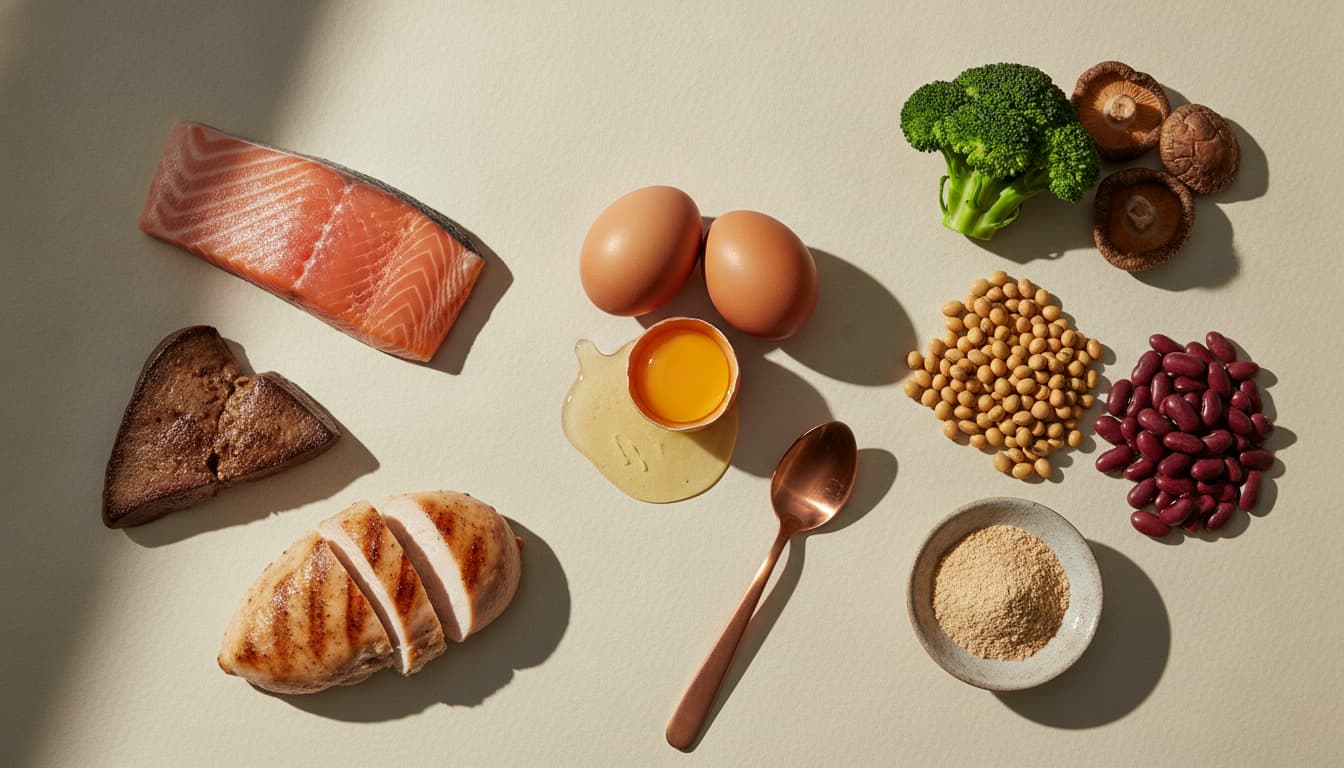
The daily target is 550 mg for men and 425 mg for women, and egg yolks, beef liver, and meat are the densest sources. The mg-per-serving ranking, why most people fall short, and how to hit it without liver.
- 01
Beef liver: ~356 mg per 3 oz, the outlier
Beef liver is the single densest source by a wide margin: a 3 oz serving supplies ~356 mg of choline, roughly two-thirds of a man's daily target and most of a woman's in one portion (USDA; NIH ODS). Like its dominance of the vitamin A and B12 rankings, this makes liver a nutrient-per-dollar standout, and one serving a week meaningfully lifts choline status. The catch is that few people eat it regularly, and its concentrated vitamin A means pregnant women are usually advised to limit it, so liver is a powerful occasional source rather than a daily habit.
- 02
Egg yolks: ~147 mg per large egg, the everyday anchor
One large egg provides ~147 mg of choline, nearly all of it in the yolk, which makes eggs the most practical everyday source and the one that does most of the work for people who skip liver (USDA; NIH ODS). Two eggs cover more than half a woman's daily target and roughly half a man's. Eating only the whites throws away almost all of it, so the whole egg is the point. The long-standing worry about egg cholesterol does not raise cardiovascular risk for most people, which makes daily eggs a low-cost, high-density way to reach the choline number.
- 03
Beef, pork, and other red meat: ~117 mg per 3 oz
A 3 oz serving of beef top round or lean pork supplies ~117 mg of choline, making everyday red meat one of the steadiest contributors after eggs (USDA; NIH ODS). None of it is dramatic on its own, but a normal dinner portion delivers a quarter to a third of the daily target alongside complete protein, iron, zinc, and B12. Because the choline travels with the protein, a meal built around a meat serving covers several nutrients at once, which is why mixed eaters who include some red meat rarely fall as short as those who cut it entirely.
- 04
Chicken, fish, and seafood: ~70-72 mg per 3 oz
Cooked chicken breast (~72 mg per 3 oz) and cod (~71 mg) sit just below red meat, with salmon, shrimp, and scallops in a similar range (USDA; NIH ODS). These leaner proteins are a reliable way to accumulate choline across the day without red meat, and oily fish add EPA and DHA omega-3s alongside. Two protein servings a day from poultry or fish put a meaningful dent in the target, and combined with an egg at breakfast they get most people close to the adequate intake without any single standout food.
- 05
Soybeans and beans: the densest plant sources
Roasted soybeans lead the plant side at ~107 mg of choline per half cup, with edamame, tofu, and other legumes such as kidney beans (~45 mg per half cup) providing useful amounts (USDA; NIH ODS). For people eating little or no animal protein, soy foods and beans are the backbone of choline intake, and because they arrive with fiber and plant protein they double up usefully. Plant sources are less concentrated than eggs or liver, so a plant-based eater needs to be more deliberate, often combining soy, beans, cruciferous vegetables, and wheat germ to reach the number.
- 06
Wheat germ, cruciferous vegetables, and dairy: the fill-ins
Toasted wheat germ (~51 mg/oz), shiitake mushrooms (~58 mg per half cup cooked), Brussels sprouts and broccoli (~30-32 mg per half cup), and a cup of milk or yogurt (~38-43 mg) are the smaller contributors that add up across a day (USDA; NIH ODS). No single one moves the needle, but a bowl of yogurt, a serving of greens, and a spoon of wheat germ stacked together can supply 100 mg or more. These foods are what turn a diet that is close to the target into one that clears it, especially for people relying on plant sources.
- 07
Why most people fall short, and who should pay attention
National surveys find most adults, and most pregnant women, do not reach the adequate intake of 550 mg (men) or 425 mg (women) (Wallace & Fulgoni 2016). The people most at risk are those who avoid both eggs and liver, especially plant-based eaters, and pregnancy raises the stakes because choline supports fetal brain development, yet many prenatal vitamins contain little or none (Zeisel 2013). The fix is rarely a dedicated supplement: one to two eggs a day plus normal protein intake covers most people. Those avoiding animal foods should lean on soy, beans, and wheat germ, and consider a supplement if intake stays low.
How this was specified
- 01Inputs measured
- Retail price (dated) · label claim · Certificate of Analysis · third-party test (Informed Sport / NSF / ConsumerLab / Clean Label) · leucine per serving from COA, not marketing.
- 02Protocols tested
- Per-kg target from four literature ranges (IOM RDA, Phillips 2017, Morton 2018, ISSN). Brands scored against Moore 2015 leucine-per-dose threshold (~0.4 g/kg).
- 03Cost-basis verified
- $/gram of protein and $/gram of leucine at warehouse pricing (Costco), mail-order (Amazon), and DTC retail. Re-checked quarterly, flagged when drift exceeds 15%.
- 04Confidence level
- High on ranked order. Medium on absolute $/g (prices drift). Low on serving-size claims where COA is older than 18 months, flagged [VERIFY].
Every claim, cited.
- [01]National Institutes of Health, Office of Dietary Supplements. Choline Fact Sheet for Health Professionals. Adequate intake 550 mg/day men and 425 mg/day women (450 mg pregnancy, 550 mg lactation); upper limit 3,500 mg/day; choline content of liver, eggs, meat, soy, and vegetables.
- [02]US Department of Agriculture, Agricultural Research Service. FoodData Central. Choline content of beef liver, eggs, beef, pork, chicken, cod, soybeans, wheat germ, and dairy.
- [03]Wallace TC, Fulgoni VL. 2016. Assessment of Total Choline Intakes in the United States. J Am Coll Nutr 35(2):108-112. Most US adults and pregnant women fall below the adequate intake.
- [04]Zeisel SH, da Costa KA. 2009. Choline: an essential nutrient for public health. Nutr Rev 67(11):615-623. Role in liver function, membranes, and neurotransmission; depletion causes reversible fatty liver.
The Larderlab Team builds evidence-led frameworks for eating, lifting, and stocking a kitchen. We cite every claim. We publish the spreadsheet when possible. We buy what we review at retail price. When new data lands, we revise with a dated note.
Next in this hub.
Foods High in Thiamin (Vitamin B1): The Densest Sources, by Milligrams
The RDA is 1.2 mg a day for men and 1.1 mg for women, and pork, fortified grains, legumes, and sunflower seeds cover it easily. The mg-per-serving ranking, why refined grains are fortified for a reason, and who is actually at risk of deficiency.
7 min · rev 2026-08-14Foods High in Riboflavin (Vitamin B2): The Densest Sources, by Milligrams
The RDA is 1.3 mg a day for men and 1.1 mg for women, and dairy, eggs, organ meats, and fortified cereals cover it easily. The mg-per-serving ranking, why milk in clear bottles loses it, and why bright yellow urine is nothing to worry about.
7 min · rev 2026-08-14Foods High in Lutein: The Densest Sources for Eye Health, by Milligrams
Lutein and its partner zeaxanthin are the carotenoids that concentrate in the retina, and cooked greens like kale and spinach top the list. The mg-per-serving ranking, why egg yolk punches above its weight, and what the AREDS2 eye-health evidence actually shows.
8 min · rev 2026-08-13Get the Larderlab Macro Planner.
A Google Sheet that calculates your protein target, splits it across 3-5 meals, and ranks 20 protein sources by $/gram. Free. Copy-and-modify your own version.
By subscribing, you agree to our Privacy Policy. Unsubscribe anytime.