Anti-inflammatory foods, by the evidence
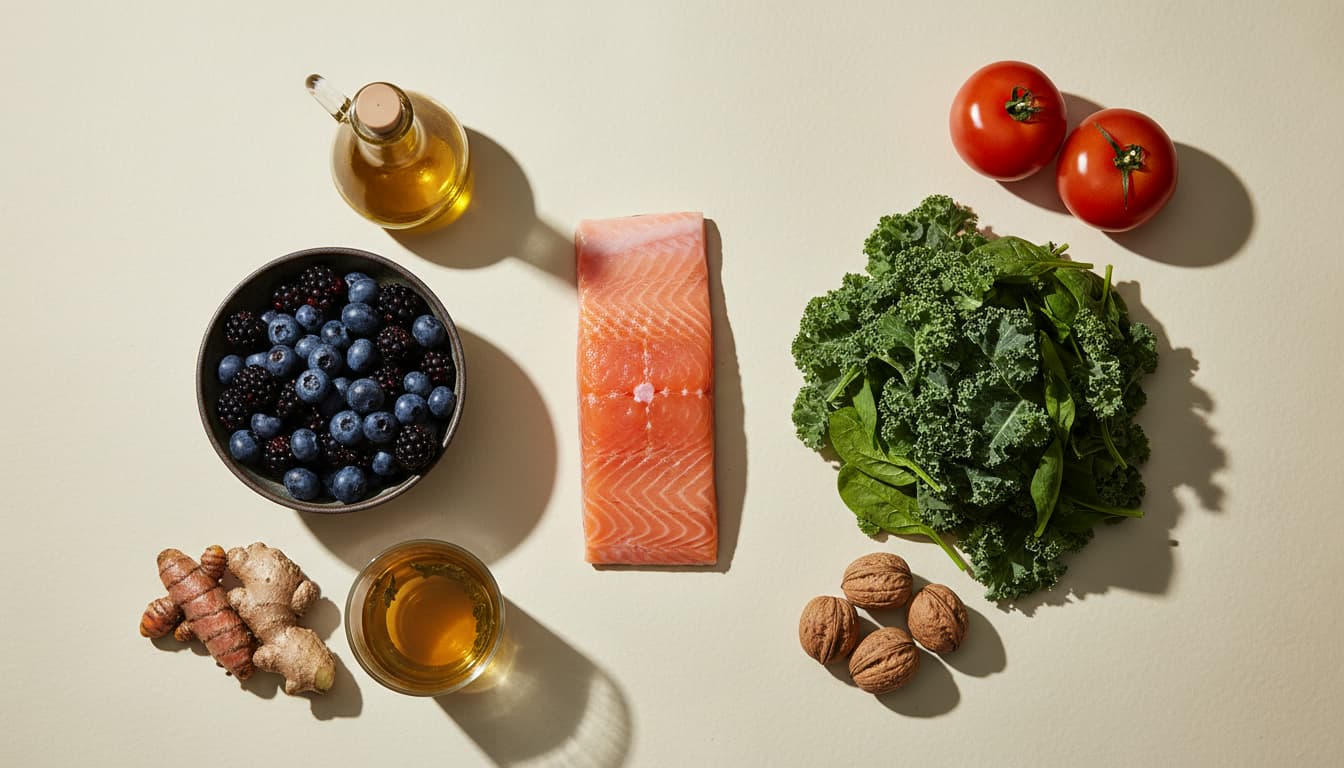
No single food lowers inflammation, but a pattern built on oily fish, extra-virgin olive oil, colorful plants, nuts, and whole grains does. The foods with the strongest evidence, why the pattern beats any one item, and what the research really shows.
- 01
Oily fish: EPA and DHA that resolve inflammation
Salmon, sardines, mackerel, and herring supply the long-chain omega-3 fatty acids EPA and DHA, which are the raw material for resolvins and protectins, the signaling molecules the body uses to actively switch inflammation off rather than merely dampen it (Calder 2017). Observational studies link higher omega-3 intake to lower CRP, and two or more servings of oily fish a week is the standard recommendation. This is the food with the clearest mechanism, because it does not just avoid provoking inflammation but supplies the substrate for resolving it, which is why oily fish also leads our ranking of omega-3-rich foods.
- 02
Extra-virgin olive oil: oleocanthal and polyphenols
Extra-virgin olive oil contributes oleocanthal, a phenolic compound that inhibits the COX-1 and COX-2 enzymes, the same targets as ibuprofen, though at much lower potency, along with other polyphenols that lower oxidative stress (Beauchamp et al. 2005). In the PREDIMED trial, a Mediterranean diet enriched with extra-virgin olive oil cut cardiovascular events, and the extra-virgin grade matters because refining strips out the phenolics that carry the effect. As the main cooking and dressing fat in place of butter or refined oils, it is the single anchor fat of an anti-inflammatory pattern and a staple of our guide to healthy fats.
- 03
Berries and deeply colored fruit: polyphenols
Blueberries, blackberries, cherries, and other deeply colored fruit are rich in anthocyanins and other polyphenols, and human trials show that regular berry intake can modestly lower CRP and other inflammatory markers (Joseph et al. 2014). The color is the clue, because the same pigments that make these fruits dark are the antioxidant compounds doing the work, which is why they feature heavily in our roundup of antioxidant-rich foods. They are best treated as a reliable daily contributor within the pattern rather than a standalone remedy, since the effect sizes in trials are real but modest.
- 04
Leafy greens and cruciferous vegetables
Spinach, kale, broccoli, and other leafy and cruciferous vegetables supply carotenoids, vitamin K, folate, and, in the case of cruciferous vegetables, sulforaphane, a compound that activates the body's own antioxidant defenses. Diets high in vegetables are consistently associated with lower inflammatory markers, partly through these compounds and partly through the fiber that feeds the gut microbiome. They are also low in calories and high in volume, so they displace more inflammatory refined foods from the plate, which is a large part of how a vegetable-heavy pattern lowers inflammation in practice.
- 05
Nuts, legumes, and whole grains: fiber for the gut
Walnuts and other nuts, beans and lentils, and intact whole grains supply fiber that gut bacteria ferment into short-chain fatty acids such as butyrate, which have direct anti-inflammatory effects on the gut lining and beyond (Koh et al. 2016). Higher fiber intake is one of the most consistent dietary predictors of lower CRP, so the same foods that hit the fiber targets in our guide to high-fiber foods do double duty here. Walnuts add the plant omega-3 ALA, and legumes add plant protein, so this group is where the anti-inflammatory diet overlaps most with everyday satiety and nutrient density.
- 06
Green tea and spices: real but modest
Green tea supplies the polyphenol EGCG, and turmeric and ginger contain curcumin and gingerols, all of which show anti-inflammatory activity in the lab and in some trials. The honest caveat is bioavailability: curcumin is poorly absorbed on its own, which is why concentrated supplements with black pepper extract are studied more than the spice itself, and the amount used in cooking is far below trial doses. Treated as everyday flavor that adds polyphenols rather than as medicine, these are a worthwhile part of the pattern, but they are minor contributors, not the reason the diet works.
- 07
What to cut matters as much as what to add
An anti-inflammatory diet is defined as much by subtraction as addition. Refined carbohydrate, added sugar, and sugar-sweetened drinks raise blood glucose and inflammatory markers, and high intakes of processed and red meat are associated with higher CRP. Because these foods are what whole-food carbohydrate and fish displace, favoring low-glycemic sources, a point covered in our guide to the glycemic index, and keeping added sugar low is not a separate step but the other half of the same pattern. This is why an isolated anti-inflammatory food added on top of a diet high in refined carbohydrate and processed meat does little: the pattern works through the balance, not through any one addition.
How this was specified
- 01Inputs measured
- Retail price (dated) · label claim · Certificate of Analysis · third-party test (Informed Sport / NSF / ConsumerLab / Clean Label) · leucine per serving from COA, not marketing.
- 02Protocols tested
- Per-kg target from four literature ranges (IOM RDA, Phillips 2017, Morton 2018, ISSN). Brands scored against Moore 2015 leucine-per-dose threshold (~0.4 g/kg).
- 03Cost-basis verified
- $/gram of protein and $/gram of leucine at warehouse pricing (Costco), mail-order (Amazon), and DTC retail. Re-checked quarterly, flagged when drift exceeds 15%.
- 04Confidence level
- High on ranked order. Medium on absolute $/g (prices drift). Low on serving-size claims where COA is older than 18 months, flagged [VERIFY].
Every claim, cited.
- [01]Estruch R, Ros E, Salas-Salvado J, et al. 2018. Primary Prevention of Cardiovascular Disease with a Mediterranean Diet Supplemented with Extra-Virgin Olive Oil or Nuts (PREDIMED). New England Journal of Medicine 378:e34.
- [02]Shivappa N, Steck SE, Hurley TG, et al. 2014. Designing and developing a literature-derived, population-based dietary inflammatory index. Public Health Nutrition 17(8):1689-1696. Diet-level scoring predicts inflammatory markers.
- [03]Calder PC. 2017. Omega-3 fatty acids and inflammatory processes: from molecules to man. Biochemical Society Transactions 45(5):1105-1115. EPA and DHA as substrate for resolvins and protectins.
- [04]Beauchamp GK, Keast RSJ, Morel D, et al. 2005. Ibuprofen-like activity in extra-virgin olive oil (oleocanthal). Nature 437:45-46. Oleocanthal inhibits COX enzymes.
The Larderlab Team builds evidence-led frameworks for eating, lifting, and stocking a kitchen. We cite every claim. We publish the spreadsheet when possible. We buy what we review at retail price. When new data lands, we revise with a dated note.
Next in this hub.
What to Avoid When Taking Collagen: Five Caveats With Evidence Behind Them
Do not count it toward your protein target, do not judge it before 8 to 12 weeks, and if you form kidney stones, know that 30 g of gelatin raised urinary oxalate by 43 percent in a controlled study. The real caveats, and the myths.
8 min · rev 2026-08-24Foods High in Collagen: Why the Real List Is Shorter Than You Think
Collagen exists only in animal connective tissue, so no plant food contains any. Gelatin powder leads at 85.6 g of protein per 100 g, pork skin at 61.3 g. And the most-marketed source, bone broth, tested poorly against supplements.
8 min · rev 2026-08-24Ashwagandha Benefits: What the Trials Show, and the Liver Signal
Pooled across 12 trials in 1,002 people, stress fell with a standardised mean difference of 1.75 and anxiety by 1.55, but heterogeneity was above 83 percent and the certainty of evidence was rated low. The dose that was tested, and the hepatic case series.
8 min · rev 2026-08-24Get the Larderlab Macro Planner.
A Google Sheet that calculates your protein target, splits it across 3-5 meals, and ranks 20 protein sources by $/gram. Free. Copy-and-modify your own version.
By subscribing, you agree to our Privacy Policy. Unsubscribe anytime.