How much protein per meal, by the evidence
The muscle-building response peaks at about 0.4 g of protein per kg of body weight per meal, roughly 25-40 g for most adults. The per-meal number, why splitting protein across the day beats one large dose, and how to hit it.
What people ask us next.
- How much protein per meal is best for building muscle?
- About 0.4 g of protein per kg of body weight per meal, which is roughly 25-30 g for a 70 kg adult and closer to 35-40 g for larger or older people (Schoenfeld & Aragon 2018). This is the dose that maximally stimulates muscle protein synthesis; going well above it in a single meal adds little extra muscle-building signal, since the response saturates. Spreading that dose across 3-4 meals a day stimulates muscle more often than concentrating protein into one large meal.
- Can the body only absorb 30 g of protein at once?
- No, that is a common myth. The body absorbs far more than 30 g of protein from a meal; digestion is not the bottleneck. What saturates near 25-40 g is muscle protein synthesis, the specific process of building muscle, not absorption (Witard et al. 2014). Protein above that per-meal amount is still digested and used for other tissues, hormones, and energy. So a large protein meal is not wasted, it is simply less efficient for the narrow goal of maximizing muscle building than the same protein split across meals.
- Does it matter how I spread protein across the day?
- Yes, at least somewhat. Because each meal can only drive so much muscle protein synthesis, eating roughly even 25-40 g doses across 3-4 meals stimulates muscle more times per day than a skewed pattern with little protein at breakfast and a large dinner. A controlled trial found even distribution produced about 25% higher 24-hour synthesis than a backloaded pattern with the same daily total (Mamerow et al. 2014). The daily total still matters most, but distribution is a real, low-effort refinement.
- How much protein per meal do older adults need?
- More than younger adults, because aging muscle is less sensitive to protein, an effect called anabolic resistance. Adults over about 60 benefit from roughly 0.4 g per kg or 35-40 g of high-quality protein per meal to trigger the same muscle-building response younger people get from 25 g (Moore et al. 2015). Since protein intake at breakfast is often lowest, raising the morning dose is usually the highest-yield change for preserving muscle with age.
- How many grams of protein should each meal have?
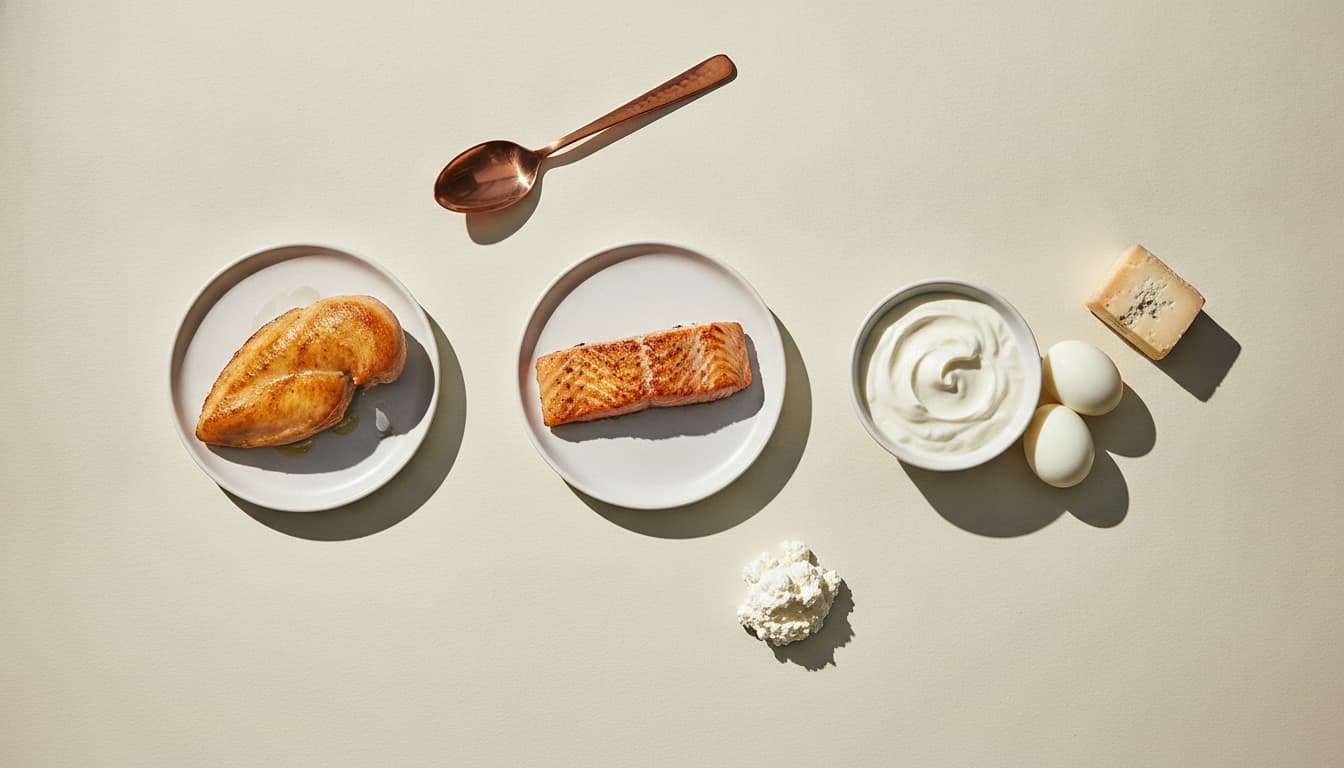
- For most adults, 25-40 g per main meal hits the target range, with the exact number scaling to body weight at about 0.4 g per kg. A 4-5 oz cooked chicken breast, a 5 oz salmon fillet, a cup of Greek yogurt with two eggs, a cup of cottage cheese, or a whey shake with milk each land in that band (USDA). Across three or four such meals, that also adds up to the daily total of around 1.6 g/kg linked with building and keeping muscle.
- Is per-meal protein more important than daily total?
- No. The daily total is the primary lever; per-meal dosing is how you arrange it for the best effect. If your daily protein is too low, perfect timing will not make up for it, and if your daily total is adequate, dividing it into 25-40 g per-meal doses is the refinement that gets the most muscle-building return from it. Set the daily number first using our guide to how much protein per day, then split it across meals.
Every claim, cited.
- [01]Schoenfeld BJ, Aragon AA. 2018. How much protein can the body use in a single meal for muscle-building? Implications for daily protein distribution. Journal of the International Society of Sports Nutrition 15:10. Per-meal dose of ~0.4 g/kg to maximize muscle protein synthesis.
- [02]Witard OC, Jackman SR, Breen L, et al. 2014. Myofibrillar muscle protein synthesis rates subsequent to a meal in response to increasing doses of whey protein at rest and after resistance exercise. American Journal of Clinical Nutrition 99(1):86-95. Response saturates near 20-40 g.
- [03]Mamerow MM, Mettler JA, English KL, et al. 2014. Dietary protein distribution positively influences 24-h muscle protein synthesis in healthy adults. Journal of Nutrition 144(6):876-880. Even distribution raised 24-h synthesis ~25% versus a skewed pattern.
- [04]Moore DR, Churchward-Venne TA, Witard O, et al. 2015. Protein ingestion to stimulate myofibrillar protein synthesis requires greater relative protein intakes in healthy older versus younger men. Journals of Gerontology Series A 70(1):57-62. Leucine threshold and higher per-meal needs with age.
The Larderlab Team builds evidence-led frameworks for eating, lifting, and stocking a kitchen. We cite every claim. We publish the spreadsheet when possible. We buy what we review at retail price. When new data lands, we revise with a dated note.
Next in this hub.
Does Avocado Have Protein? The USDA Number, and the Per-Calorie Math
USDA lists 2.0 g of protein per 100 g of raw avocado, at 160 kcal. That is 1.25 g of protein per 100 kcal, against 18.8 g per 100 kcal for roasted chicken breast. The numbers, and what avocado is actually dense in.
7 min · rev 2026-08-20Best Protein Powders Ranked by $/gram of Leucine
We ranked 14 protein powders by the metric that actually matters, cost per gram of leucine delivered, with third-party testing filters.
14 min · rev 2026-04-21Best Whole-Food Protein Sources, Ranked by $/gram
20 whole-food protein sources priced per gram of protein, with Costco and grocery-store benchmarks. Updated quarterly.
10 min · rev 2026-04-21Get the Larderlab Macro Planner.
A Google Sheet that calculates your protein target, splits it across 3-5 meals, and ranks 20 protein sources by $/gram. Free. Copy-and-modify your own version.
By subscribing, you agree to our Privacy Policy. Unsubscribe anytime.