When to take vitamin D, and why the meal matters more than the hour
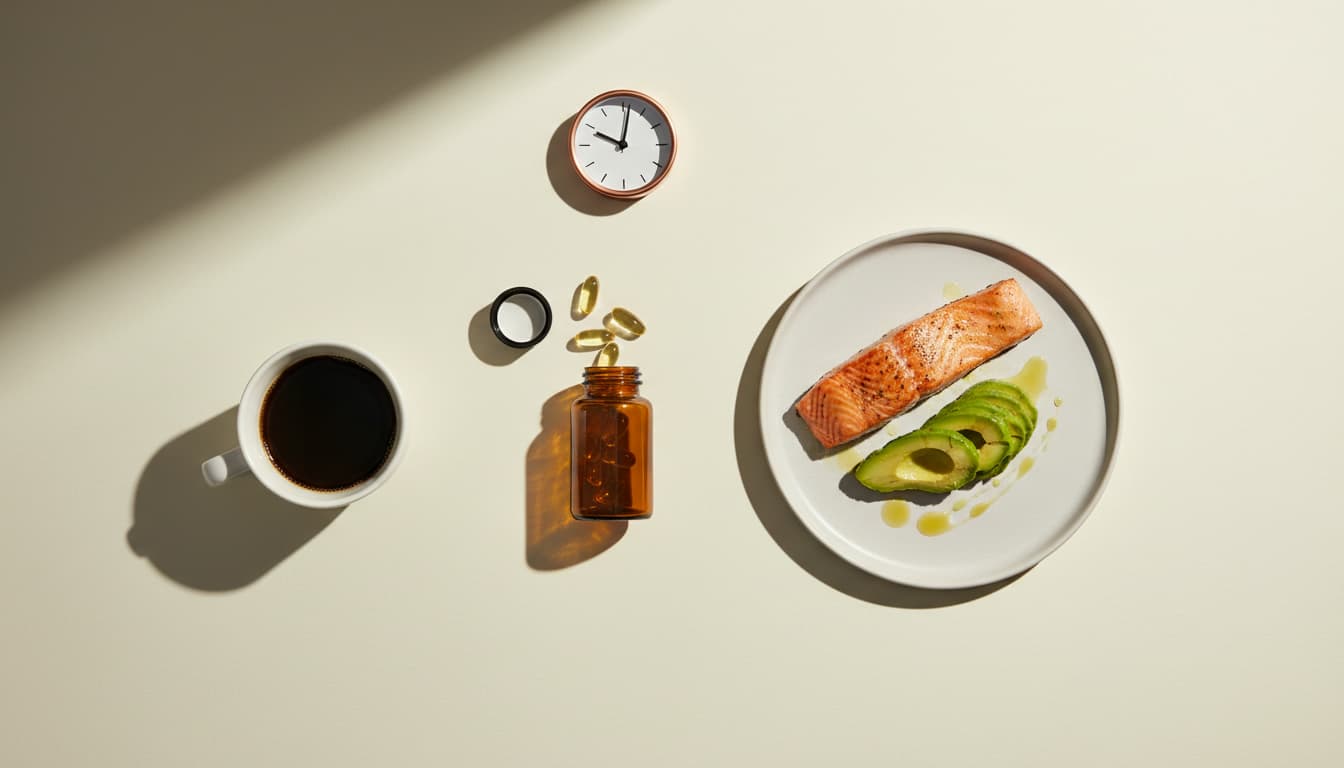
The meal beats the clock. Peak plasma vitamin D3 was 32 percent higher with a fat-containing meal than a fat-free one, and taking it with the largest meal raised serum 25(OH)D by 56 percent at an unchanged dose. Plus why large intermittent doses backfired.
- 01
Take it with fat: 32 percent higher peak plasma vitamin D3
Vitamin D is fat-soluble and is absorbed through the micelle and chylomicron route that dietary fat uses. A single-dose absorption experiment gave 50 healthy older adults 50,000 IU of vitamin D3 with a fat-free breakfast or one of two fat-containing breakfasts after a 12-hour fast, and found mean peak plasma vitamin D3 at 12 hours was 32 percent greater (95% CI 11 to 52 percent) with the fat-containing meals (Dawson-Hughes et al. 2015). The type of fat did not matter: high and low monounsaturated-to-polyunsaturated ratios performed alike.
- 02
Anchor it to the largest meal of the day
The clinical version of the fat finding is striking. Seventeen patients at a bone clinic who were being treated for vitamin D deficiency and failing to respond were told to take their existing supplement, at an unchanged dose, with the largest meal of the day. After two to three months mean serum 25(OH)D had risen from 30.5 to 47.2 ng/mL, an average increase of 56.7 percent (Mulligan and Licata 2010). This was a small prospective cohort rather than a randomised trial, so the magnitude is indicative, but it costs nothing to apply.
- 03
Time of day has no evidence behind it
There is no well-designed trial showing that morning dosing produces a different serum 25(OH)D than evening dosing, and the popular claim that evening vitamin D disrupts sleep by suppressing melatonin is not established. Vitamin D has a long half-life in circulation as 25-hydroxyvitamin D, measured in weeks, which is precisely why a single hour of the day cannot matter much. The variable worth optimising is the meal it rides on, not the clock, and attaching the dose to the biggest meal solves both absorption and adherence at once.
- 04
Daily beats intermittent: the bolus trials went the wrong way
Two large randomised trials tested the intuition that a big occasional dose can substitute for a small daily one, and both found harm. A trial in 2,256 community-dwelling women aged 70 and over gave a single annual oral dose of 500,000 IU and recorded higher rates of falls and fractures than placebo (Sanders et al. 2010). A trial in 200 adults aged 70 and over comparing monthly 24,000 IU, monthly 60,000 IU, and 24,000 IU plus calcifediol found the higher-dose regimens raised 25(OH)D but were associated with more falls (Bischoff-Ferrari et al. 2016).
- 05
Consistency is the variable that actually moves the number
Because 25-hydroxyvitamin D has a circulating half-life measured in weeks, serum status reflects the average intake over the preceding months rather than any single dose. That makes adherence the dominant term in the equation, and it is why a modest daily dose taken with dinner every night outperforms a larger dose taken sporadically. A missed day is unimportant; a missed month is not. Attaching the dose to a meal that already happens daily is the cheapest available adherence mechanism.
- 06
The numbers timing does not change
The RDA is 600 IU (15 mcg) a day for adults up to 70 and 800 IU (20 mcg) for adults over 70, with a tolerable upper intake level of 4,000 IU (100 mcg) a day, and serum 25(OH)D of at least 50 nmol/L (20 ng/mL) is considered adequate for bone health in most people (NIH Office of Dietary Supplements). Timing changes how efficiently a dose is absorbed, not where the target sits. Anyone on a clinician-set repletion protocol should follow the prescribed schedule rather than restructuring it around these general rules.
What people ask us next.
- What is the best time of day to take vitamin D?
- The meal matters far more than the hour. There is no good trial showing morning dosing produces a different serum 25(OH)D than evening dosing, but absorption is clearly better with fat: peak plasma vitamin D3 was 32 percent higher (95% CI 11 to 52 percent) when a dose was taken with a fat-containing meal rather than a fat-free one (Dawson-Hughes et al. 2015). The practical rule is to take it with the largest meal of the day, whenever that happens to fall.
- Should vitamin D be taken with food?
- Yes, and specifically with food containing some fat. Vitamin D is absorbed via the micelle and chylomicron route that dietary fat uses. In 50 healthy older adults given a single 50,000 IU dose, peak plasma vitamin D3 was 32 percent greater with fat-containing meals than with a fat-free meal (Dawson-Hughes et al. 2015), and the type of fat made no significant difference. In a bone clinic cohort, moving an unchanged dose to the largest meal raised mean 25(OH)D by about 57 percent (Mulligan and Licata 2010).
- Is it better to take vitamin D daily or once a week?
- Daily is the better-supported pattern, and very large intermittent doses have a track record of backfiring. A randomised trial in 2,256 women aged 70 and over found a single annual 500,000 IU dose increased falls and fractures versus placebo (Sanders et al. 2010), and a trial in 200 adults aged 70 and over found monthly high-dose regimens raised 25(OH)D but were associated with more falls (Bischoff-Ferrari et al. 2016). Because 25(OH)D has a half-life measured in weeks, a steady daily dose is what holds status.
- Does taking vitamin D at night affect sleep?
- There is no established evidence that it does. The claim that evening vitamin D suppresses melatonin and disrupts sleep circulates widely but is not supported by well-designed trials. Given that 25-hydroxyvitamin D has a circulating half-life measured in weeks, a single evening dose is not producing an acute hormonal event. If evening is when the largest meal happens, evening is the better time to take it, because the meal fat is the variable with measured effects.
- Can I take vitamin D on an empty stomach?
- It will be absorbed, just less efficiently. In the controlled comparison, peak plasma vitamin D3 was 32 percent lower with a fat-free meal than with fat-containing meals (Dawson-Hughes et al. 2015), and the fasting state offers no advantage. If a supplement has to be taken away from food, pairing it with any fat source, even a small one, is preferable. The simplest fix is to move the dose to whichever meal of the day is largest.
- Does timing change how much vitamin D I should take?
- No. The RDA is 600 IU (15 mcg) a day for adults up to 70 and 800 IU (20 mcg) beyond 70, with a tolerable upper intake level of 4,000 IU (100 mcg) a day (NIH Office of Dietary Supplements). Timing changes absorption efficiency, not the target. Anyone following a clinician-set repletion protocol, which often uses much larger prescription doses, should follow the schedule as prescribed rather than restructuring it around general guidance.
Every claim, cited.
- [01]Dawson-Hughes B, Harris SS, Lichtenstein AH, et al. 2015. Dietary fat increases vitamin D-3 absorption. J Acad Nutr Diet 115(2):225-230. n=50; peak 12-hour plasma vitamin D3 32% (95% CI 11-52%) greater with fat-containing meals.
- [02]Mulligan GB, Licata A. 2010. Taking vitamin D with the largest meal improves absorption and results in higher serum levels of 25-hydroxyvitamin D. J Bone Miner Res 25(4):928-30. n=17 prospective cohort; mean 25(OH)D 30.5 to 47.2 ng/mL, +56.7%.
- [03]Sanders KM, Stuart AL, Williamson EJ, et al. 2010. Annual high-dose oral vitamin D and falls and fractures in older women: a randomized controlled trial. JAMA 303(18):1815-22. n=2,256; single 500,000 IU annual dose increased falls and fractures.
- [04]Bischoff-Ferrari HA, Dawson-Hughes B, Orav EJ, et al. 2016. Monthly high-dose vitamin D treatment for the prevention of functional decline: a randomized clinical trial. JAMA Intern Med 176(2):175-83. n=200; higher monthly doses raised 25(OH)D but were associated with more falls.
- [05]NIH Office of Dietary Supplements: Vitamin D Fact Sheet for Health Professionals. RDA 600 IU (15 mcg) to age 70 and 800 IU (20 mcg) beyond; upper limit 4,000 IU (100 mcg).
The Larderlab Team builds evidence-led frameworks for eating, lifting, and stocking a kitchen. We cite every claim. We publish the spreadsheet when possible. We buy what we review at retail price. When new data lands, we revise with a dated note.
Next in this hub.
Best Vitamin D Supplement, Ranked by $/1000 IU
Vitamin D3 supplements ranked by $/1000 IU of cholecalciferol, with D3-vs-D2, K2/magnesium cofactor notes, and third-party testing status.
10 min · rev 2026-06-22Is Vitamin D the Same as D3? The Difference That Actually Matters
Vitamin D is the family name. D2 and D3 are the two forms sold, both counted in the same units, and D3 raises blood 25(OH)D more per microgram. What the label words mean and when the difference is worth paying for.
7 min · rev 2026-08-21When to Take Magnesium: Timing, Food, and Drug Spacing
For blood levels the clock is close to irrelevant. Timing matters for four specific things: tolerance, dose splitting, sleep use, and spacing around medications that magnesium binds. The rules, with the reasons.
7 min · rev 2026-08-21Get the Larderlab Macro Planner.
A Google Sheet that calculates your protein target, splits it across 3-5 meals, and ranks 20 protein sources by $/gram. Free. Copy-and-modify your own version.
By subscribing, you agree to our Privacy Policy. Unsubscribe anytime.