Vitamin D versus D3, and what a label is telling you
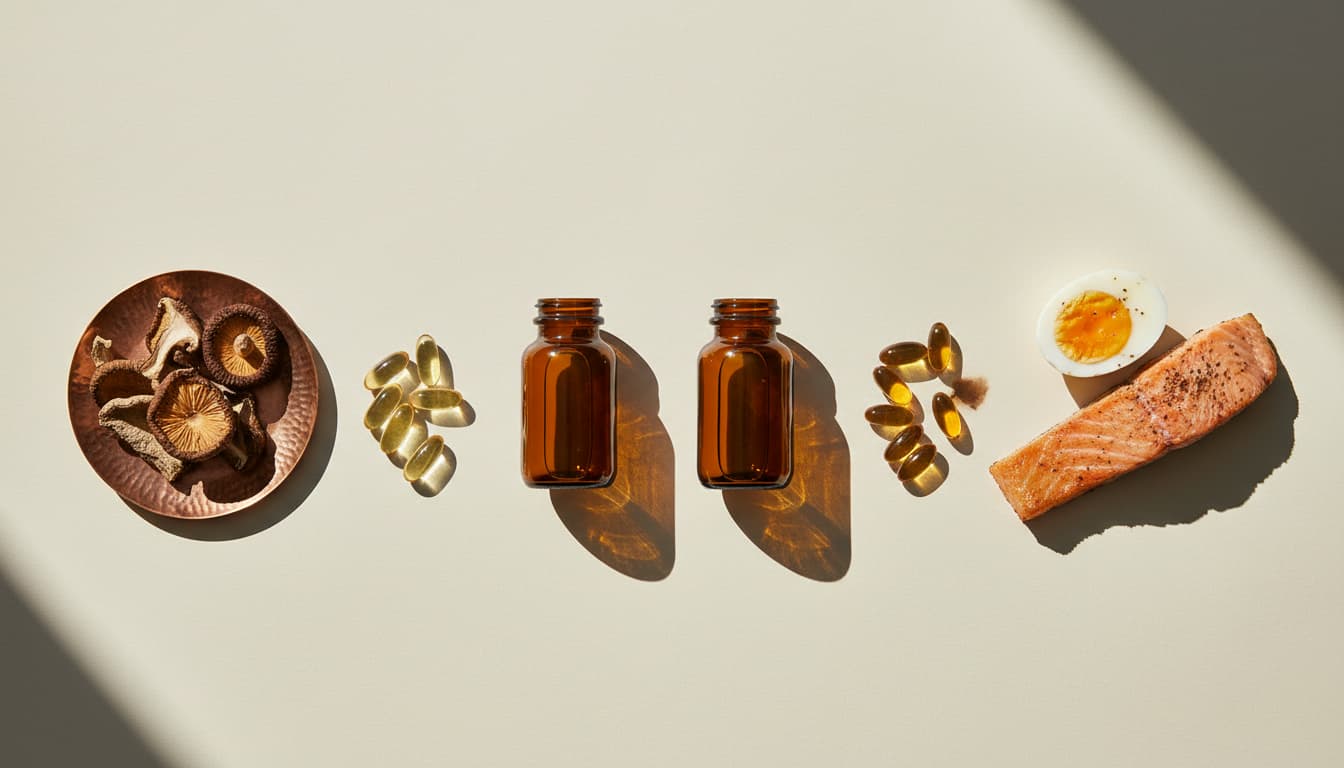
Vitamin D is the family name. D2 and D3 are the two forms sold, both counted in the same units, and D3 raises blood 25(OH)D more per microgram. What the label words mean and when the difference is worth paying for.
- 01
Vitamin D is a family name; D2 and D3 are the two members sold
Vitamin D refers to a group of fat-soluble secosteroids, and only two appear in supplements and fortified food: D2, ergocalciferol, and D3, cholecalciferol. A product labelled simply vitamin D could be either, so the useful information is the parenthetical on the Supplement Facts panel. Cholecalciferol means D3. Ergocalciferol means D2. Everything downstream, the units, the blood test, the RDA, and the upper limit, is shared between them, which is why the two are often treated as interchangeable even though they are not equally potent.
- 02
Both take the same metabolic route to the same blood marker
Whichever form is swallowed, the liver hydroxylates it to 25-hydroxyvitamin D, the circulating storage form and the marker a blood test reports, and the kidney then converts that to 1,25-dihydroxyvitamin D, the active hormone governing calcium absorption and bone mineralisation. A serum test reports total 25(OH)D and does not separate the D2-derived and D3-derived fractions unless specifically requested. This shared pathway is why both forms count toward the same intake target and why the units are identical, with 40 IU equal to 1 microgram.
- 03
The potency difference: D3 moves the blood number further per microgram
A systematic review and meta-analysis found vitamin D3 more efficacious than D2 at raising and maintaining serum 25(OH)D (Tripkovic et al. 2012). The follow-up randomised, double-blind, placebo-controlled trial fortified juice and biscuits with 15 mcg a day for 12 weeks in 335 South Asian and white European women, and the D3 groups showed an absolute incremental rise in total 25(OH)D roughly 15.3 and 16.0 nmol/L greater than the D2 biscuit group (Tripkovic et al. 2017). At a matched labelled dose, D3 is the more efficient way to raise the number that gets measured.
- 04
Where each form comes from, including the vegan option
D3 is what human skin makes from 7-dehydrocholesterol under UVB light, and commercially it is extracted from lanolin in sheep wool, which makes conventional D3 unsuitable for a vegan diet. Lichen-derived cholecalciferol solves that, and it is D3, not D2. Vitamin D2 is produced by ultraviolet irradiation of yeast and fungi, which is also why UV-exposed mushrooms are among the very few plant foods with a meaningful vitamin D content. Origin, not chemistry, is the reason D2 became the historical default for plant-based products.
- 05
Prescription high-dose capsules in the US are usually D2
The 50,000 IU capsules prescribed in the United States for correcting deficiency are typically ergocalciferol, which is a practical reason to know the difference: the prescription form and the over-the-counter form on the shelf are frequently not the same molecule. Given that D3 raises 25(OH)D further per microgram, a repletion course using D2 relies on a much larger dose to reach the same serum target. Anyone following a clinician-set repletion protocol should follow it as written rather than substituting forms on their own.
- 06
The numbers that do not change with form
The RDA is 600 IU (15 mcg) a day for adults up to 70 and 800 IU (20 mcg) for adults over 70, and the tolerable upper intake level is 4,000 IU (100 mcg) a day, with serum 25(OH)D of at least 50 nmol/L (20 ng/mL) considered adequate for bone health in most people (NIH Office of Dietary Supplements). None of these thresholds is form-specific, because both forms feed the same marker. The form question therefore affects how efficiently a given dose gets you there, not where the target sits.
What people ask us next.
- Is vitamin D the same as vitamin D3?
- Not quite. Vitamin D is the family name for a group of fat-soluble secosteroids, and D3 (cholecalciferol) is one of the two members sold, the other being D2 (ergocalciferol). A label reading only vitamin D does not say which one is inside, so the parenthetical on the Supplement Facts panel is the informative part. Both are counted in the same units, both raise serum 25-hydroxyvitamin D, and both count toward the same RDA, but they are not the same molecule.
- Is D3 better than D2?
- At raising blood levels, yes. A systematic review and meta-analysis found D3 more efficacious than D2 at increasing serum 25-hydroxyvitamin D (Tripkovic et al. 2012), and a 12-week randomised, double-blind, placebo-controlled trial in 335 women taking 15 mcg a day found the D3 groups gained roughly 15 to 16 nmol/L more in total 25(OH)D than the D2 group (Tripkovic et al. 2017). Both forms work; D3 simply gets more out of the same labelled dose.
- How do I tell which form a supplement contains?
- Read the parenthesis on the Supplement Facts panel. Cholecalciferol is vitamin D3. Ergocalciferol is vitamin D2. Marketing text on the front of the bottle is often just vitamin D, which is not specific enough. If the label lists lichen or lichen extract as the source, that is vegan-suitable D3; conventional D3 is derived from lanolin in sheep wool, and D2 is made by ultraviolet irradiation of yeast or fungi.
- Does a blood test tell the difference between D2 and D3?
- A standard test reports total 25-hydroxyvitamin D, which combines the D2-derived and D3-derived fractions, so it does not separate them unless the assay is specifically asked to. That is the point of the shared pathway: whichever form is taken, the liver converts it to the same measured storage form. This is also why both forms count toward the same intake targets and why an adequacy threshold of 50 nmol/L is not form-specific.
- Is vegan vitamin D always D2?
- No, not any more. Vitamin D2 from UV-irradiated yeast and fungi was the historical vegan default because conventional D3 comes from lanolin in sheep wool. Lichen-derived cholecalciferol is now widely available and is genuinely D3, so a vegan diet no longer requires accepting the less efficient form. Check the source line on the label: lichen means vegan D3, lanolin means animal-derived D3, and yeast or fungal origin means D2.
- How much vitamin D should I take, and does the form change the number?
- The RDA is 600 IU (15 mcg) a day for adults up to 70 and 800 IU (20 mcg) beyond 70, with a tolerable upper intake level of 4,000 IU (100 mcg) a day (NIH Office of Dietary Supplements). The targets are not form-specific. What changes is efficiency: because D3 raises serum 25(OH)D further per microgram, the same labelled dose of D2 will move the blood number less, which is one reason prescription repletion courses using ergocalciferol rely on much larger doses.
Every claim, cited.
- [01]NIH Office of Dietary Supplements: Vitamin D Fact Sheet for Health Professionals. RDA 600 IU (15 mcg) to age 70 and 800 IU (20 mcg) beyond; upper limit 4,000 IU (100 mcg); D2 and D3 definitions and units.
- [02]Tripkovic L, Lambert H, Hart K, et al. 2012. Comparison of vitamin D2 and vitamin D3 supplementation in raising serum 25-hydroxyvitamin D status: a systematic review and meta-analysis. Am J Clin Nutr 95(6):1357-64.
- [03]Tripkovic L, Wilson LR, Hart K, et al. 2017. Daily supplementation with 15 mcg vitamin D2 compared with vitamin D3 in healthy South Asian and white European women: a 12-wk randomized, placebo-controlled food-fortification trial. Am J Clin Nutr 106(2):481-490. n=335; D3 incremental advantage 15.3 and 16.0 nmol/L.
- [04]Holick MF, Binkley NC, Bischoff-Ferrari HA, et al. 2011. Evaluation, treatment, and prevention of vitamin D deficiency: an Endocrine Society clinical practice guideline. J Clin Endocrinol Metab 96(7):1911-30. Context for high-dose ergocalciferol repletion protocols.
The Larderlab Team builds evidence-led frameworks for eating, lifting, and stocking a kitchen. We cite every claim. We publish the spreadsheet when possible. We buy what we review at retail price. When new data lands, we revise with a dated note.
Next in this hub.
Best Vitamin D Supplement, Ranked by $/1000 IU
Vitamin D3 supplements ranked by $/1000 IU of cholecalciferol, with D3-vs-D2, K2/magnesium cofactor notes, and third-party testing status.
10 min · rev 2026-06-22When to Take Vitamin D: With Fat, and Why Daily Beats a Bolus
The meal beats the clock. Peak plasma vitamin D3 was 32 percent higher with a fat-containing meal than a fat-free one, and taking it with the largest meal raised serum 25(OH)D by 56 percent at an unchanged dose. Plus why large intermittent doses backfired.
8 min · rev 2026-08-21What Does Vitamin D Do? The Functions, by the Evidence
Vitamin D is a hormone precursor that runs calcium absorption, bone mineralization, and immune signaling. What it does, what the big trials found, and the dose that works.
9 min · rev 2026-06-28Get the Larderlab Macro Planner.
A Google Sheet that calculates your protein target, splits it across 3-5 meals, and ranks 20 protein sources by $/gram. Free. Copy-and-modify your own version.
By subscribing, you agree to our Privacy Policy. Unsubscribe anytime.