The supplement guide: the short list worth paying for
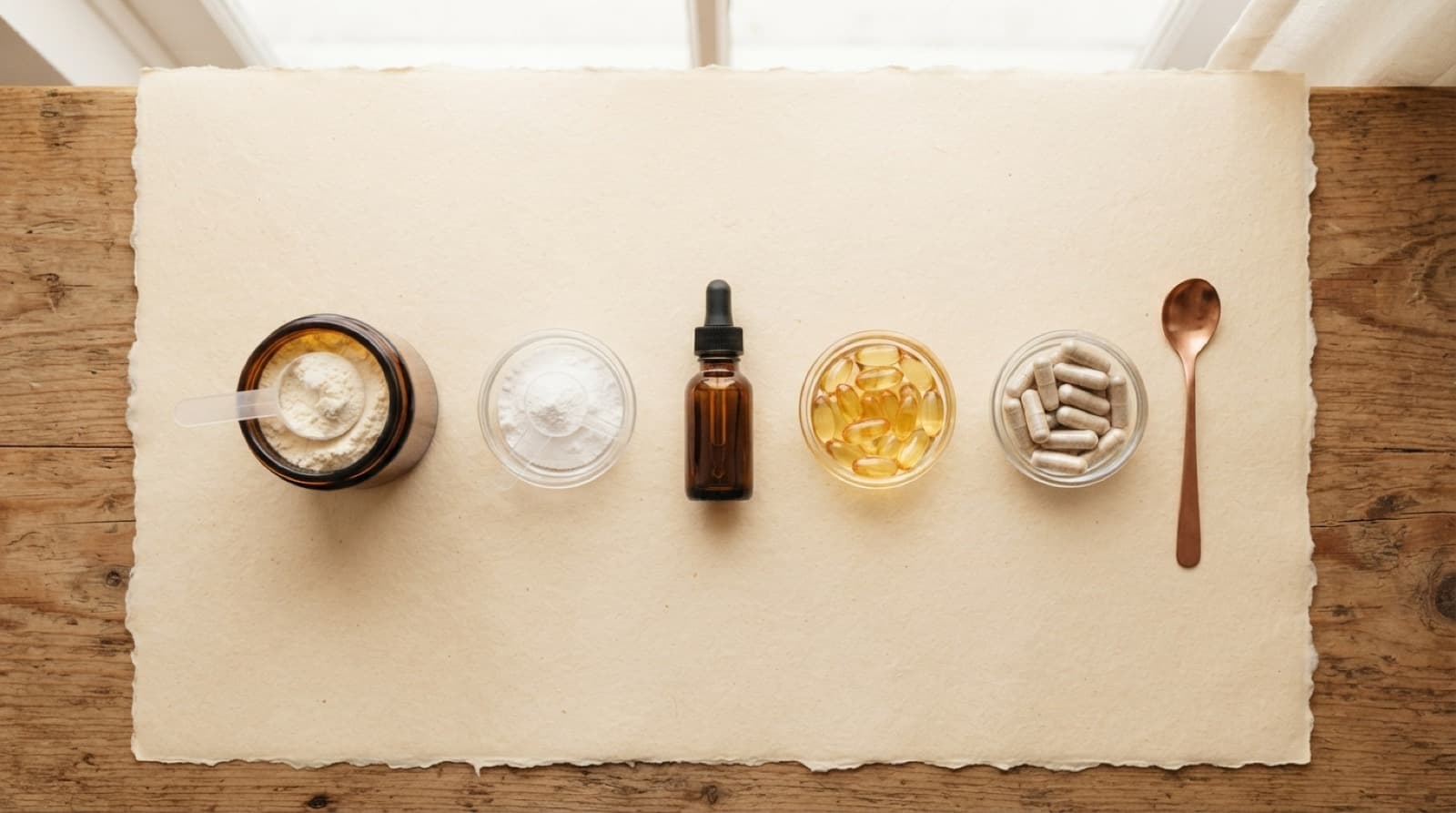
An evidence-tiered guide to the supplements that earn their cost. Each entry: what the literature supports, the dose that matters, and a link to the $/g comparison. The ones to skip, and why.
The four-tier framework: take, consider, skip, avoid
Most people own the wrong supplement stack because they buy on marketing, not on evidence grade plus cost-per-effective-dose. The defensible short list for a general-population adult is small. Tier A (take if the goal applies): creatine monohydrate (3-5 g/day, the most replicated ergogenic in sports nutrition, Kreider et al. 2017), vitamin D3 (correct a measured deficiency, NIH ODS), omega-3 EPA+DHA (if oily-fish intake is below ~2 servings/week, Mozaffarian 2006), and protein powder (a food, not a drug, but the cheapest complete protein per gram). Tier B (consider, goal-specific): magnesium glycinate for sleep or measured low intake, electrolytes for high sweat loss, collagen for connective-tissue loading. Tier C (skip for most): multivitamins as insurance in an already-adequate diet. Each tier links down to its educational explainer, its dosing page, and its $/g money page so the buying decision carries receipts. Build the stack from this list, then price every item per effective dose, not per bottle.
The questions people actually bring us.
- What supplements are actually worth taking?
- For a general-population adult, the short list is small. Creatine monohydrate (3-5 g/day) is the most replicated performance supplement (Kreider et al. 2017, J Int Soc Sports Nutr); see our explainer on what creatine does and the dosing page on how much to take, then the $/g comparison best-creatine-monohydrate. Vitamin D3 is worth it only to correct a measured deficiency: see what vitamin d does and how much vitamin d per day, then best-vitamin-d. Omega-3 (EPA+DHA) is worth it if you eat oily fish under ~2x/week (Mozaffarian 2006, JAMA): see what omega-3 does, then best-fish-oil. Protein powder is a cheap complete-protein food: see best-protein-powders. Everything else is goal-specific or skippable.
- How do you decide whether a supplement earns its cost?
- Two filters, in order. First, evidence grade: is there replicated human RCT data for the endpoint you care about, or just mechanistic and marketing claims? We tag every supplement review with an A-F evidence tier. Second, cost per effective dose: not the bottle price, but the price per gram of the active ingredient at the dose the trials used. A $40 bottle delivering 60 effective doses beats a $20 bottle delivering 20. Every comparison on this site carries a $/g or $/serving column for exactly this reason. A supplement passes only if it clears both filters: real evidence for your goal, and competitive unit economics.
- Do I need a multivitamin?
- For most people eating an adequate, varied diet, no. The large multivitamin trials (Physicians' Health Study II, Sesso et al. 2012; the COSMOS-Mind cognition data) show small or no all-cause benefit in well-nourished populations. The multivitamin is insurance against gaps, not a performance lever. It earns a place only when intake of a specific nutrient is genuinely constrained (restrictive diet, malabsorption, life stage). The higher-yield move is to identify the one or two nutrients you are actually short on (often vitamin D, sometimes magnesium or omega-3) and dose those specifically. See best-multivitamin-2026 for when the insurance case holds and which formulas avoid the megadose-and-binder problem.
- Which supplements are the biggest waste of money?
- The ones sold on mechanism without human outcome data at a realistic dose. The recurring offenders: testosterone boosters, most fat burners (caffeine plus filler), proprietary blends that hide per-ingredient doses (you cannot dose what you cannot see), greens powders priced at 10-20x the produce they claim to replace, and any product whose marketing leans on a single rodent study. The tell is always the same: strong claim, weak evidence tier, and no published per-serving cost of the active ingredient. When a label hides the dose behind a proprietary blend, treat the whole product as unpriceable and skip it.
- In what order should I add supplements?
- Goal-first, cheapest-effective-first. If the goal is strength or training output, start with adequate protein (food first, then powder for the gap) and creatine, the two with the best evidence-to-cost ratio. If a blood test shows low vitamin D, correct that next. If you eat little oily fish, add omega-3. Only then consider the Tier B items (magnesium for sleep or low intake, electrolytes for heavy sweat loss). Add one item at a time, hold it for 8-12 weeks, and judge it against a measurable endpoint. A stack of ten supplements you cannot evaluate is worse than three you can.
- Are supplements regulated for what's on the label?
- In the US, supplements are regulated as food, not drugs (DSHEA 1994), so the manufacturer, not the FDA, is responsible for label accuracy before sale. Independent testing repeatedly finds label-dose discrepancies and contamination in unverified products. The practical defense is third-party certification: look for Informed Sport, NSF Certified for Sport, or USP verification, which test the finished product against the label. Every comparison on this site notes certification status because an unverified gram is not the same as a verified gram, and the unverified one is not actually cheaper per effective dose.
How this was specified
- 01Inputs measured
- Retail price (dated) · label claim · Certificate of Analysis · third-party test (Informed Sport / NSF / ConsumerLab / Clean Label) · leucine per serving from COA, not marketing.
- 02Protocols tested
- Per-kg target from four literature ranges (IOM RDA, Phillips 2017, Morton 2018, ISSN). Brands scored against Moore 2015 leucine-per-dose threshold (~0.4 g/kg).
- 03Cost-basis verified
- $/gram of protein and $/gram of leucine at warehouse pricing (Costco), mail-order (Amazon), and DTC retail. Re-checked quarterly, flagged when drift exceeds 15%.
- 04Confidence level
- High on ranked order. Medium on absolute $/g (prices drift). Low on serving-size claims where COA is older than 18 months, flagged [VERIFY].
Every claim, cited.
- [01]Kreider RB, Kalman DS, Antonio J, et al. 2017. International Society of Sports Nutrition position stand: safety and efficacy of creatine supplementation in exercise, sport, and medicine. J Int Soc Sports Nutr 14:18.
- [02]Mozaffarian D, Rimm EB. 2006. Fish intake, contaminants, and human health: evaluating the risks and the benefits. JAMA 296(15):1885-1899.
- [03]Sesso HD, Christen WG, Bubes V, et al. 2012. Multivitamins in the prevention of cardiovascular disease in men: the Physicians' Health Study II randomized controlled trial. JAMA 308(17):1751-1760.
- [04]NIH Office of Dietary Supplements. Dietary Supplements: What You Need to Know. Regulation under DSHEA and third-party verification.
- [05]Morton RW, Murphy KT, McKellar SR, et al. 2018. A systematic review, meta-analysis and meta-regression of the effect of protein supplementation on resistance training-induced gains in muscle mass and strength in healthy adults. Br J Sports Med 52(6):376-384.
The Larderlab Team builds evidence-led frameworks for eating, lifting, and stocking a kitchen. We cite every claim. We publish the spreadsheet when possible. We buy what we review at retail price. When new data lands, we revise with a dated note.
Next in this hub.
Best Vitamin D Supplement, Ranked by $/1000 IU
Vitamin D3 supplements ranked by $/1000 IU of cholecalciferol, with D3-vs-D2, K2/magnesium cofactor notes, and third-party testing status.
10 min · rev 2026-06-22Foods High in Collagen: Why the Real List Is Shorter Than You Think
Collagen exists only in animal connective tissue, so no plant food contains any. Gelatin powder leads at 85.6 g of protein per 100 g, pork skin at 61.3 g. And the most-marketed source, bone broth, tested poorly against supplements.
8 min · rev 2026-08-24How Much Calcium Per Day: The Numbers by Age, and the Supplement Debate
The RDA is 1,000 mg a day for most adults and 1,200 mg for older women and men, but more is not better. The numbers by age, why food beats supplements, the vitamin D connection, and the evidence behind concerns about calcium pills and the heart.
8 min · rev 2026-08-12Get the Larderlab Macro Planner.
A Google Sheet that calculates your protein target, splits it across 3-5 meals, and ranks 20 protein sources by $/gram. Free. Copy-and-modify your own version.
By subscribing, you agree to our Privacy Policy. Unsubscribe anytime.