Mercury in fish: the low-mercury, high-omega-3 short list
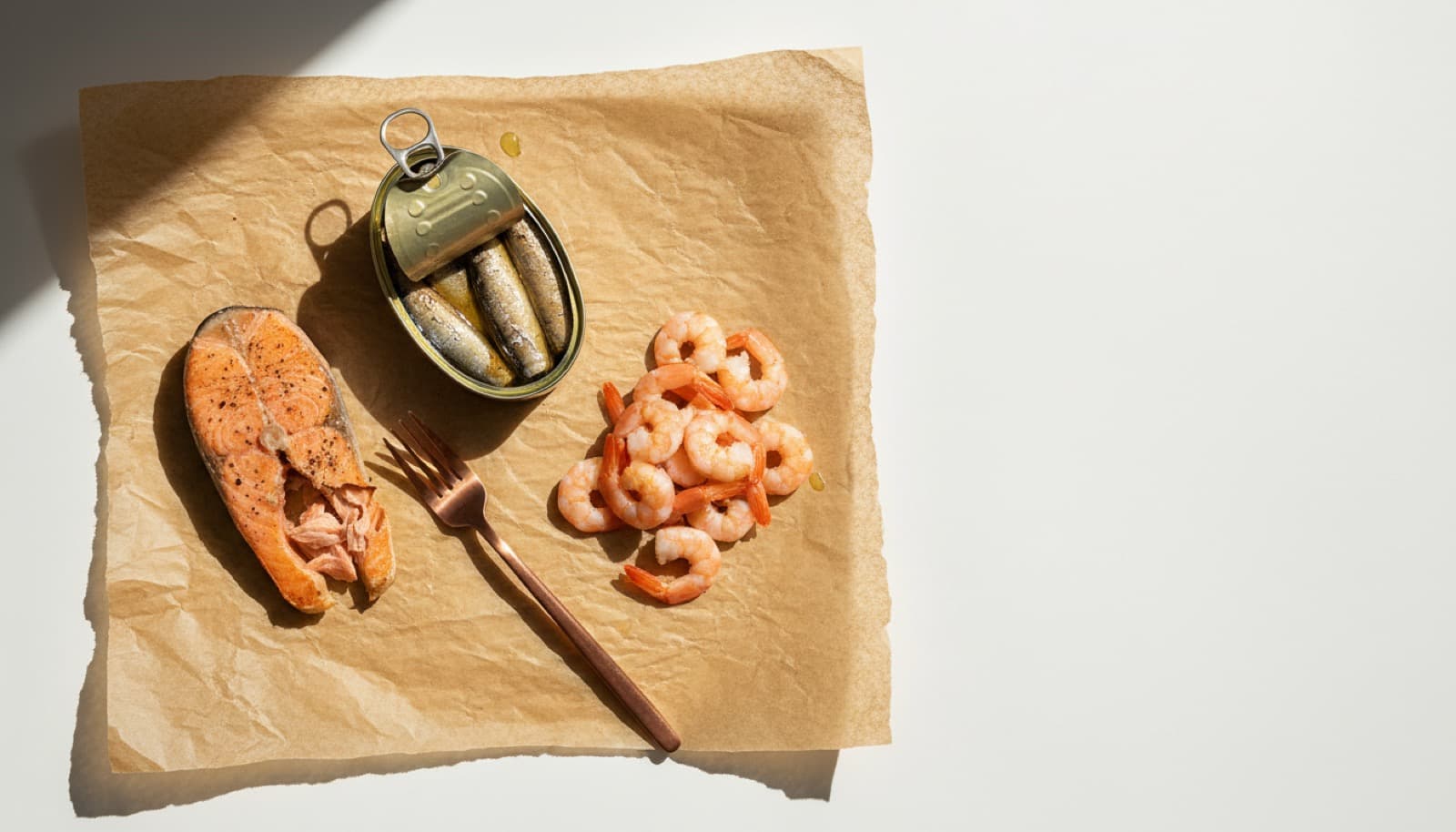
Mercury (ppm) by species against omega-3 yield, using FDA and EPA data. The fish that maximize EPA+DHA per serving while staying under the weekly mercury limit, and the ones to limit.
- 01
Wild salmon (canned or fresh)
~0.022 ppm mercury (FDA), among the lowest of any commonly eaten fish, paired with ~1.5-2 g EPA+DHA per 100 g cooked. The best mercury-to-omega-3 ratio on the list: high oily-fish omega-3 yield with negligible mercury. Canned wild salmon adds soft, edible bones (calcium). The default pick for hitting omega-3 targets from food rather than a fish-oil capsule.
- 02
Sardines
~0.013 ppm mercury (FDA), about the lowest measured, with ~1.4 g EPA+DHA per 100 g. Short-lived, low on the food chain, so they accumulate little mercury. Canned in water or olive oil, shelf-stable, and among the cheapest omega-3 sources per gram. The constraint is palatability, not safety.
- 03
Atlantic mackerel (not king mackerel)
~0.05 ppm mercury for Atlantic/Pacific mackerel, with one of the highest omega-3 yields of any fish (~2.5 g EPA+DHA per 100 g). Critical distinction: Atlantic mackerel is a low-mercury best choice, while KING mackerel is on the FDA avoid list at ~0.73 ppm. The species name matters more than the category.
- 04
Canned light tuna (skipjack)
~0.13 ppm mercury (FDA), a 'best choice' in moderation, with ~0.27 g EPA+DHA per 100 g. The cheapest reliable shelf-stable protein-plus-omega-3 source. Skipjack (light) runs roughly 3x lower mercury than albacore (white) tuna, which is the single most useful swap most people can make at the can shelf.
- 05
Albacore (white) tuna
~0.35 ppm mercury (FDA), roughly 3x canned light tuna. A 'good choice' the FDA caps at about one serving per week for adults, and lower for pregnancy and children. Higher omega-3 than skipjack, but the mercury limit makes it a once-weekly item, not a daily protein. When in doubt at the shelf, light tuna is the higher-frequency choice.
- 06
Shrimp, cod, tilapia, pollock
All under ~0.04 ppm mercury (FDA best choices) and safe to eat several times a week, but low omega-3 (under ~0.3 g EPA+DHA per 100 g). These are excellent low-mercury lean proteins; they just do not move the omega-3 needle. Eat them for protein and variety, and get EPA+DHA from salmon, sardines, or mackerel.
- 07
Avoid list: king mackerel, shark, swordfish, tilefish, bigeye tuna, marlin
~0.7-1.5 ppm mercury (FDA avoid list), the large, long-lived predators at the top of the food chain that concentrate the most methylmercury. The FDA and EPA advise avoiding these entirely for anyone pregnant, breastfeeding, or feeding young children, and limiting them for everyone else. No omega-3 benefit justifies these mercury levels when salmon and sardines exist.
How this was specified
- 01Inputs measured
- Retail price (dated) · label claim · Certificate of Analysis · third-party test (Informed Sport / NSF / ConsumerLab / Clean Label) · leucine per serving from COA, not marketing.
- 02Protocols tested
- Per-kg target from four literature ranges (IOM RDA, Phillips 2017, Morton 2018, ISSN). Brands scored against Moore 2015 leucine-per-dose threshold (~0.4 g/kg).
- 03Cost-basis verified
- $/gram of protein and $/gram of leucine at warehouse pricing (Costco), mail-order (Amazon), and DTC retail. Re-checked quarterly, flagged when drift exceeds 15%.
- 04Confidence level
- High on ranked order. Medium on absolute $/g (prices drift). Low on serving-size claims where COA is older than 18 months, flagged [VERIFY].
Every claim, cited.
- [01]FDA/EPA. 2021. Advice About Eating Fish, and the Best Choices / Good Choices / Choices to Avoid chart with mercury levels by species.
- [02]FDA. Mercury Levels in Commercial Fish and Shellfish (1990-2012). Mean methylmercury concentration (ppm) by species.
- [03]Mozaffarian D, Rimm EB. 2006. Fish intake, contaminants, and human health: evaluating the risks and the benefits. JAMA 296(15):1885-1899. Net benefit of fish intake outweighs mercury risk for most adults.
- [04]USDA FoodData Central. EPA + DHA (omega-3) content per 100 g by species: mackerel ~2.5 g, salmon ~1.5-2 g, herring ~1.7 g, sardines ~1.4 g.
The Larderlab Team builds evidence-led frameworks for eating, lifting, and stocking a kitchen. We cite every claim. We publish the spreadsheet when possible. We buy what we review at retail price. When new data lands, we revise with a dated note.
Next in this hub.
Wild vs Farmed Salmon: Omega-3, Contaminants, and Cost, Compared
Farmed salmon is fattier and often higher in total omega-3 per serving, while wild is leaner with a better omega ratio and fewer calories. The honest comparison on nutrition, contaminants, color, cost, and why both are a healthy choice.
8 min · rev 2026-08-12Foods High in Glutathione: Why You Cannot Really Eat Your Way to More
Glutathione is the body's own master antioxidant, but the glutathione in food is largely broken down before absorption. The foods that contain it, why the sulfur-amino-acid precursors matter more, and what the evidence says about boosting your own levels.
8 min · rev 2026-08-14Foods High in Lectins: The Real Risk, and Why Cooking Solves It
Lectins are proteins in beans, grains, and nightshades, and raw kidney beans really can make you sick, but cooking destroys them. The ranking, why the anti-lectin diet overstates the danger, and why most high-lectin foods are among the healthiest.
8 min · rev 2026-08-13Get the Larderlab Macro Planner.
A Google Sheet that calculates your protein target, splits it across 3-5 meals, and ranks 20 protein sources by $/gram. Free. Copy-and-modify your own version.
By subscribing, you agree to our Privacy Policy. Unsubscribe anytime.