How much fat per day, by the evidence
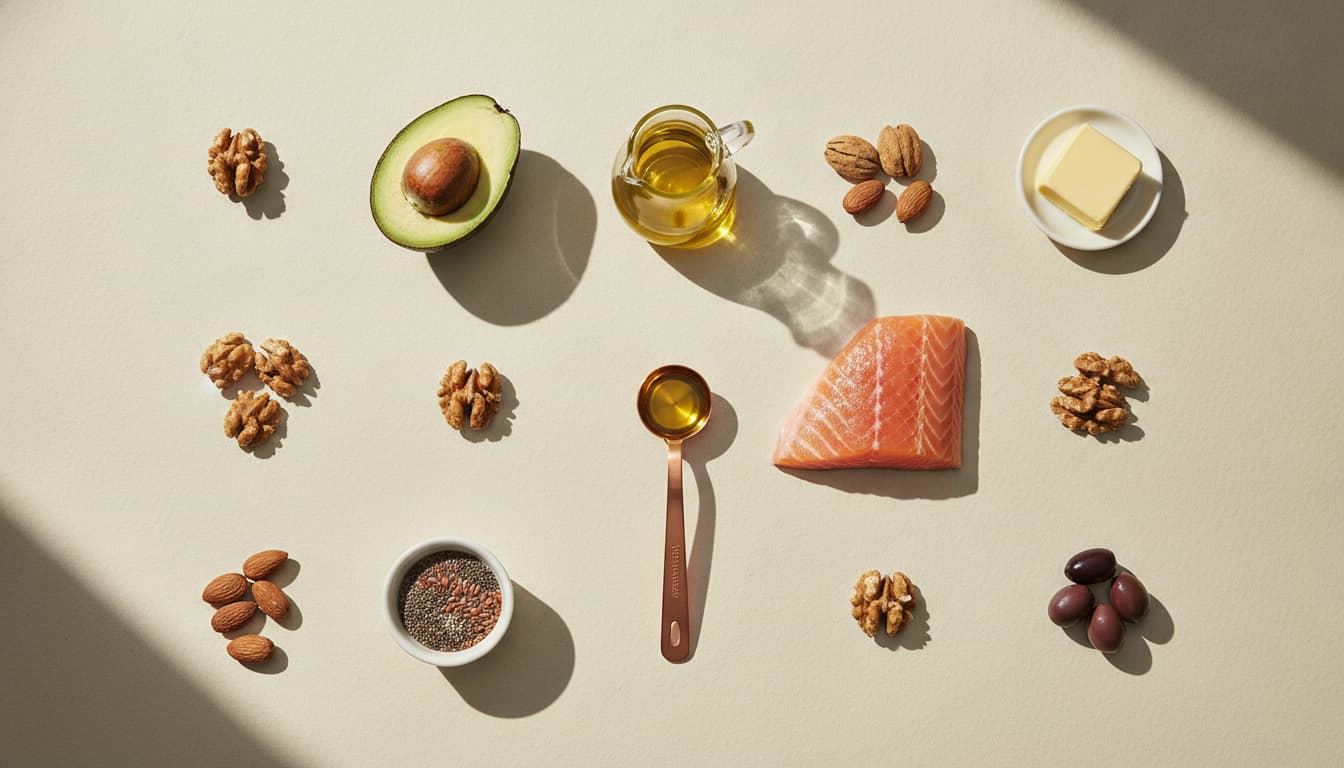
Fat has no single recommended amount, only a range: the AMDR puts it at 20-35% of calories, about 44-78 g on a 2,000-calorie diet, with a floor near 20-30 g for essential fatty acids and vitamin absorption. The range, how to turn it into grams, and why the type of fat matters more than the total.
- 01
The official range: 20-35% of calories
The only formal guidance on fat intake is a range, not a target: the Institute of Medicine's Acceptable Macronutrient Distribution Range puts fat at 20 to 35% of total calories for adults (Dietary Reference Intakes, 2005). The band is wide because healthy diets exist across almost all of it, from lower-fat, higher-carbohydrate patterns near 20% to Mediterranean and low-carb patterns near or above 35%. It is expressed as a share of energy rather than a fixed gram figure precisely because the right amount scales with how much you eat, so a 1,600-calorie diet and a 2,800-calorie diet reach very different gram totals while sitting in the same percentage band.
- 02
The math: turning percent into grams
Because fat carries about 9 calories per gram, converting the percentage band into grams is one calculation: multiply total calories by the percent and divide by nine. At 2,000 calories, 20 to 35% equals 400 to 700 calories from fat, or 44 to 78 g. At 1,600 calories it is 36 to 62 g, and at 2,500 calories it is 56 to 97 g. The reason to run the math yourself is that fat is more than twice as energy-dense as protein or carbohydrate, so gram targets borrowed from someone with a different calorie total are meaningless, and small volumes of oil, butter, and nuts add up faster than they look.
- 03
The floor: essential fatty acids and vitamin absorption
There is a lower limit below the range. The body cannot synthesize the two essential fatty acids, linoleic acid (an omega-6) and alpha-linolenic acid (an omega-3), so they must come from food, and it needs some fat present in a meal to absorb the fat-soluble vitamins A, D, E, and K (Institute of Medicine, 2005). The IOM's Adequate Intake for essential fatty acids is 17 g/day linoleic and 1.6 g alpha-linolenic for adult men, and 12 g and 1.1 g for women. In practice this means total fat much below roughly 20 to 30 g/day risks shorting both essential fats and vitamin absorption, which is why very-low-fat diets are harder to run well than they sound.
- 04
Set calories and protein first, fat and carbs fill the rest
Fat is not the macronutrient to set first. It has no minimum to hit the way protein does and no tight ceiling the way total energy does, so the reliable order is to fix total calories for your goal, set protein at roughly 1.6 g per kg of body weight to protect muscle and manage appetite, and then let fat and carbohydrate share the remaining energy. Built this way the fat number falls out of the other two decisions rather than being aimed at directly. It also explains low-carb eating in one line: cutting carbohydrate does not lower calories by itself, it just moves the leftover energy into fat, so the two macronutrients trade off within a fixed calorie budget.
- 05
Saturated fat: under 10% of calories
The one firm fat sub-limit worth following is on saturated fat. The US Dietary Guidelines recommend keeping it under 10% of daily calories, about 22 g on a 2,000-calorie diet (USDA/HHS 2020-2025). The evidence that matters is what you replace it with: an American Heart Association advisory found that swapping saturated fat for unsaturated fat lowers cardiovascular risk, while swapping it for refined carbohydrate and sugar does not (Sacks et al. 2017). So the useful instruction is not fat-phobia but substitution, use olive oil, nuts, and fish in place of butter, fatty processed meat, and palm oil, rather than cutting fat and adding white starch.
- 06
Type beats total: unsaturated, saturated, trans
The AMDR counts every gram of fat the same, but the type is what tracks with health outcomes. Unsaturated fats, the monounsaturated fat in olive oil and avocados and the polyunsaturated fats in fish, walnuts, and seeds, are the ones to build the budget around. Saturated fat, mostly from fatty meat, butter, and tropical oils, is the sub-total to cap under 10% of calories. Industrial trans fat, once common in partially hydrogenated oils and now largely removed from the food supply, has no safe intake level and should sit as near zero as possible. Two people eating the same 70 g of fat, one from fish and olive oil and the other from processed meat and pastry, are not eating the same diet.
- 07
Low-fat and high-fat both work at matched calories
Fat percentage within the wide 20-to-35% band, and even outside it on ketogenic diets, is largely a matter of preference and adherence rather than a metabolic lever. A large randomized trial comparing healthy low-fat with healthy low-carbohydrate diets found no significant difference in weight loss over a year once food quality was emphasized and calories were not deliberately counted (Gardner et al. 2018). The consistent finding across controlled studies is that fat loss is driven by the calorie deficit, not by the fat-to-carbohydrate ratio, so the right fat number is the one that lets you eat in a way you can sustain while keeping saturated fat capped and protein adequate.
What people ask us next.
- How much fat should I eat per day?
- There is no single number; the Institute of Medicine sets a range of 20 to 35% of total calories from fat, which is about 44 to 78 g on a 2,000-calorie diet since fat carries roughly 9 calories per gram (Dietary Reference Intakes, 2005). Where you land inside that band is mostly preference, because low-fat and higher-fat diets produce similar results at matched calories. Set your total calories and protein first and let fat fill part of the remainder, keep saturated fat under 10% of calories, and favor unsaturated sources.
- How many grams of fat per day to lose weight?
- There is no special fat number for weight loss; fat loss comes from a calorie deficit, and fat can sit anywhere in the 20-to-35% range as long as total calories are below maintenance. A randomized trial found healthy low-fat and healthy low-carbohydrate diets produced similar weight loss over a year when calories were not deliberately counted (Gardner et al. 2018). Because fat is energy-dense at 9 calories per gram, trimming added oils and fatty processed foods is an easy way to cut calories, but keep enough fat for essential fatty acids and vitamin absorption.
- Is 70 grams of fat a day too much?
- Not by itself. On a 2,000-calorie diet, 70 g of fat is about 32% of calories, which sits comfortably inside the 20-to-35% range (Institute of Medicine, 2005). Whether it is appropriate depends on your total calories and, more importantly, the type of fat: 70 g built from olive oil, fish, nuts, and avocado is very different from 70 g built from fatty processed meat and pastry. The number to watch is not total fat but saturated fat, which should stay under 10% of calories, about 22 g.
- How much saturated fat per day is safe?
- The US Dietary Guidelines recommend keeping saturated fat under 10% of daily calories, about 22 g on a 2,000-calorie diet (USDA/HHS 2020-2025). The key evidence is about substitution: replacing saturated fat with unsaturated fat lowers cardiovascular risk, while replacing it with refined carbohydrate and sugar does not (Sacks et al. 2017). So the practical target is not simply less fat but swapping butter, fatty meat, and tropical oils for olive oil, nuts, and fish, while keeping the saturated share under the 10% ceiling.
- What is the minimum amount of fat I need per day?
- Roughly 20 to 30 g/day is a sensible practical floor for most adults. The body cannot make the two essential fatty acids, linoleic acid and alpha-linolenic acid, and it needs some dietary fat to absorb the fat-soluble vitamins A, D, E, and K (Institute of Medicine, 2005). The formal Adequate Intake for essential fatty acids is 17 g linoleic and 1.6 g alpha-linolenic for men and 12 g and 1.1 g for women, a smaller and separate target than total fat. Very-low-fat diets risk shorting both essential fats and vitamin absorption, which is why they are harder to run well than they sound.
- Are all fats equally healthy?
- No, and the type matters more than the total. Unsaturated fats, from olive oil, avocados, fish, nuts, and seeds, are the ones to build most of the fat budget around. Saturated fat, mainly from fatty meat, butter, and tropical oils, should stay under 10% of calories. Industrial trans fat, now largely removed from the food supply, has no safe level. Two diets with the same fat grams can differ sharply in health impact depending on the mix, which is why our guide to healthy fats focuses on sources rather than a single number.
Every claim, cited.
- [01]Institute of Medicine. 2005. Dietary Reference Intakes for Energy, Carbohydrate, Fiber, Fat, Fatty Acids, Cholesterol, Protein, and Amino Acids. AMDR for fat set at 20-35% of energy; Adequate Intakes for essential fatty acids.
- [02]US Departments of Agriculture and Health and Human Services. Dietary Guidelines for Americans, 2020-2025. Saturated fat recommended below 10% of total daily calories.
- [03]Sacks FM, Lichtenstein AH, Wu JHY, et al. 2017. Dietary fats and cardiovascular disease: a presidential advisory from the American Heart Association. Circulation 136(3):e1-e23. Replacing saturated with unsaturated fat lowers CVD risk; replacing it with refined carbohydrate does not.
- [04]Gardner CD, Trepanowski JF, Del Gobbo LC, et al. 2018. Effect of low-fat vs low-carbohydrate diet on 12-month weight loss (DIETFITS randomized trial). JAMA 319(7):667-679. No significant difference in weight loss between healthy low-fat and low-carbohydrate diets.
The Larderlab Team builds evidence-led frameworks for eating, lifting, and stocking a kitchen. We cite every claim. We publish the spreadsheet when possible. We buy what we review at retail price. When new data lands, we revise with a dated note.
Next in this hub.
How Much Protein Per Meal? The Per-Sitting Number, by the Evidence
The muscle-building response peaks at about 0.4 g of protein per kg of body weight per meal, roughly 25-40 g for most adults. The per-meal number, why splitting protein across the day beats one large dose, and how to hit it.
8 min · rev 2026-07-21Does Avocado Have Protein? The USDA Number, and the Per-Calorie Math
USDA lists 2.0 g of protein per 100 g of raw avocado, at 160 kcal. That is 1.25 g of protein per 100 kcal, against 18.8 g per 100 kcal for roasted chicken breast. The numbers, and what avocado is actually dense in.
7 min · rev 2026-08-20How Much Protein Should I Eat a Day? The Number, by Goal
Sedentary adults need 0.8 g/kg/day (RDA); people who resistance train need 1.6 g/kg/day (Morton 2018). The daily protein number by goal, bodyweight, and meal split.
9 min · rev 2026-06-26Get the Larderlab Macro Planner.
A Google Sheet that calculates your protein target, splits it across 3-5 meals, and ranks 20 protein sources by $/gram. Free. Copy-and-modify your own version.
By subscribing, you agree to our Privacy Policy. Unsubscribe anytime.