High-protein snacks, ranked by grams per serving
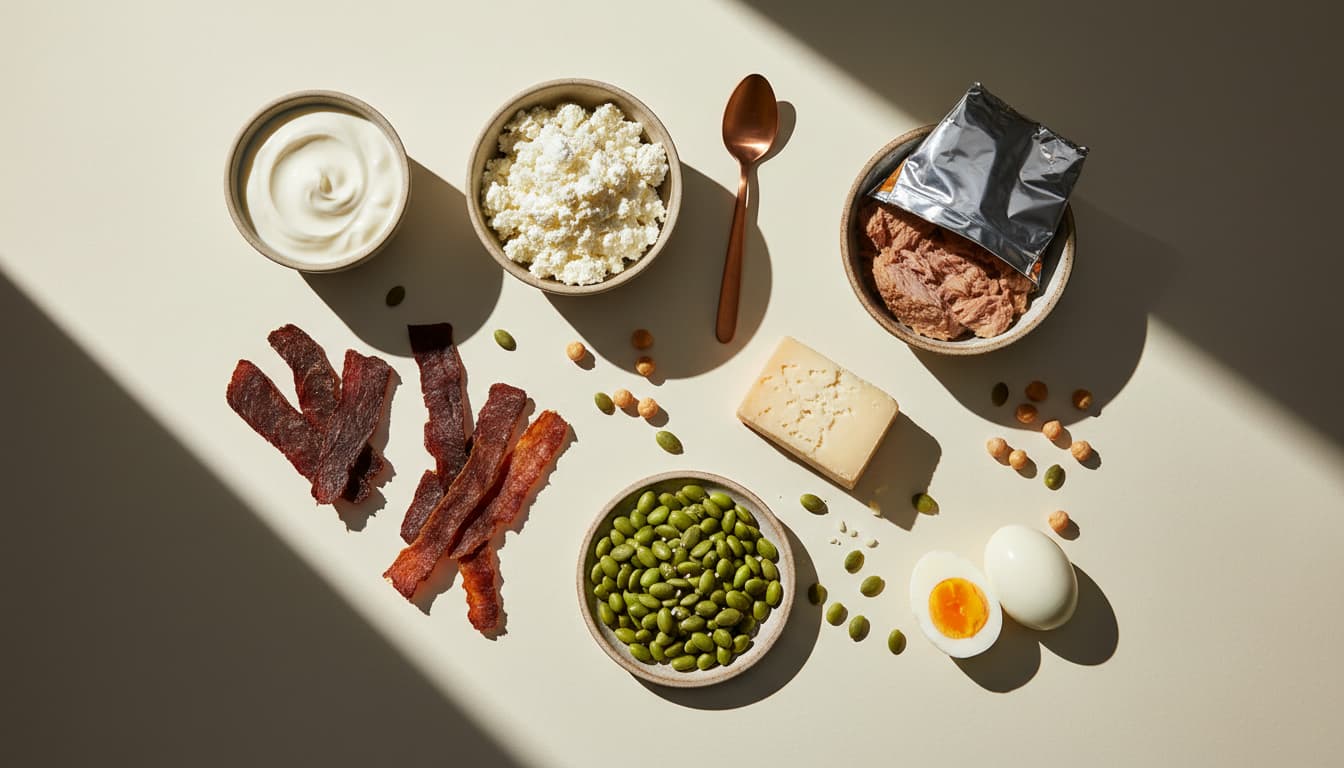
Biltong, Greek yogurt, cottage cheese, and tuna pouches deliver 15-25 g of protein per serving, far more than a protein bar for the money. The grams-per-serving ranking, the leucine threshold that makes a snack count, and why whole foods beat the packaged aisle.
- 01
Greek yogurt: ~17-20 g per single tub
A single 170 g tub of plain nonfat Greek yogurt delivers ~17-20 g of complete, high-leucine protein, more than double regular yogurt because the straining that removes whey concentrates the casein (USDA FoodData Central). It is the highest-protein snack most people already keep in the fridge, and the casein digests slowly, which is part of why it holds off hunger well. Plain is the better buy: the protein is identical to flavored versions while the added sugar is not, and folding in frozen berries or a scoop of whey is a faster way to sweeten it without the sugar load.
- 02
Tuna and salmon pouches: ~17-20 g per pouch
A standard 2.6 oz foil pouch of tuna or salmon carries ~17-20 g of complete protein and needs no draining or refrigeration, which makes it the most portable serious protein on this list (USDA). Salmon pouches add the omega-3s EPA and DHA on top. Chunk light tuna is the lower-mercury choice over albacore per EPA guidance, a distinction our guide to mercury in fish spells out, so pouches are a snack you can repeat several times a week without the mercury math becoming a concern.
- 03
Biltong and beef jerky: ~9-16 g per ounce
Air-dried biltong leads at ~16 g of protein per ounce and beef jerky follows at ~9-11 g, because drying removes water and concentrates the protein into a dense, shelf-stable bite (USDA). Both are complete, high-leucine animal protein and need no refrigeration, which is their real advantage as a travel or desk snack. The one number to watch is sodium: a single ounce can carry several hundred milligrams, so a serving is a genuine protein hit but not something to graze on all afternoon.
- 04
Cottage cheese: ~12-14 g per half cup
A half-cup of low-fat cottage cheese supplies ~12-14 g of protein and a full cup ~24-28 g, most of it slow-digesting casein (USDA). That slow release is why cottage cheese is a common pre-sleep protein, since it drip-feeds amino acids for hours (Res et al. 2012). It pairs well with fruit for a sweet snack or tomatoes and pepper for a savory one, and the protein density per calorie is among the best on this list, which makes it a strong choice when the goal is protein without many extra calories.
- 05
Roasted edamame and soy snacks: ~11-13 g per ounce
Dry-roasted edamame delivers ~11-13 g of protein per ounce, the strongest plant-based option here because soy is one of the few plant proteins that is complete, carrying all essential amino acids in useful amounts (USDA). Roasted chickpeas and other roasted legumes trail at ~6 g per ounce. Edamame stacks fiber alongside the protein, so it does more per serving than a comparable nut, and it is the snack that lets a plant-based eater reach a real protein dose without an animal source.
- 06
Hard-boiled eggs and cheese: ~6-12 g per serving
Two hard-boiled eggs supply ~12 g of complete protein and a single string-cheese stick ~6-7 g, both cheap, portable, and needing no preparation once cooked (USDA). Eggs are the reference protein for amino-acid quality, and a batch boiled at the start of the week is a grab-and-go primitive. Cheese adds calcium along with the protein but also saturated fat and sodium, so a stick or two is a sensible top-up rather than a base. Neither is the densest option alone, but paired they build a quick ~18 g snack.
- 07
Nuts, seeds, and nut butter: ~6-9 g per serving
An ounce of pumpkin seeds carries ~9 g of protein, an ounce of almonds or two tablespoons of nut butter ~6-7 g (USDA). These are the lightest protein sources here and the most calorie-dense, since most of their energy is fat, so they read as protein snacks but are really fat-and-fiber snacks with protein attached. Their value is as an accompaniment, a spoon of nut butter on Greek yogurt or a scatter of pumpkin seeds over cottage cheese, rather than as the protein anchor of a snack on their own.
How this was specified
- 01Inputs measured
- Retail price (dated) · label claim · Certificate of Analysis · third-party test (Informed Sport / NSF / ConsumerLab / Clean Label) · leucine per serving from COA, not marketing.
- 02Protocols tested
- Per-kg target from four literature ranges (IOM RDA, Phillips 2017, Morton 2018, ISSN). Brands scored against Moore 2015 leucine-per-dose threshold (~0.4 g/kg).
- 03Cost-basis verified
- $/gram of protein and $/gram of leucine at warehouse pricing (Costco), mail-order (Amazon), and DTC retail. Re-checked quarterly, flagged when drift exceeds 15%.
- 04Confidence level
- High on ranked order. Medium on absolute $/g (prices drift). Low on serving-size claims where COA is older than 18 months, flagged [VERIFY].
Every claim, cited.
- [01]US Department of Agriculture, Agricultural Research Service. FoodData Central. Protein content of Greek yogurt, cottage cheese, canned and pouched fish, biltong and jerky, roasted edamame, eggs, cheese, nuts, and seeds.
- [02]Paddon-Jones D, Rasmussen BB. 2009. Dietary protein recommendations and the prevention of sarcopenia. Curr Opin Clin Nutr Metab Care 12(1):86-90. Per-meal leucine threshold (~2-3 g) and 25-30 g protein per feeding.
- [03]Res PT, et al. 2012. Protein ingestion before sleep improves postexercise overnight recovery. Med Sci Sports Exerc 44(8):1560-1569. Slow-digesting casein supports overnight muscle protein synthesis.
- [04]National Academies of Sciences, Engineering, and Medicine. Dietary Reference Intakes for Energy, Carbohydrate, Fiber, Fat, Fatty Acids, Cholesterol, Protein, and Amino Acids. RDA for protein 0.8 g/kg/day.
The Larderlab Team builds evidence-led frameworks for eating, lifting, and stocking a kitchen. We cite every claim. We publish the spreadsheet when possible. We buy what we review at retail price. When new data lands, we revise with a dated note.
Next in this hub.
12 High-Protein Foods Ranked by $/gram
A shopping list to hit 150 g of protein a day for under $5, built from 12 foods ranked by cost-per-gram.
9 min · rev 2026-04-21High-Fiber Foods: The Densest Sources, by Grams
The target is ~25 g/day for women and 38 g for men, and beans, lentils, chia, avocado, and whole grains are the densest sources. The grams-per-serving ranking, why most people hit only half the number, and how to close the gap without bloating.
8 min · rev 2026-07-09Casein vs Whey Protein: Whey Wins the Hour, Casein Wins the Night
Whey raised muscle protein synthesis about 93 percent above casein at rest and 122 percent after exercise, yet casein produced the more positive 7-hour net leucine balance. Pre-sleep casein added 3.6 square centimetres of quadriceps growth over 12 weeks against a noncaloric placebo.
14 min · rev 2026-09-10Get the Larderlab Macro Planner.
A Google Sheet that calculates your protein target, splits it across 3-5 meals, and ranks 20 protein sources by $/gram. Free. Copy-and-modify your own version.
By subscribing, you agree to our Privacy Policy. Unsubscribe anytime.