Foods high in selenium, ranked by micrograms
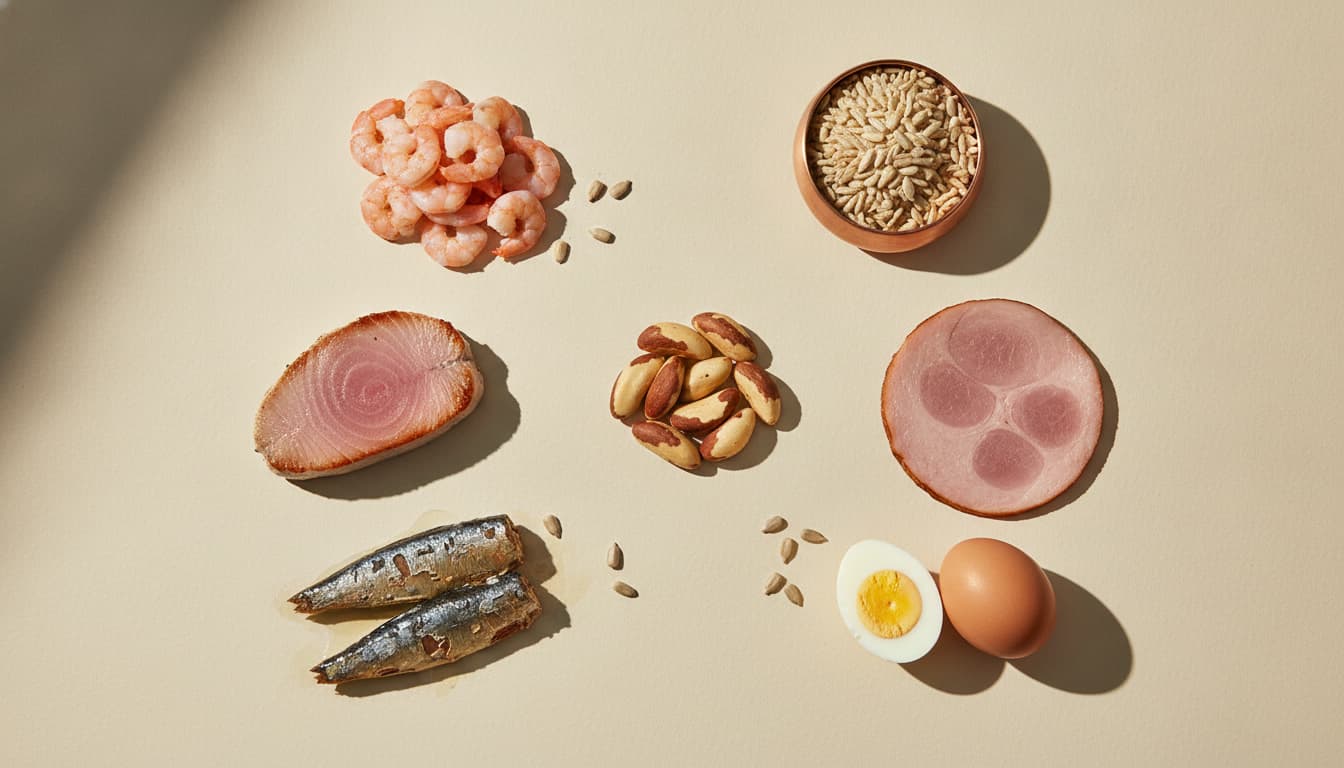
The daily selenium target is 55 mcg for adults, and Brazil nuts, tuna, sardines, and organ meats are the densest sources. The mcg-per-serving ranking, why one Brazil nut can cover a day, and how much is too much.
- 01
Brazil nuts: ~68-91 mcg each, the outlier to ration
Brazil nuts are the single densest source by a wide margin: one nut carries roughly 68-91 mcg of selenium, so one to two nuts can cover the entire daily target, and a one-ounce handful of six to eight can reach 500 mcg or more, past the 400 mcg upper limit (NIH ODS; USDA). Content varies with the soil the trees grew in, so a given batch can be higher still. This is the rare food where the advice is to eat less, not more: a couple of nuts a few times a week is a reliable top-up, while a daily handful is the classic route to selenium excess.
- 02
Tuna and white fish: ~47-92 mcg per 3 oz
Seafood is the most practical dense source after Brazil nuts. Cooked yellowfin tuna supplies ~92 mcg of selenium per 3 oz, well above the daily target in one modest serving, with halibut ~47 mcg and most other fish in a useful range (USDA; NIH ODS). Sea fish concentrate selenium reliably, so a couple of fish meals a week cover the number without the overshoot risk of Brazil nuts, and oily fish bring EPA and DHA omega-3s alongside, so the same meal handles more than one nutrient.
- 03
Sardines, ham, and shrimp: ~42-45 mcg per 3 oz
Canned sardines (~45 mcg per 3 oz), ham (~42 mcg), and shrimp (~42 mcg) form the dependable middle of the ranking, each supplying most of the daily target in one serving (USDA; NIH ODS). Sardines are especially efficient, stacking selenium with calcium from the soft bones, omega-3s, and B12. Shellfish add zinc and iodine as well, so a seafood-forward week covers a cluster of trace minerals at once rather than one at a time.
- 04
Beef, turkey, and chicken: ~22-33 mcg per 3 oz
Meat and poultry are the steady background source: a 3 oz serving of beef supplies ~33 mcg, turkey ~31 mcg, beef liver ~28 mcg, and chicken ~22 mcg (USDA; NIH ODS). None is a standout on its own, but a daily protein serving reliably contributes a third to two-thirds of the target, and because the selenium arrives with complete protein and other trace minerals, building the plate around a protein source is what quietly keeps most mixed eaters above 55 mcg without any thought.
- 05
Eggs and dairy: ~8-20 mcg per serving
One large egg provides ~15 mcg of selenium, a cup of cottage cheese ~20 mcg, and a cup of milk ~8 mcg, making eggs and dairy a modest but consistent contributor (USDA; NIH ODS). None replaces seafood or a protein serving as the main source, but two or three eggs across a day add a meaningful share of the target, and for lacto-ovo vegetarians who skip fish and meat, eggs and dairy become the backbone of selenium intake alongside grains.
- 06
Grains, seeds, and nuts: dense but soil-dependent
Whole grains, sunflower seeds, and most nuts carry useful selenium, with a cup of brown rice ~19 mcg, an ounce of sunflower seeds ~19 mcg, and a slice of whole-wheat bread ~13 mcg (USDA; NIH ODS). The catch is soil: the selenium in plant foods reflects where they were grown, so grain from selenium-rich US wheat belts is far higher than grain from selenium-poor regions. This regional swing is why plant-heavy diets are adequate in some countries and marginal in others, and why national selenium intake tracks geology more than food choice.
- 07
Why more is not better, and who is at risk
Selenium has one of the narrowest gaps between the target and the ceiling of any nutrient: the RDA is 55 mcg but the upper limit is 400 mcg/day, and chronic intake above it causes selenosis, with hair and nail brittleness or loss, garlic breath, and gastrointestinal upset (NIH ODS). The realistic route to excess is daily Brazil nuts or high-dose supplements, not ordinary food. Genuine deficiency is rare in selenium-rich regions but real in low-soil areas and in people on long-term restricted diets, where a modest supplement or a few Brazil nuts a week is the fix. For most people the message is that a mixed diet already clears the target.
How this was specified
- 01Inputs measured
- Retail price (dated) · label claim · Certificate of Analysis · third-party test (Informed Sport / NSF / ConsumerLab / Clean Label) · leucine per serving from COA, not marketing.
- 02Protocols tested
- Per-kg target from four literature ranges (IOM RDA, Phillips 2017, Morton 2018, ISSN). Brands scored against Moore 2015 leucine-per-dose threshold (~0.4 g/kg).
- 03Cost-basis verified
- $/gram of protein and $/gram of leucine at warehouse pricing (Costco), mail-order (Amazon), and DTC retail. Re-checked quarterly, flagged when drift exceeds 15%.
- 04Confidence level
- High on ranked order. Medium on absolute $/g (prices drift). Low on serving-size claims where COA is older than 18 months, flagged [VERIFY].
Every claim, cited.
- [01]National Institutes of Health, Office of Dietary Supplements. Selenium Fact Sheet for Health Professionals. RDA 55 mcg/day for adults (60 mcg pregnancy, 70 mcg lactation); upper limit 400 mcg/day; content of Brazil nuts, seafood, meat, and eggs.
- [02]US Department of Agriculture, Agricultural Research Service. FoodData Central. Selenium content of Brazil nuts, tuna, sardines, ham, shrimp, beef, poultry, eggs, and grains.
- [03]Rayman MP. 2012. Selenium and human health. Lancet 379(9822):1256-1268. Selenium status, selenoproteins, and the narrow window between deficiency and excess.
- [04]German Nutrition Society (DGE). Referenzwerte fuer die Naehrstoffzufuhr: Selen. Estimated adequate intake of 70 mcg/day for men and 60 mcg/day for women.
The Larderlab Team builds evidence-led frameworks for eating, lifting, and stocking a kitchen. We cite every claim. We publish the spreadsheet when possible. We buy what we review at retail price. When new data lands, we revise with a dated note.
Next in this hub.
Foods High in Biotin (Vitamin B7): The Densest Sources, by Micrograms
The adequate intake is just 30 mcg a day, and beef liver, eggs, and salmon cover it easily. The mcg-per-serving ranking, why deficiency is rare, why raw egg whites work against you, and why hair-growth megadoses are mostly wasted.
7 min · rev 2026-08-06Foods High in Vitamin K: The Densest Sources, by Micrograms
The adequate intake is 120 mcg/day for men and 90 mcg for women, and cooked leafy greens dominate while fermented natto tops the list. The mcg-per-serving ranking, why K1 and K2 count the same, and what people on blood thinners actually need to do.
8 min · rev 2026-07-27Foods High in Copper: The Densest Sources, by Micrograms
The daily copper target is 900 mcg for adults, and beef liver, oysters, dark chocolate, cashews, and seeds are the densest sources. The mcg-per-serving ranking, why one serving of liver covers a week, and how too much zinc can drain it.
8 min · rev 2026-07-21Get the Larderlab Macro Planner.
A Google Sheet that calculates your protein target, splits it across 3-5 meals, and ranks 20 protein sources by $/gram. Free. Copy-and-modify your own version.
By subscribing, you agree to our Privacy Policy. Unsubscribe anytime.