Foods high in copper, ranked by micrograms
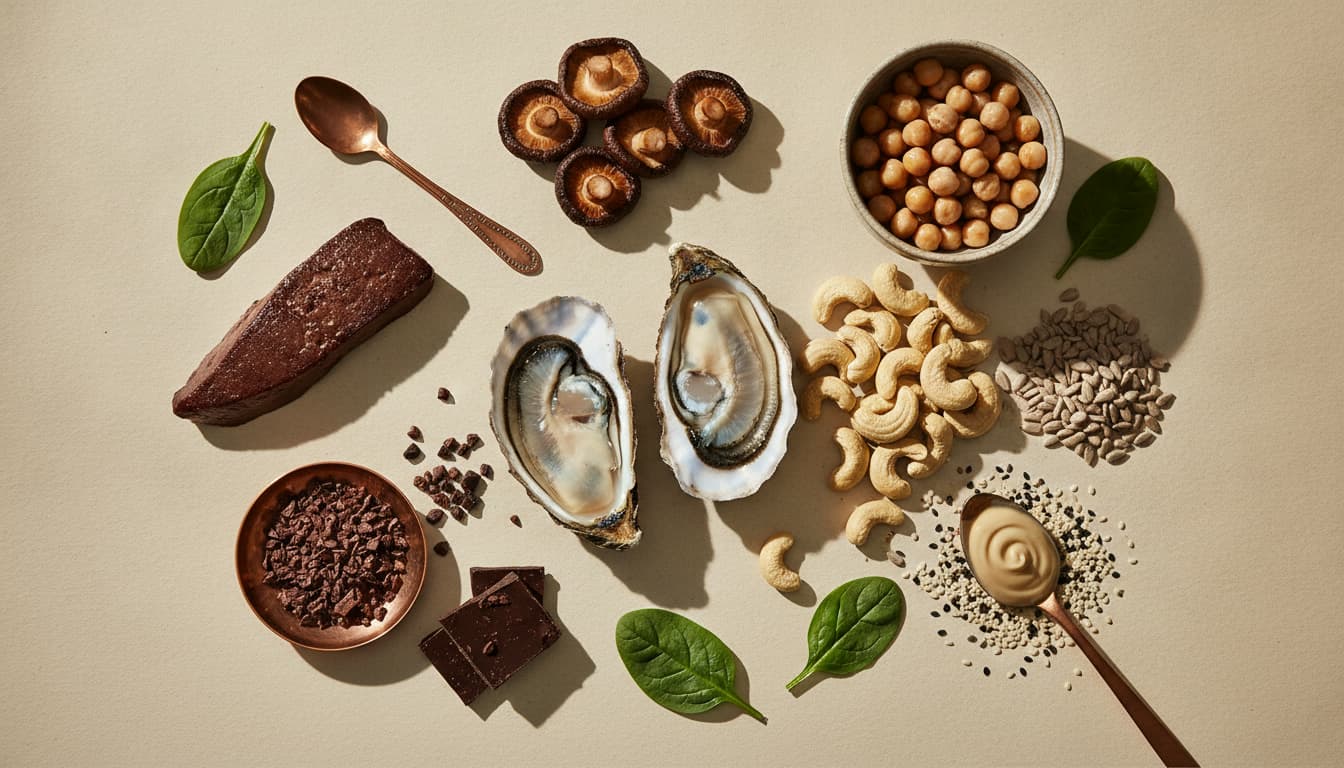
The daily copper target is 900 mcg for adults, and beef liver, oysters, dark chocolate, cashews, and seeds are the densest sources. The mcg-per-serving ranking, why one serving of liver covers a week, and how too much zinc can drain it.
- 01
Beef liver: ~12,000 mcg per 3 oz, the outlier
Beef liver is the single densest source by a wide margin: a 3 oz serving carries roughly 12,000 mcg of copper, more than a week's worth of the 900 mcg target in one sitting (USDA). Liver concentrates copper because it is the body's main storage organ for the mineral in animals, just as it is in humans. This is the rare food where a little goes a very long way, so a serving once or twice a month is a reliable top-up rather than something to eat weekly. The same portion also delivers extreme amounts of vitamin A and B12, which is the other reason to keep liver occasional rather than routine.
- 02
Oysters and shellfish: ~4,850 mcg per 3 oz
Cooked oysters supply ~4,850 mcg of copper per 3 oz, several times the daily target in one modest serving, with Dungeness crab (~624 mcg per 3 oz) and other shellfish contributing usefully further down (USDA; NIH ODS). Shellfish concentrate copper along with zinc, selenium, and iodine, so a serving covers a cluster of trace minerals at once. Oysters in particular carry so much copper that a few of them clear the day comfortably, which makes them the most practical dense source for anyone who does not eat organ meats.
- 03
Nuts and seeds: ~290-630 mcg per ounce
Cashews (~629 mcg per oz) and sunflower seeds (~615 mcg per oz) lead the plant sources, with sesame seeds and tahini, hazelnuts, and almonds (~290 mcg) filling in behind (USDA). An ounce of cashews covers roughly two-thirds of the daily target, which makes a handful of mixed nuts one of the easiest ways to reach the number without animal foods. Seeds and nuts are the backbone of copper intake on a plant-based diet, and because they arrive with magnesium, healthy fats, and plant protein, they do more than one job per serving.
- 04
Shiitake mushrooms and potatoes: ~650-675 mcg per serving
Cooked shiitake mushrooms carry ~650 mcg of copper per half cup, and a medium potato eaten with the skin supplies ~675 mcg, each covering the better part of a day in one ordinary portion (USDA). These are the quiet staples that keep copper intake steady in people who eat neither organ meats nor shellfish. Mushrooms are unusually copper-dense for a vegetable, and potatoes deliver most of their copper in and just under the skin, which is one more reason to leave it on rather than peel it away.
- 05
Dark chocolate and cocoa: ~500-940 mcg per ounce
Cocoa is genuinely copper-rich: an ounce of 70-85% dark chocolate provides ~500 mcg, and unsweetened baking chocolate or cocoa powder reaches ~900-940 mcg per ounce (USDA). This is the rare case where a small amount of a treat food makes a real nutritional contribution, since an ounce of good dark chocolate delivers roughly half to a full day of copper. It is also a large part of why cocoa scores so high in our roundup of foods high in antioxidants, as the same flavanols travel alongside the mineral. The catch is portion: chocolate brings sugar and calories, so it is a bonus source, not a base to build on.
- 06
Legumes and whole grains: ~350-580 mcg per cup
Cooked chickpeas (~578 mcg per cup), lentils (~497 mcg), and other beans, plus whole grains like quinoa, buckwheat, and whole wheat, form the dependable middle of the ranking (USDA). None is a standout on its own, but a cup of legumes covers more than half the daily target and arrives with fiber, potassium, and plant protein, so building meals around beans and intact grains keeps copper topped up as a side effect. This is why plant-forward diets are rarely short on copper as long as they include legumes, nuts, and whole grains rather than refined staples.
- 07
Why zinc, not food, is the real risk
The most common threat to copper status is not a poor diet but high-dose zinc. Zinc and copper compete for absorption, and chronic zinc intake above roughly 40 mg/day, the tolerable upper limit, induces a gut protein called metallothionein that traps copper and blocks it from entering the body (NIH ODS). Long-running use of high-strength zinc lozenges or supplements is the textbook cause of acquired copper deficiency, which shows up as an anemia unresponsive to iron plus a low white-cell count. The fix is not more copper but less supplemental zinc: staying at or below 40 mg/day of zinc from supplements keeps the two minerals in balance and protects copper status.
How this was specified
- 01Inputs measured
- Retail price (dated) · label claim · Certificate of Analysis · third-party test (Informed Sport / NSF / ConsumerLab / Clean Label) · leucine per serving from COA, not marketing.
- 02Protocols tested
- Per-kg target from four literature ranges (IOM RDA, Phillips 2017, Morton 2018, ISSN). Brands scored against Moore 2015 leucine-per-dose threshold (~0.4 g/kg).
- 03Cost-basis verified
- $/gram of protein and $/gram of leucine at warehouse pricing (Costco), mail-order (Amazon), and DTC retail. Re-checked quarterly, flagged when drift exceeds 15%.
- 04Confidence level
- High on ranked order. Medium on absolute $/g (prices drift). Low on serving-size claims where COA is older than 18 months, flagged [VERIFY].
Every claim, cited.
- [01]National Institutes of Health, Office of Dietary Supplements. Copper Fact Sheet for Health Professionals. RDA 900 mcg/day for adults (1,000 mcg pregnancy, 1,300 mcg lactation); upper limit 10,000 mcg/day; food content and the zinc interaction.
- [02]US Department of Agriculture, Agricultural Research Service. FoodData Central. Copper content of beef liver, oysters, cashews, sunflower seeds, shiitake mushrooms, potatoes, dark chocolate, chickpeas, and lentils.
- [03]Bost M, Houdart S, Oberli M, et al. 2016. Dietary copper and human health: Current evidence and unresolved issues. Journal of Trace Elements in Medicine and Biology 35:107-115. Copper enzymes, deficiency, and dietary sources.
- [04]European Food Safety Authority (EFSA). 2015. Scientific Opinion on Dietary Reference Values for copper. Adequate intake 1.6 mg/day for men and 1.3 mg/day for women.
The Larderlab Team builds evidence-led frameworks for eating, lifting, and stocking a kitchen. We cite every claim. We publish the spreadsheet when possible. We buy what we review at retail price. When new data lands, we revise with a dated note.
Next in this hub.
Foods High in Biotin (Vitamin B7): The Densest Sources, by Micrograms
The adequate intake is just 30 mcg a day, and beef liver, eggs, and salmon cover it easily. The mcg-per-serving ranking, why deficiency is rare, why raw egg whites work against you, and why hair-growth megadoses are mostly wasted.
7 min · rev 2026-08-06Foods High in Vitamin K: The Densest Sources, by Micrograms
The adequate intake is 120 mcg/day for men and 90 mcg for women, and cooked leafy greens dominate while fermented natto tops the list. The mcg-per-serving ranking, why K1 and K2 count the same, and what people on blood thinners actually need to do.
8 min · rev 2026-07-27Foods High in Vitamin B12: The Densest Sources, by Micrograms
The RDA is 2.4 mcg/day, and clams, beef liver, and oily fish are the densest sources. The mcg-per-serving ranking, why B12 is almost absent from plant foods, and when vegetarians and vegans need a supplement.
8 min · rev 2026-07-07Get the Larderlab Macro Planner.
A Google Sheet that calculates your protein target, splits it across 3-5 meals, and ranks 20 protein sources by $/gram. Free. Copy-and-modify your own version.
By subscribing, you agree to our Privacy Policy. Unsubscribe anytime.