Foods high in folate, ranked by micrograms
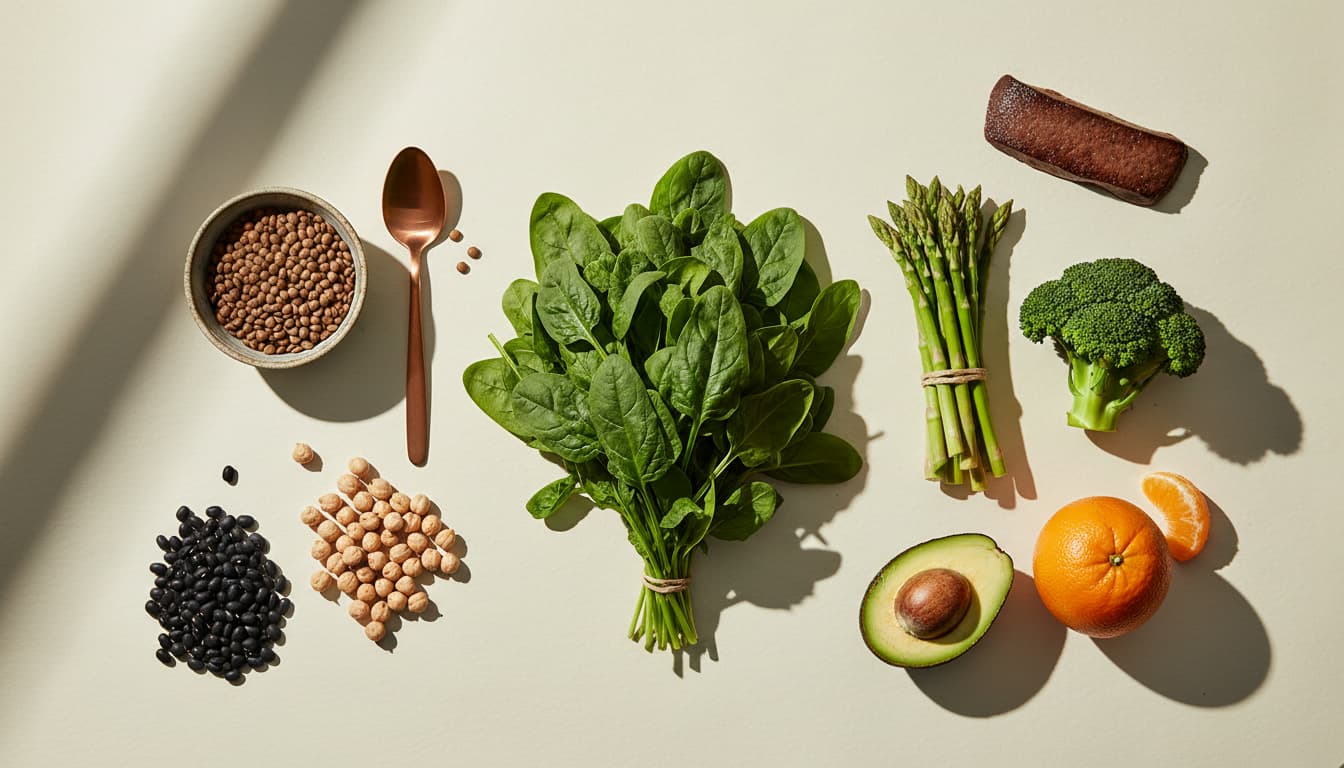
The daily target is 400 mcg for adults and 600 mcg in pregnancy, and lentils, beef liver, leafy greens, and beans are the densest sources. The mcg-per-serving ranking, why cooking destroys folate, and folate versus folic acid.
- 01
Lentils and chickpeas: ~140-180 mcg per half cup
Cooked lentils are the densest everyday source at ~180 mcg of folate per half cup, roughly 45% of the daily target, with chickpeas at ~140 mcg and other beans close behind (USDA; NIH ODS). Legumes are the backbone of folate intake for most of the world and the single best option for plant-based eaters, since they combine high folate with fiber, plant protein, and iron. Unlike leafy greens, the folate in cooked legumes is fairly stable because they are eaten with their cooking liquid absorbed rather than boiled and drained, so little is lost.
- 02
Beef liver: ~215 mcg per 3 oz, the densest animal source
A 3 oz serving of cooked beef liver supplies ~215 mcg of folate, more than half the daily target, making it the densest animal source by a wide margin (USDA; NIH ODS). As with choline and vitamin A, liver is a nutrient standout that few people eat regularly, and pregnant women, the group with the highest folate need, are usually advised to limit it because of its concentrated vitamin A. That tension is exactly why the folate story leans so heavily on legumes and greens: the densest animal source is the one the highest-need group is told to ration.
- 03
Spinach and leafy greens: ~130 mcg per half cup cooked
Cooked spinach delivers ~130 mcg of folate per half cup, with other greens like romaine, mustard greens, and turnip greens in a strong range (USDA; NIH ODS). The word folate comes from the Latin for leaf, and greens earn the name. The catch is fragility: folate is heat- and water-sensitive, so boiling greens and pouring off the water can discard much of it. Steaming briefly, sauteing quickly, or eating tender greens raw in a salad preserves far more, which is why how you cook greens matters almost as much as how much you eat.
- 04
Asparagus, broccoli, and Brussels sprouts: ~50-90 mcg per serving
Four spears of asparagus carry ~89 mcg of folate, half a cup of Brussels sprouts ~78 mcg, and broccoli ~52 mcg, making green vegetables a reliable daily contributor (USDA; NIH ODS). None matches lentils or liver alone, but a normal vegetable serving alongside a bean or grain dish stacks up quickly toward the target. Like leafy greens, these lose folate to prolonged boiling, so steaming or roasting keeps more intact. A plate that pairs a legume with one of these green vegetables covers a large share of the daily requirement in a single meal.
- 05
Avocado, oranges, and fruit: ~30-60 mcg per serving
Half a cup of avocado provides ~59 mcg of folate, a whole orange ~40 mcg, and papaya and other fruit useful amounts (USDA; NIH ODS). Fruit is a smaller contributor than legumes or greens, but it has one advantage: it is usually eaten raw, so none of the folate is lost to cooking. Oranges and orange juice were long a recommended folate source for exactly this reason, and avocado adds monounsaturated fat and fiber alongside. Fruit is the easy fill-in that closes the gap on days when vegetable intake runs low.
- 06
Fortified grains: folic acid, not folate
Fortified breakfast cereals, bread, pasta, and rice supply synthetic folic acid, with fortified cereals ranging from ~100 to 400 mcg DFE per serving (USDA; NIH ODS). In countries that mandate fortification, such as the US, these foods are a major source and were introduced specifically to cut neural tube defects across the population. The distinction matters: this is folic acid, absorbed at close to 85-100%, not the folate found naturally in beans and greens. Fortification is why deficiency became rare in the US, though several European countries, including Germany, do not fortify and rely on diet plus supplements.
- 07
Folate versus folic acid, and why pregnancy is the key case
The two forms are not interchangeable in practice. Food folate is absorbed at roughly 50%, while synthetic folic acid is absorbed at close to 85-100%, which is why supplements and fortified foods are so effective and why the RDA is measured in dietary folate equivalents (NIH ODS). The upper limit of 1,000 mcg/day applies only to folic acid, because high doses can mask the anemia of B12 deficiency. For pregnancy the evidence is unambiguous: 400 mcg of folic acid daily before conception and in early pregnancy prevents most neural tube defects, a benefit food folate alone is less reliable at delivering (US CDC).
How this was specified
- 01Inputs measured
- Retail price (dated) · label claim · Certificate of Analysis · third-party test (Informed Sport / NSF / ConsumerLab / Clean Label) · leucine per serving from COA, not marketing.
- 02Protocols tested
- Per-kg target from four literature ranges (IOM RDA, Phillips 2017, Morton 2018, ISSN). Brands scored against Moore 2015 leucine-per-dose threshold (~0.4 g/kg).
- 03Cost-basis verified
- $/gram of protein and $/gram of leucine at warehouse pricing (Costco), mail-order (Amazon), and DTC retail. Re-checked quarterly, flagged when drift exceeds 15%.
- 04Confidence level
- High on ranked order. Medium on absolute $/g (prices drift). Low on serving-size claims where COA is older than 18 months, flagged [VERIFY].
Every claim, cited.
- [01]National Institutes of Health, Office of Dietary Supplements. Folate Fact Sheet for Health Professionals. RDA 400 mcg DFE/day for adults (600 mcg pregnancy, 500 mcg lactation); upper limit 1,000 mcg/day folic acid; folate versus folic acid absorption; content of lentils, liver, spinach, and asparagus.
- [02]US Department of Agriculture, Agricultural Research Service. FoodData Central. Folate content of lentils, beef liver, chickpeas, spinach, asparagus, broccoli, avocado, and oranges.
- [03]US Centers for Disease Control and Prevention. Folic Acid Recommendations. 400 mcg of folic acid daily for women who could become pregnant to prevent neural tube defects.
- [04]German Nutrition Society (DGE). Referenzwerte fuer die Naehrstoffzufuhr: Folat. Recommended intake 300 mcg folate equivalents/day for adults, 550 mcg in pregnancy; women who could become pregnant advised to take an additional 400 mcg folic acid.
The Larderlab Team builds evidence-led frameworks for eating, lifting, and stocking a kitchen. We cite every claim. We publish the spreadsheet when possible. We buy what we review at retail price. When new data lands, we revise with a dated note.
Next in this hub.
Foods High in Biotin (Vitamin B7): The Densest Sources, by Micrograms
The adequate intake is just 30 mcg a day, and beef liver, eggs, and salmon cover it easily. The mcg-per-serving ranking, why deficiency is rare, why raw egg whites work against you, and why hair-growth megadoses are mostly wasted.
7 min · rev 2026-08-06Foods High in Vitamin K: The Densest Sources, by Micrograms
The adequate intake is 120 mcg/day for men and 90 mcg for women, and cooked leafy greens dominate while fermented natto tops the list. The mcg-per-serving ranking, why K1 and K2 count the same, and what people on blood thinners actually need to do.
8 min · rev 2026-07-27Foods High in Copper: The Densest Sources, by Micrograms
The daily copper target is 900 mcg for adults, and beef liver, oysters, dark chocolate, cashews, and seeds are the densest sources. The mcg-per-serving ranking, why one serving of liver covers a week, and how too much zinc can drain it.
8 min · rev 2026-07-21Get the Larderlab Macro Planner.
A Google Sheet that calculates your protein target, splits it across 3-5 meals, and ranks 20 protein sources by $/gram. Free. Copy-and-modify your own version.
By subscribing, you agree to our Privacy Policy. Unsubscribe anytime.