Does Gatorade have electrolytes, and how many milligrams
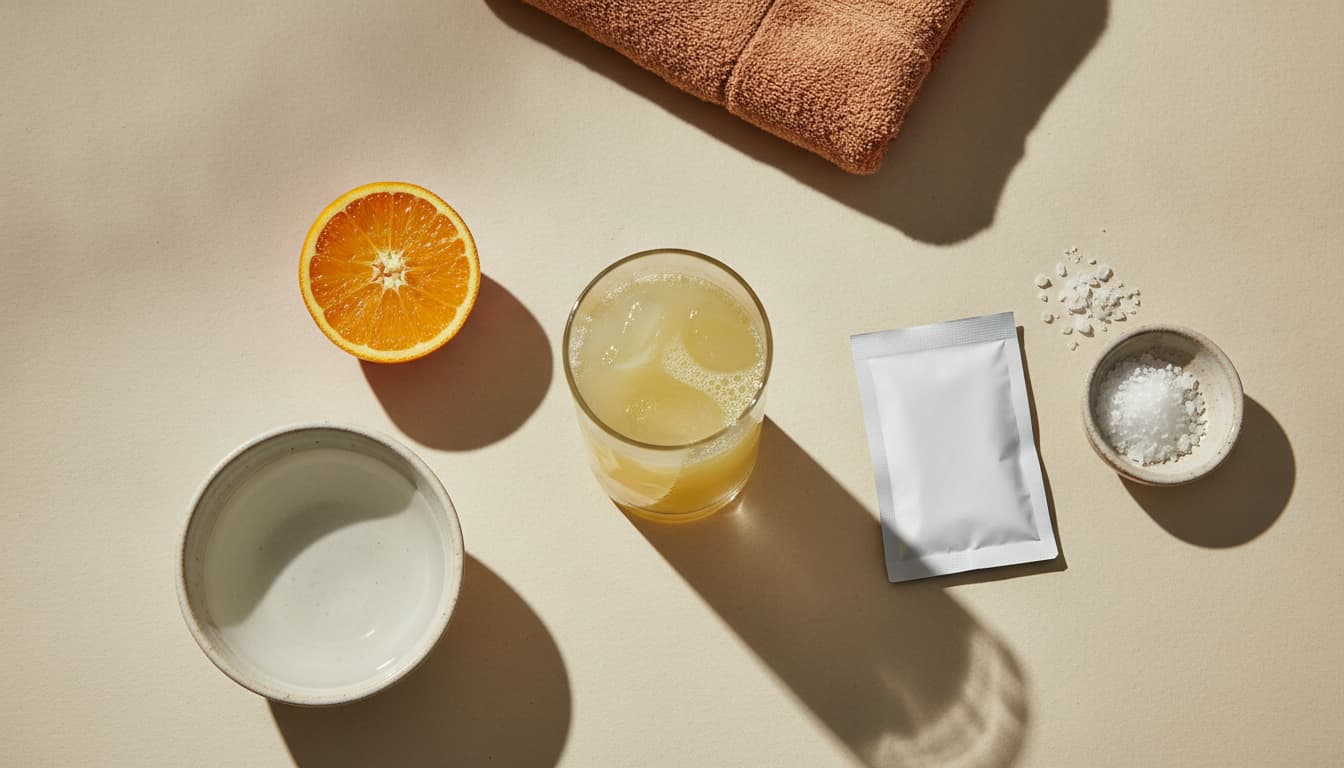
Yes: about 460 mg of sodium and 130 mg of potassium per litre, per USDA branded data. Set against an American football player losing sodium at roughly 1,290 mg an hour, the numbers explain what it is and is not for.
Yes, Gatorade contains electrolytes, specifically sodium and potassium. USDA branded-food data for Gatorade Thirst Quencher lists about 46 mg of sodium and 13 mg of potassium per 100 mL, which works out to roughly 163 mg of sodium, 46 mg of potassium, 21 g of sugar, and 82 kcal in a 12 fl oz (355 mL) serving, and about 272 mg of sodium and 77 mg of potassium in a 20 fl oz bottle. Per litre that is roughly 460 mg of sodium, against roughly 1,725 mg per litre in a WHO oral rehydration solution. It contains no meaningful magnesium or calcium. It is built to be drunk in volume during prolonged exercise, not sipped as a concentrated electrolyte dose.
The answer is yes, and the useful version is the concentration. USDA FoodData Central branded-food entries for Gatorade Thirst Quencher list approximately 46 mg of sodium and 13 mg of potassium per 100 mL, alongside about 5.8 g of sugar and 23 kcal per 100 mL. Scaled to the containers people actually buy, a 12 fl oz (355 mL) serving carries roughly 163 mg of sodium, 46 mg of potassium, 21 g of sugar, and 82 kcal; a 20 fl oz (591 mL) bottle carries roughly 272 mg of sodium, 77 mg of potassium, 34 g of sugar, and 136 kcal; a 28 fl oz (828 mL) bottle carries roughly 381 mg of sodium and 108 mg of potassium. Expressed as a concentration, that is about 460 mg of sodium and 130 mg of potassium per litre. Two comparisons put that number in context. The first is clinical rehydration: the WHO and UNICEF reduced-osmolarity oral rehydration solution is formulated at 75 mmol per litre of sodium and 20 mmol per litre of potassium, which is roughly 1,725 mg of sodium and 780 mg of potassium per litre, about 3.7 times the sodium concentration of the sports drink. That gap is deliberate. Oral rehydration solution is designed to correct an established fluid and electrolyte deficit in illness; a sports drink is designed to be palatable enough to drink a litre or more of during exercise, and dialling the sodium up to clinical concentrations would make that unpleasant. The second comparison is sweat loss. Normative sweat data compiled from 1,303 athletes found whole-body sweating rates highest in American football at 1.51 plus or minus 0.70 litres per hour and endurance athletes at 1.28 plus or minus 0.57 litres per hour, with rates of sweat sodium loss of 55.9 plus or minus 36.8 mmol per hour in American football and 51.7 plus or minus 27.8 mmol per hour in endurance, against 34.6 in soccer, 34.5 in basketball, and 27.2 in baseball (Barnes et al. 2019). Converting the football figure, that is roughly 1,290 mg of sodium lost per hour, so a full litre of Gatorade replaces around a third of one hour's sodium loss for an athlete at the top of that range. That is the honest frame: the drink genuinely contains electrolytes and genuinely is not a high-concentration replacement product. The American College of Sports Medicine position stand makes the same point structurally, recommending customised fluid replacement programmes because sweating rates and sweat electrolyte content vary considerably between individuals, and setting the goal of drinking during exercise as preventing more than 2 percent body-weight loss from water deficit rather than matching any fixed formula (Sawka et al. 2007). The sugar is the other half of the product and is not incidental: carbohydrate co-transported with sodium speeds water absorption in the small intestine, which is why oral rehydration solutions contain glucose too. For someone exercising hard for over an hour that carbohydrate is a feature. For someone sipping it at a desk, 34 g of sugar for 272 mg of sodium is an expensive way to obtain a mineral that a quarter teaspoon of table salt supplies at roughly 590 mg. The lower-sugar lines keep the electrolytes: USDA lists a G2 entry at about 45 mg of sodium and 12 mg of potassium per 100 mL with roughly 2 g of sugar. The electrolyte powders comparison on this site ranks products by cost per serving, and the guide to what electrolytes are covers what each mineral does.
The differences that are measurable.
- 01
The numbers: about 163 mg sodium and 46 mg potassium per 12 fl oz
USDA FoodData Central branded-food data for Gatorade Thirst Quencher lists approximately 46 mg of sodium and 13 mg of potassium per 100 mL, with about 5.8 g of sugar and 23 kcal per 100 mL. Scaled up: a 12 fl oz (355 mL) serving carries roughly 163 mg of sodium, 46 mg of potassium, 21 g of sugar, and 82 kcal. A 20 fl oz bottle carries roughly 272 mg of sodium, 77 mg of potassium, 34 g of sugar, and 136 kcal. A 28 fl oz bottle carries roughly 381 mg of sodium and 108 mg of potassium.
- 02
Two electrolytes, not five: no meaningful magnesium or calcium
Sports drinks in this category are sodium and potassium products. Magnesium and calcium, which are also electrolytes and are prominent in supplement marketing, are not present in quantities that matter here. That is a defensible formulation choice rather than an omission, because sweat sodium losses are large while sweat potassium losses are small and sweat magnesium and calcium losses are smaller still. It does mean that anyone buying a sports drink expecting a broad mineral profile is buying something narrower than the label imagery suggests.
- 03
Against clinical rehydration: about 460 mg per litre versus 1,725
Expressed as a concentration, Gatorade carries roughly 460 mg of sodium and 130 mg of potassium per litre. The WHO and UNICEF reduced-osmolarity oral rehydration solution is formulated at 75 mmol per litre of sodium and 20 mmol per litre of potassium, roughly 1,725 mg and 780 mg per litre, about 3.7 times the sodium. The gap is deliberate. Oral rehydration solution corrects an established deficit in illness; a sports drink has to stay palatable enough to consume a litre or more of during exercise, and clinical sodium concentrations would not be.
- 04
Against sweat loss: roughly a third of one hour for a heavy sweater
Normative data compiled from 1,303 athletes found whole-body sweating rates of 1.51 plus or minus 0.70 L/h in American football and 1.28 plus or minus 0.57 L/h in endurance sport, with sweat sodium loss rates of 55.9 plus or minus 36.8 mmol/h and 51.7 plus or minus 27.8 mmol/h respectively, against 34.6 in soccer, 34.5 in basketball, and 27.2 in baseball (Barnes et al. 2019). The football figure converts to roughly 1,290 mg of sodium per hour, so a full litre of Gatorade replaces around a third of that hour's loss.
- 05
The sugar is functional during exercise and expensive outside it
The 21 g of sugar in a 12 fl oz serving is not incidental. Glucose co-transported with sodium in the small intestine speeds the absorption of both water and sodium, which is why oral rehydration solutions include glucose by design. During prolonged hard exercise that carbohydrate is a feature, supplying fuel as well as aiding absorption. Outside that context the trade changes: 34 g of sugar in a 20 fl oz bottle to obtain 272 mg of sodium is an inefficient purchase when a quarter teaspoon of table salt supplies roughly 590 mg with no sugar at all.
- 06
When a sports drink actually earns its place
The American College of Sports Medicine position stand recommends customised fluid replacement because sweating rates and sweat electrolyte content vary considerably between individuals, sets the goal of drinking during exercise as preventing more than 2 percent body-weight loss from water deficit, and notes that beverages containing electrolytes and carbohydrate can offer benefits over water alone under certain circumstances (Sawka et al. 2007). Those circumstances are the case for the product: continuous exercise beyond about an hour, heat, and a high sweat rate. Sipped at a desk, it is sugar water with a modest amount of salt.
How this was specified
- 01Inputs measured
- Retail price (dated) · label claim · Certificate of Analysis · third-party test (Informed Sport / NSF / ConsumerLab / Clean Label) · leucine per serving from COA, not marketing.
- 02Protocols tested
- Per-kg target from four literature ranges (IOM RDA, Phillips 2017, Morton 2018, ISSN). Brands scored against Moore 2015 leucine-per-dose threshold (~0.4 g/kg).
- 03Cost-basis verified
- $/gram of protein and $/gram of leucine at warehouse pricing (Costco), mail-order (Amazon), and DTC retail. Re-checked quarterly, flagged when drift exceeds 15%.
- 04Confidence level
- High on ranked order. Medium on absolute $/g (prices drift). Low on serving-size claims where COA is older than 18 months, flagged [VERIFY].
What people ask us most.
- Does Gatorade have electrolytes?
- Yes, sodium and potassium. USDA branded-food data for Gatorade Thirst Quencher lists approximately 46 mg of sodium and 13 mg of potassium per 100 mL, which works out to roughly 163 mg of sodium and 46 mg of potassium in a 12 fl oz serving, or about 272 mg and 77 mg in a 20 fl oz bottle. It does not contain meaningful magnesium or calcium, so it is a two-electrolyte product rather than the broad mineral formula the category imagery often implies.
- How much sodium is in a bottle of Gatorade?
- Roughly 272 mg in a 20 fl oz (591 mL) bottle and roughly 381 mg in a 28 fl oz (828 mL) bottle, based on USDA branded-food data listing about 46 mg of sodium per 100 mL. Expressed as a concentration that is about 460 mg per litre. For comparison, a quarter teaspoon of table salt supplies roughly 590 mg of sodium, more than a whole 20 fl oz bottle, which is worth knowing if sodium replacement is the actual goal.
- Is Gatorade as good as an oral rehydration solution?
- Not for correcting an established deficit. The WHO and UNICEF reduced-osmolarity oral rehydration solution is formulated at 75 mmol per litre of sodium and 20 mmol per litre of potassium, roughly 1,725 mg and 780 mg per litre, about 3.7 times the sodium concentration of a sports drink. The difference is by design: oral rehydration solution treats illness-related fluid and electrolyte loss, while a sports drink is formulated to stay palatable enough to drink in volume during exercise.
- Does Gatorade replace what you lose in sweat?
- Only partially, and it depends heavily on sweat rate. Normative data from 1,303 athletes found sweat sodium loss rates of 55.9 plus or minus 36.8 mmol per hour in American football and 51.7 plus or minus 27.8 in endurance sport, against 34.6 in soccer and 27.2 in baseball (Barnes et al. 2019). The football figure converts to roughly 1,290 mg of sodium an hour, so a full litre of Gatorade, at about 460 mg of sodium, replaces around a third of one hour's loss at the top of that range.
- Do I need a sports drink if I am not exercising hard?
- For ordinary daily activity, no. The American College of Sports Medicine position stand frames the goal of drinking during exercise as preventing more than 2 percent body-weight loss from water deficit and notes that electrolyte- and carbohydrate-containing beverages offer benefits over water alone only under certain circumstances (Sawka et al. 2007). Those circumstances are continuous exercise beyond about an hour, heat, and a high sweat rate. Outside them, water plus normally salted food covers it.
- Do zero-sugar versions still contain electrolytes?
- Yes, at similar concentrations. USDA branded data for a lower-sugar G2 entry lists about 45 mg of sodium and 12 mg of potassium per 100 mL with roughly 2 g of sugar, so the electrolyte content is essentially unchanged while the carbohydrate is cut. That is the right trade outside of exercise, but during prolonged hard exercise the sugar is doing real work, since glucose co-transported with sodium speeds absorption of both water and sodium in the small intestine.
A published Certificate of Analysis from a ranked brand that contradicts the label claim we scored against. An independent lab result (Clean Label, ConsumerLab) finding heavy-metal or amino-spiking failures on a current top pick. A peer-reviewed meta-analysis that shifts the leucine-per-dose threshold. Any of those triggers a dated revision within a week.
Every claim, cited.
- [01]USDA FoodData Central, branded foods: Gatorade Thirst Quencher (Pepsico Inc.), approximately 46 mg sodium, 13 mg potassium, 5.81 g sugar and 23 kcal per 100 mL; G2 Thirst Quencher approximately 45 mg sodium and 12 mg potassium per 100 mL.
- [02]WHO and UNICEF joint statement: Clinical Management of Acute Diarrhoea. Reduced-osmolarity oral rehydration salts formulation, 75 mmol/L sodium and 20 mmol/L potassium.
- [03]Barnes KA, Anderson ML, Stofan JR, et al. 2019. Normative data for sweating rate, sweat sodium concentration, and sweat sodium loss in athletes: an update and analysis by sport. J Sports Sci 37(20):2356-2366. n=1,303; sweat sodium loss 55.9 mmol/h in American football.
- [04]American College of Sports Medicine, Sawka MN, Burke LM, et al. 2007. ACSM position stand: exercise and fluid replacement. Med Sci Sports Exerc 39(2):377-90. Customised replacement, the 2 percent body-weight-loss threshold, and when electrolyte-carbohydrate beverages beat water.
- [05]NIH Office of Dietary Supplements: Potassium Fact Sheet for Health Professionals. Reference intakes used to frame the potassium figures here.
The Larderlab Team builds evidence-led frameworks for eating, lifting, and stocking a kitchen. We cite every claim. We publish the spreadsheet when possible. We buy what we review at retail price. When new data lands, we revise with a dated note.
Next in this hub.
What Are Electrolytes? The Minerals, the Roles, and the Dose
Electrolytes are charged minerals, sodium, potassium, magnesium, chloride, that run hydration, nerve signaling, and muscle contraction. What they do and how much you need.
8 min · rev 2026-06-28How to Get Electrolytes: Food, DIY Drinks, and When You Need More
Most people get enough electrolytes from food; you only need extra with heavy sweating, illness, low-carb diets, or fasting. The food sources, a DIY drink recipe with real numbers, and when a powder is worth it.
8 min · rev 2026-07-16Best Electrolyte Powders, 2026: Ranked by $/mg of Sodium
Eight electrolyte powders ranked on cost-per-mg of sodium, the actual ingredient most consumers under-dose. LMNT, Liquid IV, Re-Lyte, and 5 alternatives, with the failure modes nobody publishes.
11 min · rev 2026-04-29Get the Larderlab Macro Planner.
A Google Sheet that calculates your protein target, splits it across 3-5 meals, and ranks 20 protein sources by $/gram. Free. Copy-and-modify your own version.
By subscribing, you agree to our Privacy Policy. Unsubscribe anytime.