Does creatine make you gain weight, and what kind of weight
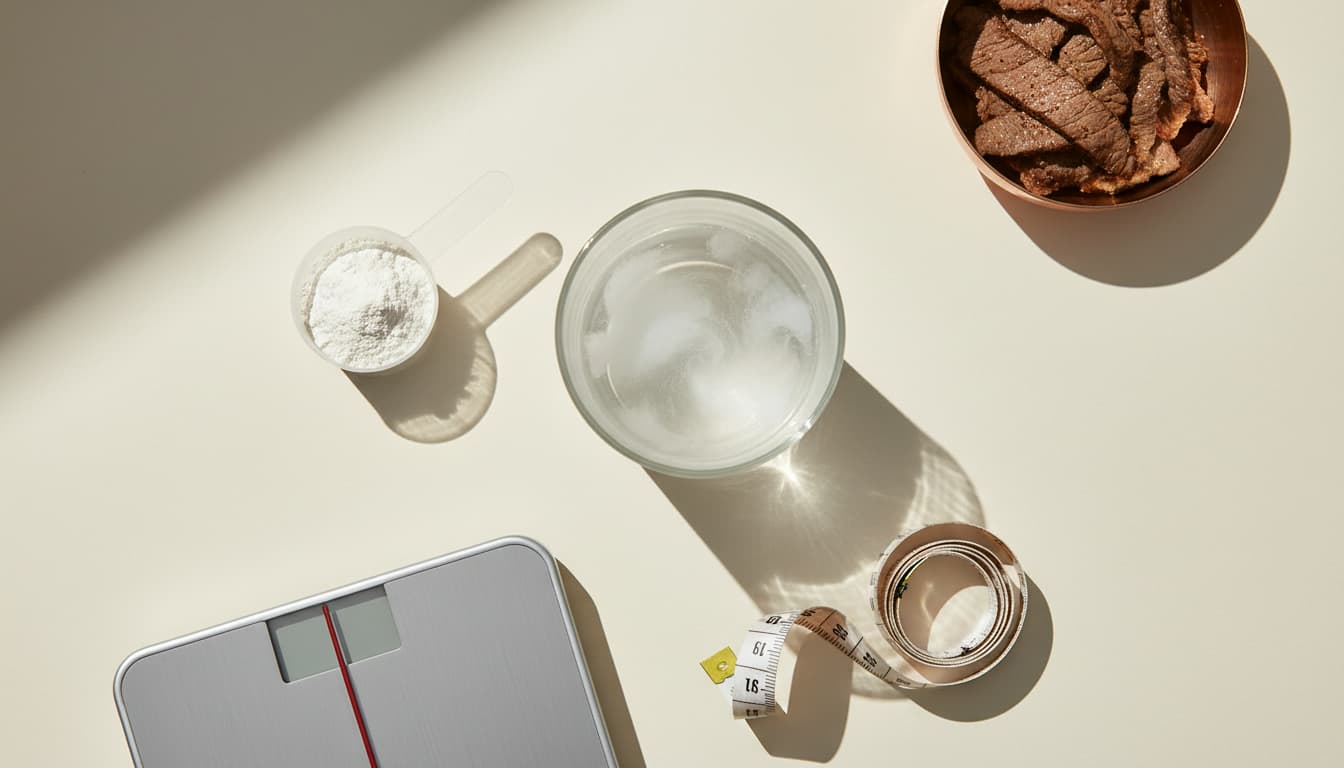
Yes, the scale moves, by about 0.86 kg pooled across 143 trials. It is intracellular water and lean tissue, not fat, and pooled data show body fat percentage going slightly down. The numbers, and how to blunt the jump.
- 01
The pooled number: 0.86 kg body mass, 0.82 kg of it fat-free
A GRADE-assessed systematic review and dose-response meta-analysis of 143 randomised controlled trials found creatine increased body mass by 0.86 kg (95% CI 0.76 to 0.96) and fat-free mass by 0.82 kg (95% CI 0.57 to 1.06), while reducing body fat percentage by 0.28 points (Pashayee-Khamene et al. 2024). Those figures sit almost on top of each other, which is the whole answer: the scale gain and the fat-free gain are effectively the same gain. Effects were larger when creatine was combined with resistance training and when a maintenance dose was used.
- 02
The early gain is water, and it goes inside muscle cells
Creatine is stored as phosphocreatine and is osmotically active, so saturating muscle draws water in with it. A controlled trial measured this directly with deuterium oxide and sodium bromide dilution in 32 resistance-trained men and women across a 7-day load at 25 g a day and 21 days at 5 g a day, and found creatine raised muscle creatine, body mass, and total body water without altering the intracellular-to-extracellular water ratio (Powers et al. 2003). Water added inside muscle is what makes muscle look fuller, and it is not the subcutaneous fluid that produces a puffy appearance.
- 03
None of it is fat, and the pooled data point the other way
Creatine at 3 to 5 g a day supplies a negligible number of calories, so there is no energetic mechanism by which it could add fat tissue. The pooled evidence goes further: a meta-analysis of 12 trials in 266 adults under 50 found resistance exercise plus creatine reduced body fat percentage by 1.19 points versus resistance exercise plus placebo (p=0.006), with no significant change in absolute fat mass (Candow et al. 2023). The percentage falls chiefly because the denominator, total body mass, gains lean tissue while fat mass holds steady.
- 04
Over a training block, the gain becomes actual muscle
Beyond the first weeks of water, creatine plus resistance training adds lean tissue that training alone does not. A meta-analysis of 22 randomised trials in 721 adults with a mean age of 57 to 70 across studies found 1.37 kg more lean tissue mass (95% CI 0.97 to 1.76) with creatine, plus greater chest press and leg press strength (Chilibeck et al. 2017), and earlier pooled work in younger trainees found the same direction for body composition and performance (Branch 2003). The mechanism is more training volume at higher intensity, not a direct anabolic effect of the molecule.
- 05
How to blunt the scale jump: skip the loading phase
The size and speed of the early water gain is set by the protocol. Loading with 20 g a day for six days raises muscle total creatine by about 20 percent, and a similar but more gradual 20 percent increase is reached with 3 g a day over 28 days (Hultman et al. 1996). The saturation endpoint is the same; only the speed differs. Taking 3 to 5 g a day from the start spreads the water shift over a month instead of a week, produces a smaller day-to-day scale change, and causes less gastrointestinal upset. Loading is worth it only when the effect is needed inside a week.
- 06
Who should actually factor the weight in, and what happens on stopping
For most people the gain is either irrelevant or desirable. It genuinely matters in two situations: weight-class sports, where 1 to 2 kg can move a competitor out of a bracket, and any context where a scale number is being tracked as a proxy for fat loss, because a stalled scale during the first weeks of creatine can hide real fat loss. Both are solved by measuring waist circumference or body composition rather than body mass alone. The change is reversible: muscle creatine returns to baseline about 30 days after stopping supplementation (Hultman et al. 1996), and the associated water leaves with it.
What people ask us next.
- Does creatine make you gain weight?
- Yes, but almost all of it is fat-free mass. Pooled across 143 randomised trials, creatine increased body mass by 0.86 kg (95% CI 0.76 to 0.96) and fat-free mass by 0.82 kg (95% CI 0.57 to 1.06), while body fat percentage fell by 0.28 points (Pashayee-Khamene et al. 2024). The first weeks of gain are intracellular water drawn into muscle by osmosis; over a training block the gain shifts toward actual lean tissue. There is no mechanism by which creatine adds fat.
- How much weight will I gain on creatine, and how fast?
- Expect roughly 1 to 2 kg in the first week if you load with 20 g a day, or a smaller, slower change spread over about a month at 3 to 5 g a day. The difference is speed, not endpoint: 20 g a day for six days and 3 g a day for 28 days both raise muscle total creatine by about 20 percent (Hultman et al. 1996). The pooled long-run figure across 143 trials is 0.86 kg of body mass (Pashayee-Khamene et al. 2024).
- Is creatine weight gain water or muscle?
- Both, in that order. The first weeks are intracellular water: creatine is osmotically active, so loading muscle pulls water in with it. A trial measuring fluid compartments with deuterium oxide and sodium bromide dilution in 32 trainees found creatine raised total body water without changing the intracellular-to-extracellular ratio (Powers et al. 2003). Over a training block the gain becomes lean tissue, with meta-analyses reporting greater lean mass than training alone (Chilibeck et al. 2017).
- Does creatine make you look bloated or puffy?
- The evidence does not support that. The water creatine draws in goes inside muscle cells rather than into the subcutaneous space that produces a puffy appearance, and a controlled trial measuring the compartments directly found total body water rose with no shift in the intracellular-to-extracellular ratio (Powers et al. 2003). The visible effect of more intracellular water in muscle is fuller-looking muscle. Gastrointestinal bloating during a 20 g loading phase is a separate and avoidable issue that disappears without loading.
- Does creatine make you gain fat?
- No. A 3 to 5 g daily dose contributes a negligible number of calories, so there is no energetic route to fat gain. Pooled data run the other way: 143 trials found body fat percentage fell by 0.28 points with creatine (Pashayee-Khamene et al. 2024), and a meta-analysis of 12 trials in 266 adults under 50 found resistance exercise plus creatine reduced body fat percentage by 1.19 points versus exercise plus placebo, with no significant change in absolute fat mass (Candow et al. 2023).
- Will I lose the weight if I stop taking creatine?
- The water portion, yes. Muscle total creatine declines gradually after stopping and returns to the pre-supplementation concentration about 30 days later, with urinary creatinine excretion rising correspondingly during that period (Hultman et al. 1996). The associated intracellular water leaves with it. Lean tissue built through training while supplemented is not water and does not disappear on stopping, provided training continues.
Every claim, cited.
- [01]Pashayee-Khamene F, Heidari Z, Asbaghi O, et al. 2024. Creatine supplementation protocols with or without training interventions on body composition: a GRADE-assessed systematic review and dose-response meta-analysis. J Int Soc Sports Nutr 21(1):2380058. 143 RCTs; body mass +0.86 kg, fat-free mass +0.82 kg, body fat -0.28%.
- [02]Powers ME, Arnold BL, Weltman AL, et al. 2003. Creatine supplementation increases total body water without altering fluid distribution. J Athl Train 38(1):44-50. n=32; deuterium oxide and sodium bromide dilution.
- [03]Candow DG, Prokopidis K, Forbes SC, et al. 2023. Resistance exercise and creatine supplementation on fat mass in adults under 50 years of age: a systematic review and meta-analysis. Nutrients 15(20). 12 studies, n=266; body fat -1.19%, absolute fat mass unchanged.
- [04]Hultman E, Soderlund K, Timmons JA, et al. 1996. Muscle creatine loading in men. J Appl Physiol 81(1):232-7. 20 g/day for 6 days and 3 g/day for 28 days both raise muscle total creatine ~20%; washout ~30 days.
- [05]Chilibeck PD, Kaviani M, Candow DG, Zello GA. 2017. Effect of creatine supplementation during resistance training on lean tissue mass and muscular strength in older adults: a meta-analysis. Open Access J Sports Med 8:213-226. 22 studies, n=721; lean tissue +1.37 kg.
- [06]Branch JD. 2003. Effect of creatine supplementation on body composition and performance: a meta-analysis. Int J Sport Nutr Exerc Metab 13(2):198-226.
- [07]Kreider RB, Kalman DS, Antonio J, et al. 2017. ISSN position stand: safety and efficacy of creatine supplementation in exercise, sport, and medicine. J Int Soc Sports Nutr 14:18.
The Larderlab Team builds evidence-led frameworks for eating, lifting, and stocking a kitchen. We cite every claim. We publish the spreadsheet when possible. We buy what we review at retail price. When new data lands, we revise with a dated note.
Next in this hub.
Best Creatine Monohydrate, Ranked by $/gram
Creapure-certified creatine ranked by $/gram, with third-party testing status and brand transparency.
10 min · rev 2026-04-21Creatine for the Brain: Who the Cognitive Data Actually Applies To
Across six randomised trials in 281 people, short-term memory and reasoning improved but performance was unchanged in young individuals, and vegetarians outperformed meat-eaters on memory tasks. The subgroup effect, and the dosing catch.
8 min · rev 2026-08-26Creatine for Women: What the Evidence Shows, and the Dose
Women hold 70 to 80 percent lower endogenous creatine stores than men, and the dose is the same 3 to 5 g a day. Strength, lean mass, bone, mood, and what the evidence does and does not support across the lifespan.
8 min · rev 2026-08-20Get the Larderlab Macro Planner.
A Google Sheet that calculates your protein target, splits it across 3-5 meals, and ranks 20 protein sources by $/gram. Free. Copy-and-modify your own version.
By subscribing, you agree to our Privacy Policy. Unsubscribe anytime.