What creatine does for women, by the evidence
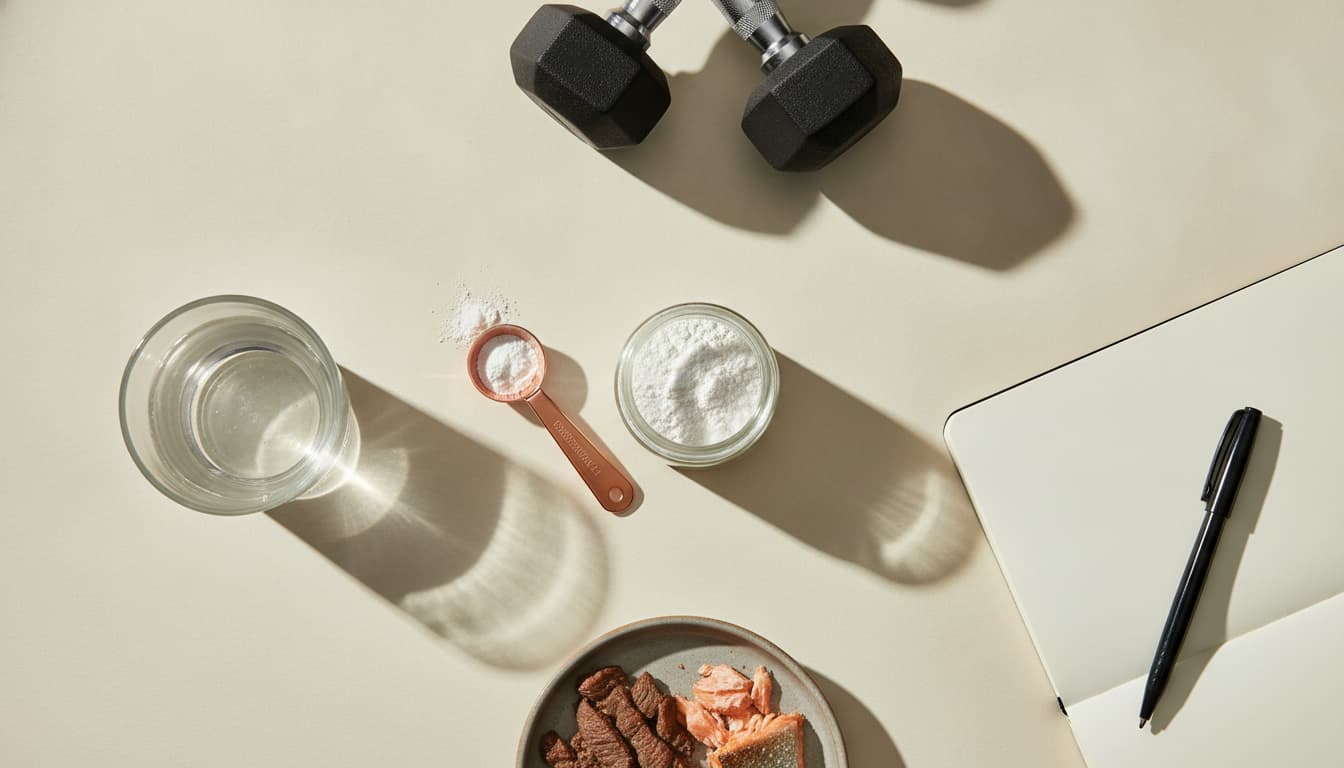
Women hold 70 to 80 percent lower endogenous creatine stores than men, and the dose is the same 3 to 5 g a day. Strength, lean mass, bone, mood, and what the evidence does and does not support across the lifespan.
- 01
The baseline gap: 70 to 80 percent lower endogenous stores
A lifespan review of creatine in women's health reports that females exhibit 70 to 80 percent lower endogenous creatine stores than males, and that creatine kinetics and phosphocreatine resynthesis shift with the hormonal environment (Smith-Ryan et al. 2021). Dietary creatine comes almost entirely from meat and fish, so lower intake of both compounds the gap. A lower starting pool is the mechanistic argument for supplementation mattering more, not less, in women, though it is a rationale rather than a demonstrated larger effect size.
- 02
Pre-menopause: strength and exercise performance
The same review concludes that creatine supplementation among pre-menopausal females appears effective for improving strength and exercise performance (Smith-Ryan et al. 2021). The mechanism is not sex-specific: creatine expands the phosphocreatine pool that regenerates ATP during short, high-intensity efforts, which permits more quality repetitions per session, and the adaptation follows from the accumulated training rather than from the compound itself. This is why creatine reliably outperforms placebo when it accompanies a training programme and does little on its own.
- 03
Post-menopause: the higher dose, and the bone caveat
For post-menopausal women the review reports benefits in skeletal muscle size and function at higher intakes around 0.3 g per kg per day, and favorable effects on bone when creatine is combined with resistance training (Smith-Ryan et al. 2021). The conditional is the important part: bone outcomes are tied to the training, not to the powder. Supporting the direction, a meta-analysis of 22 trials in 721 older adults found 1.37 kg more lean tissue mass with creatine during resistance training, plus greater upper and lower body strength (Chilibeck et al. 2017).
- 04
The scale change is water and lean tissue, not fat
The most common reason women stop creatine is the early scale movement, and the pooled numbers settle it. Across 143 randomised trials creatine raised body mass by 0.86 kg (95% CI 0.76 to 0.96) while fat-free mass rose 0.82 kg and body fat percentage fell 0.28 points (Pashayee-Khamene et al. 2024). A trial that measured fluid compartments with deuterium oxide and sodium bromide dilution found the early gain is total body water added without altering the intracellular-to-extracellular ratio, meaning the water sits inside muscle cells rather than under the skin (Powers et al. 2003).
- 05
Mood and cognition: promising, and still preliminary
The lifespan review notes pre-clinical and clinical evidence for positive effects of creatine on mood and cognition, possibly by restoring brain energy levels and homeostasis, and raises the possibility that this route is particularly relevant in females (Smith-Ryan et al. 2021). The brain is an energetically expensive organ that also uses the phosphocreatine system, so the mechanism is coherent. The evidence base, however, is small and heterogeneous, and this belongs in the column of reasonable hypotheses rather than established outcomes.
- 06
The dose and form: nothing sex-specific to buy
The everyday dose is 3 to 5 g a day of plain creatine monohydrate, taken daily, with no loading phase required, and there is no evidence supporting a sex-specific dose for general use. Skipping the load spreads the water shift over about a month rather than a week. Monohydrate is the form with the evidence behind it; HCl, buffered, and liquid versions cost more without a demonstrated advantage. Pregnancy and the post-partum period are flagged in the review as periods of interest, but human trial evidence is lacking, so that decision belongs with a clinician.
What people ask us next.
- What does creatine do for women?
- The same thing it does for men, from a lower starting point. A lifespan review reports that females exhibit 70 to 80 percent lower endogenous creatine stores than males, and concludes that supplementation in pre-menopausal women appears effective for improving strength and exercise performance, while post-menopausal women show benefits in skeletal muscle size and function at higher intakes around 0.3 g per kg per day, plus favorable bone effects when combined with resistance training (Smith-Ryan et al. 2021).
- How much creatine should a woman take?
- 3 to 5 g a day of plain creatine monohydrate, taken daily, with no loading phase required. There is no evidence for a sex-specific dose in general use. The one exception noted in the literature is post-menopausal muscle and bone outcomes, where the reviewed benefits came from higher intakes around 0.3 g per kg per day combined with resistance training (Smith-Ryan et al. 2021), which is a substantially larger dose and a decision worth taking with a clinician.
- Will creatine make a woman look bulky or gain fat?
- No on fat, and the bulk concern misreads the mechanism. Pooled across 143 randomised trials creatine raised body mass by 0.86 kg while fat-free mass rose 0.82 kg and body fat percentage fell 0.28 points (Pashayee-Khamene et al. 2024). The early gain is water drawn inside muscle cells, with a trial measuring the compartments directly finding no shift in the intracellular-to-extracellular ratio (Powers et al. 2003). Muscle gained afterwards comes from the training programme, at whatever rate that programme produces.
- Is creatine useful for women after menopause?
- That is where the case is arguably strongest. The lifespan review reports benefits in skeletal muscle size and function at intakes around 0.3 g per kg per day, and favorable effects on bone when creatine is combined with resistance training rather than taken alone (Smith-Ryan et al. 2021). A meta-analysis of 22 randomised trials in 721 older adults found 1.37 kg more lean tissue mass and greater chest press and leg press strength when creatine accompanied resistance training (Chilibeck et al. 2017).
- Does the menstrual cycle change how creatine works?
- Possibly, and the evidence is preliminary. The lifespan review notes that creatine kinetics and phosphocreatine resynthesis vary with the hormonal environment, which is why supplementation may be particularly relevant during menses, pregnancy, the post-partum period, and around menopause (Smith-Ryan et al. 2021). That is a mechanistic observation rather than a dosing instruction, and there is no evidence supporting cycling the dose by cycle phase. Daily, consistent intake remains the protocol with evidence behind it.
- Is creatine safe for women to take long term?
- In healthy adults the safety record is strong. Across a large body of trials, including studies running beyond four years, creatine monohydrate at 3 to 5 g a day shows no adverse renal, hepatic, or cardiovascular effects in healthy people (Kreider et al. 2017). The reproducible effect is intracellular water in the first weeks. Pregnancy and breastfeeding are the gap: the lifespan review flags them as periods of interest but human trial evidence is lacking, so that decision belongs with a clinician.
Every claim, cited.
- [01]Smith-Ryan AE, Cabre HE, Eckerson JM, Candow DG. 2021. Creatine supplementation in women's health: a lifespan perspective. Nutrients 13(3). Reports 70-80% lower endogenous creatine stores in females; pre- and post-menopausal outcomes and the 0.3 g/kg/day figure.
- [02]Chilibeck PD, Kaviani M, Candow DG, Zello GA. 2017. Effect of creatine supplementation during resistance training on lean tissue mass and muscular strength in older adults: a meta-analysis. Open Access J Sports Med 8:213-226. 22 studies, n=721; lean tissue +1.37 kg.
- [03]Pashayee-Khamene F, Heidari Z, Asbaghi O, et al. 2024. Creatine supplementation protocols with or without training interventions on body composition: a GRADE-assessed systematic review and dose-response meta-analysis. J Int Soc Sports Nutr 21(1):2380058.
- [04]Powers ME, Arnold BL, Weltman AL, et al. 2003. Creatine supplementation increases total body water without altering fluid distribution. J Athl Train 38(1):44-50.
- [05]Kreider RB, Kalman DS, Antonio J, et al. 2017. ISSN position stand: safety and efficacy of creatine supplementation in exercise, sport, and medicine. J Int Soc Sports Nutr 14:18.
The Larderlab Team builds evidence-led frameworks for eating, lifting, and stocking a kitchen. We cite every claim. We publish the spreadsheet when possible. We buy what we review at retail price. When new data lands, we revise with a dated note.
Next in this hub.
Does Creatine Cause Hair Loss? What the Evidence Actually Shows
The hair-loss claim rests on one 2009 study that measured DHT, not hair, and has never been replicated in 15+ years. What the trials show, the mechanism, and who is actually at risk.
8 min · rev 2026-06-30What Does Creatine Do? The Mechanism, Effects, and Dose
Creatine recycles ATP for short, hard efforts: ~1-2 kg muscle, ~5-15% more reps, and emerging cognitive effects. What it does, how fast, and at what dose.
9 min · rev 2026-06-25How Much Creatine Should I Take? The Dose, by Bodyweight
The evidence-backed dose is 3-5 g/day of creatine monohydrate, every day. Loading (20 g/day for 5-7 days) is optional. The dose by bodyweight, plus when to load.
8 min · rev 2026-06-28Get the Larderlab Macro Planner.
A Google Sheet that calculates your protein target, splits it across 3-5 meals, and ranks 20 protein sources by $/gram. Free. Copy-and-modify your own version.
By subscribing, you agree to our Privacy Policy. Unsubscribe anytime.