Whey vs plant protein, by the evidence
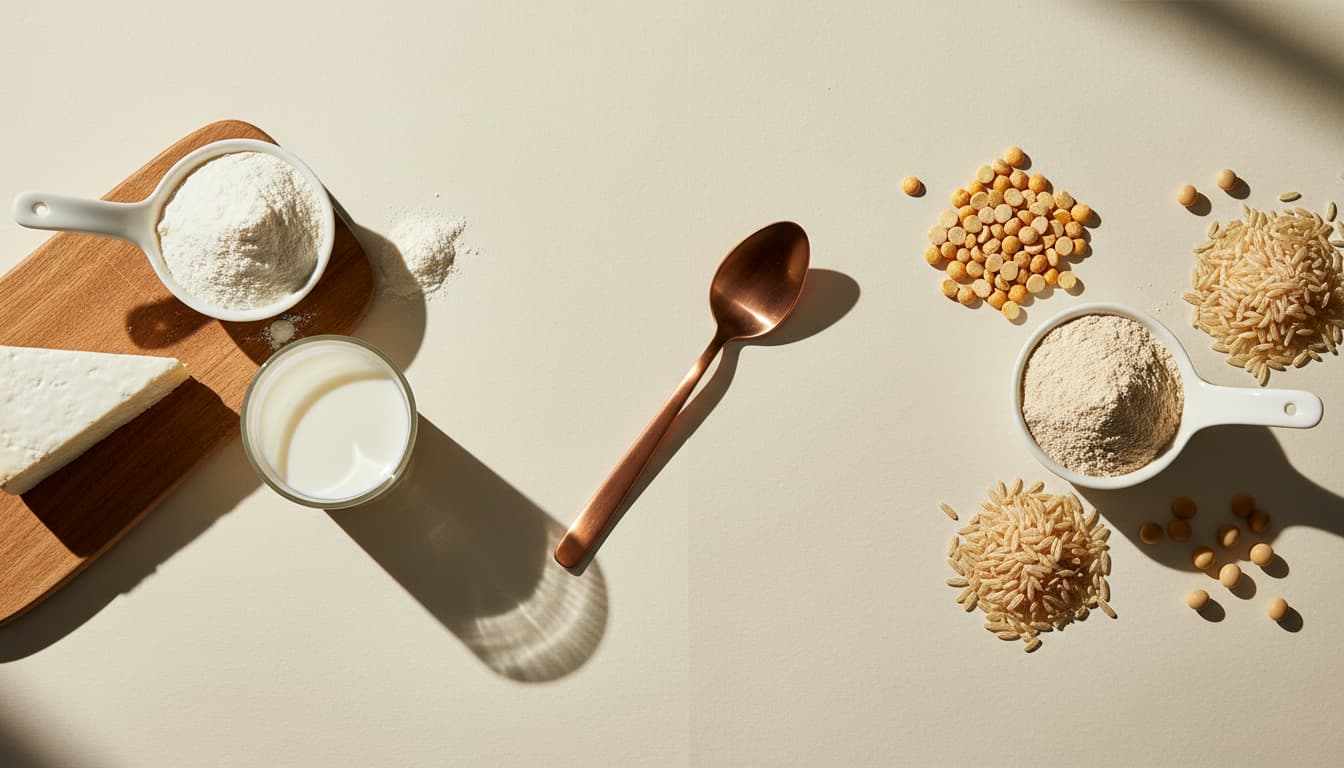
Whey wins per gram on completeness, leucine, and digestibility, but soy and blended plant proteins close most of the gap at a higher dose. What separates them, when it matters, and how to choose.
- 01
Completeness: whey wins, soy ties, most single plants lose
A complete protein supplies all nine essential amino acids in usable amounts. Whey is complete and scores at the top of the DIAAS quality scale. Among plants, soy is the standout, also complete with a DIAAS near animal proteins. But most single plant proteins are incomplete: rice is low in lysine, pea is low in methionine (Gorissen et al. 2018). This is the core biochemical gap, and it is the one that blending is designed to fix.
- 02
Leucine: whey is the richest, plants need a bigger dose
Leucine is the amino acid that triggers muscle protein synthesis once a per-meal dose of about 2.5-3 g is reached (Moore et al. 2015). Whey is around 11% leucine, so a 25 g scoop clears the threshold. Pea and rice proteins run lower, roughly 7-8% leucine, so you need a larger serving to hit the same threshold. The gap is real but it is a dose problem, not a ceiling: more grams, or a higher-leucine blend, closes it.
- 03
Blends fix the missing amino acid
The limiting-amino-acid problem has a direct solution: combine complementary plant proteins. Pea protein is low in methionine but decent in lysine; rice protein is the mirror image. Blend the two and the profile becomes complete, which is why most quality vegan powders are pea-rice blends rather than a single source. This is the same complementary-protein logic behind beans and rice as a traditional food pairing, applied to isolates.
- 04
Digestion speed and what it does and does not matter for
Whey digests fast, with amino acids appearing in the blood within roughly 30-60 minutes, useful for hitting the leucine threshold quickly. Plant proteins and casein release more slowly. For most people this speed difference is minor, because total daily protein intake matters far more than the timing of any single dose. It is a genuine but small edge for whey around training, not a reason to avoid plant protein for general muscle-building.
- 05
What the muscle-building trials actually show
Per gram and per acute dose, animal protein edges plant for the muscle-protein-synthesis response (van Vliet et al. 2015). But over full training studies, when total daily protein is adequate, the practical difference in muscle and strength gains shrinks or disappears (Morton et al. 2018). The read: whey is more efficient per gram, but a plant-based eater who hits an adequate daily protein target with complete or blended sources builds muscle effectively too.
- 06
How to actually choose
This is a fit decision, not an effectiveness one. Choose whey if you tolerate dairy and want the cheapest, most efficient route to the leucine threshold per gram. Choose soy or a pea-rice blend if you are vegan, lactose-intolerant, or simply prefer plants, and plan for a slightly larger dose to match leucine. Either way, hit your daily protein target first. Our protein powder ranking prices products by $/gram of leucine so you can compare types honestly on cost.
What people ask us next.
- Is whey or plant protein better for building muscle?
- Per gram, whey, because it is complete, scores highest on the DIAAS quality scale, and is richest in leucine, the amino acid that triggers muscle growth (Moore et al. 2015). But the gap is a dose problem, not a wall. Soy is a complete plant protein, and pea-rice blends fix the missing amino acids, so at a slightly larger serving plant protein drives comparable gains when total daily protein is adequate (Morton et al. 2018). Choose based on diet, tolerance, and cost.
- Why is whey considered higher quality than plant protein?
- Two reasons. First, completeness: whey supplies all nine essential amino acids in usable ratios and scores at the top of the DIAAS scale, while most single plant proteins are low in one, rice in lysine, pea in methionine (Gorissen et al. 2018). Second, leucine: whey is about 11% leucine versus roughly 7-8% for pea or rice, so it hits the muscle-building threshold in a smaller dose. Soy is the plant exception that matches animal protein on completeness.
- Can I build the same muscle on plant protein?
- Yes, with two adjustments. Use complete or blended sources (soy, or a pea-rice blend) so you are not short an essential amino acid, and take a slightly larger dose to match whey's leucine. Controlled studies show animal protein edges plant per gram acutely, but full training trials show comparable muscle and strength gains when total daily protein is adequate (van Vliet et al. 2015; Morton et al. 2018). The daily total matters more than the source.
- Is soy protein as good as whey?
- For muscle-building it is close. Soy is a complete protein with a DIAAS near animal proteins, and it clears the leucine threshold at a reasonable dose, making it the strongest single plant protein. Whey still has a small per-gram edge on leucine content and digestion speed, but for practical muscle-building with an adequate daily protein intake, soy is a legitimate substitute, especially for people avoiding dairy.
- What about pea and rice protein?
- Individually, each is incomplete: pea is low in methionine, rice is low in lysine, and both are lower in leucine than whey. Blended together, they complement each other into a complete profile, which is why most quality vegan powders are pea-rice blends. Take a slightly larger serving than you would of whey to match the leucine threshold, and they build muscle effectively as part of an adequate daily protein intake.
- Which is cheaper, whey or plant protein?
- It depends on the metric. The fair comparison is not $/gram of protein but $/gram of leucine, since leucine drives the muscle-building effect and plant proteins carry less of it per gram. On that basis whey concentrate is usually the cheapest route to the threshold, with soy and quality blends competitive. Our protein powder ranking prices tested products by $/gram of leucine so you can compare whey and plant options on the metric that matters.
Every claim, cited.
- [01]Gorissen SHM, Crombag JJR, Senden JMG, et al. 2018. Protein content and amino acid composition of commercially available plant-based protein isolates. Amino Acids 50(12):1685-1695. Leucine and essential amino acid content of pea, rice, soy, and other plant isolates versus whey.
- [02]van Vliet S, Burd NA, van Loon LJC. 2015. The skeletal muscle anabolic response to plant- versus animal-based protein consumption. J Nutr 145(9):1981-1991. Animal protein edges plant per gram acutely; completeness and leucine explain the gap.
- [03]Morton RW, Murphy KT, McKellar SR, et al. 2018. A systematic review, meta-analysis and meta-regression of the effect of protein supplementation on resistance training-induced gains in muscle mass and strength. Br J Sports Med 52(6):376-384. Daily target ~1.6 g/kg; total intake dominates source.
- [04]Moore DR, et al. Per-meal leucine threshold research. ~2.5-3 g leucine per meal for maximal muscle protein synthesis.
The Larderlab Team builds evidence-led frameworks for eating, lifting, and stocking a kitchen. We cite every claim. We publish the spreadsheet when possible. We buy what we review at retail price. When new data lands, we revise with a dated note.
Next in this hub.
Casein vs Whey Protein: Whey Wins the Hour, Casein Wins the Night
Whey raised muscle protein synthesis about 93 percent above casein at rest and 122 percent after exercise, yet casein produced the more positive 7-hour net leucine balance. Pre-sleep casein added 3.6 square centimetres of quadriceps growth over 12 weeks against a noncaloric placebo.
14 min · rev 2026-09-10Best Protein Powders Ranked by $/gram of Leucine
We ranked 14 protein powders by the metric that actually matters, cost per gram of leucine delivered, with third-party testing filters.
14 min · rev 2026-04-21How Much Protein to Build Muscle: Per-Meal Dose, Leucine, and Timing
The hypertrophy levers are the per-meal dose (~0.4 g/kg for the leucine trigger), distribution across 3-4 meals, pre/post-training, and the ~1.6 up to ~2.2 g/kg ceiling. For your daily total by bodyweight, see our daily protein guide.
8 min · rev 2026-07-02Get the Larderlab Macro Planner.
A Google Sheet that calculates your protein target, splits it across 3-5 meals, and ranks 20 protein sources by $/gram. Free. Copy-and-modify your own version.
By subscribing, you agree to our Privacy Policy. Unsubscribe anytime.