Seed oil vs butter vs olive oil
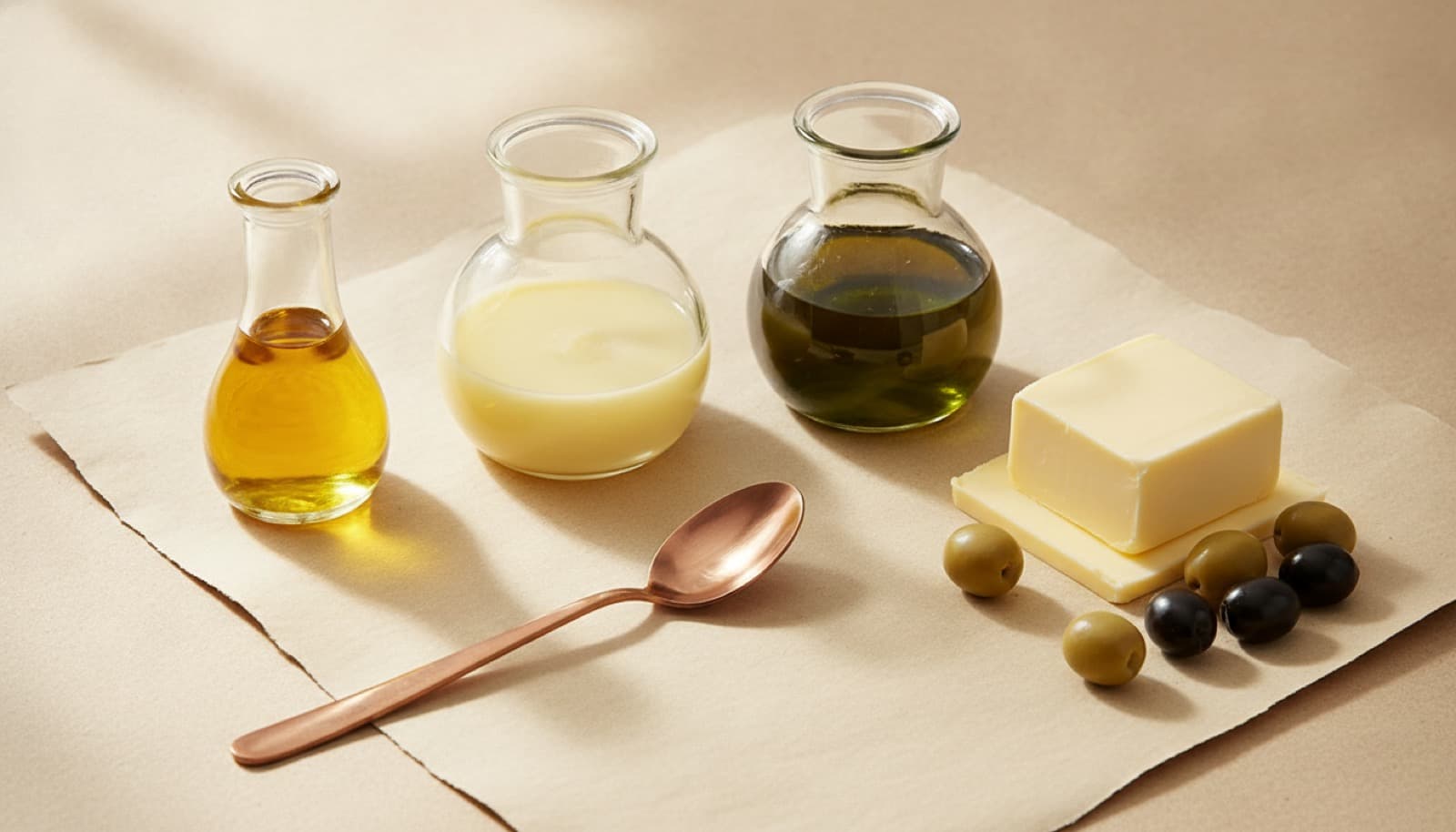
Three claims conflated into one debate, we separate the linoleic-acid, oxidation, and inflammation questions and state our position.
What people ask us next.
- Are seed oils actually bad for you?
- The answer depends on which claim. Linoleic acid intake has risen from ~2% to ~7% of energy over 100 years (Blasbalg 2011), real. Repeated high-heat frying produces aldehydes and oxidation products with plausible harm (Vladykovskaya 2012), real, mostly a restaurant problem. 'Linoleic acid causes inflammation', weak in humans (Johnson & Fritsche 2012 meta-analysis, Hooper 2020 Cochrane review). Most online discourse argues the inflammation claim while citing oxidation studies.
- What oil should I cook with at home?
- For 80% of home cooking, extra-virgin olive oil. Smoke point ~190-210 C covers sauté, roast, and most pan-frying. For high-heat sear (200+ C prolonged), ghee or grass-fed butter (Kerrygold, Pure Indian Foods). For salad dressing, EVOO again. Avocado oil (Chosen Foods, Primal Kitchen) is a reasonable swap for high-heat if you dislike ghee flavor, check for adulteration (UC Davis Modern Mist report 2020).
- Is olive oil destroyed by cooking?
- No, within reason. Extra-virgin olive oil has smoke point ~190-210 C and oxidative stability comparable to many refined oils because of its polyphenol content (De Alzaa 2018). Sauté, roast, stir-fry all fine. What degrades EVOO: repeated reuse, storage in heat and light, time. The frying oil in a restaurant fryer is the oxidation concern, not your 5-minute sauté.
- Is butter better than seed oil?
- For high-heat cooking, often yes (butter/ghee oxidative stability beats most polyunsaturated oils). For cardiovascular endpoints, replacing butter with polyunsaturated oils reduces events in the meta-analyses (Mozaffarian 2010, Hooper 2020). The answer is 'use butter where it performs better, use olive oil where the data is strongest, skip deep-frying oils.' The framing as 'butter vs seed oil' is a false binary.
- What about canola oil specifically?
- Refined canola has a high smoke point (~204 C) and a relatively low linoleic acid content (~20%), better oxidative stability than refined sunflower or safflower. No human trial data shows canola causes harm at normal intakes. The objection to canola is process-based (solvent extraction, refinement), not outcome-based. Our position: not our first choice, but not the villain it's made into.
- Does grass-fed butter (like Kerrygold) matter?
- On micronutrients, mildly. Grass-fed butter has ~40% higher CLA and omega-3 content than conventional (Couvreur 2006). On total fat quality in a mixed diet, the effect is small. Kerrygold is the category reference; generic organic grass-fed is equivalent at lower price. Pay the premium if you value the sourcing; don't pay it expecting meaningful macro differences.
- What's wrong with deep-fried restaurant food beyond calories?
- Repeated-use fryer oil accumulates polar compounds, aldehydes, and trans fats from thermal oxidation. Vladykovskaya 2012 documented the oxidation product biology; Ng 2014 tracked restaurant-fryer oil chemistry over a working week. This is the legitimate 'seed oil is bad' argument, and it applies to any oil reused at high heat for hours, not just seed oils. Restaurant fry oil is the problem; the bottle in your pantry isn't.
Every claim, cited.
- [01]Blasbalg TL et al. 2011. Changes in consumption of omega-3 and omega-6 fatty acids in the United States during the 20th century. Am J Clin Nutr 93(5):950-962.
- [02]Johnson GH, Fritsche K. 2012. Effect of dietary linoleic acid on markers of inflammation in healthy persons: a systematic review of randomized controlled trials. J Acad Nutr Diet 112(7):1029-1041.
- [03]Hooper L et al. 2020. Reduction in saturated fat intake for cardiovascular disease. Cochrane Database Syst Rev 8(8):CD011737.
- [04]Mozaffarian D, Micha R, Wallace S. 2010. Effects on coronary heart disease of increasing polyunsaturated fat in place of saturated fat: a systematic review and meta-analysis of randomized controlled trials. PLoS Med 7(3):e1000252.
- [05]Estruch R et al. 2013 (PREDIMED). Primary prevention of cardiovascular disease with a Mediterranean diet. N Engl J Med 368:1279-1290.
- [06]De Alzaa F, Guillaume C, Ravetti L. 2018. Evaluation of chemical and physical changes in different commercial oils during heating. Acta Scientific Nutritional Health 2(6):2-11.
The Larderlab Team builds evidence-led frameworks for eating, lifting, and stocking a kitchen. We cite every claim. We publish the spreadsheet when possible. We buy what we review at retail price. When new data lands, we revise with a dated note.
Next in this hub.
Is Canola Oil Bad For You? What the Evidence Actually Shows
Canola is ~63% monounsaturated, ~10% ALA omega-3, low saturated, and neutral-to-favorable in lipid trials. The fear narrative outruns the data.
9 min · rev 2026-06-22Does Olive Oil Go Bad? The Four Numbers That Decide It
Extra virgin is a chemical grade with numeric limits, not a marketing word. Peroxide value, free acidity and the two ultraviolet indices all track storage time, and the bottle plus the initial phenolic content decide how fast.
9 min · rev 2026-08-30Grass-Fed vs Grain-Fed Beef: The Ratio Improves, the Milligrams Do Not
USDA lists grass-fed ground beef at 88 mg of total omega-3 per 100 g, of which 1 mg is EPA and none is DHA. The fatty acid ratio genuinely improves on grass. The absolute amounts stay too small to matter for an omega-3 target.
8 min · rev 2026-08-25Get the Larderlab Macro Planner.
A Google Sheet that calculates your protein target, splits it across 3-5 meals, and ranks 20 protein sources by $/gram. Free. Copy-and-modify your own version.
By subscribing, you agree to our Privacy Policy. Unsubscribe anytime.