Pantry staples: how to stock a kitchen by cost-per-use
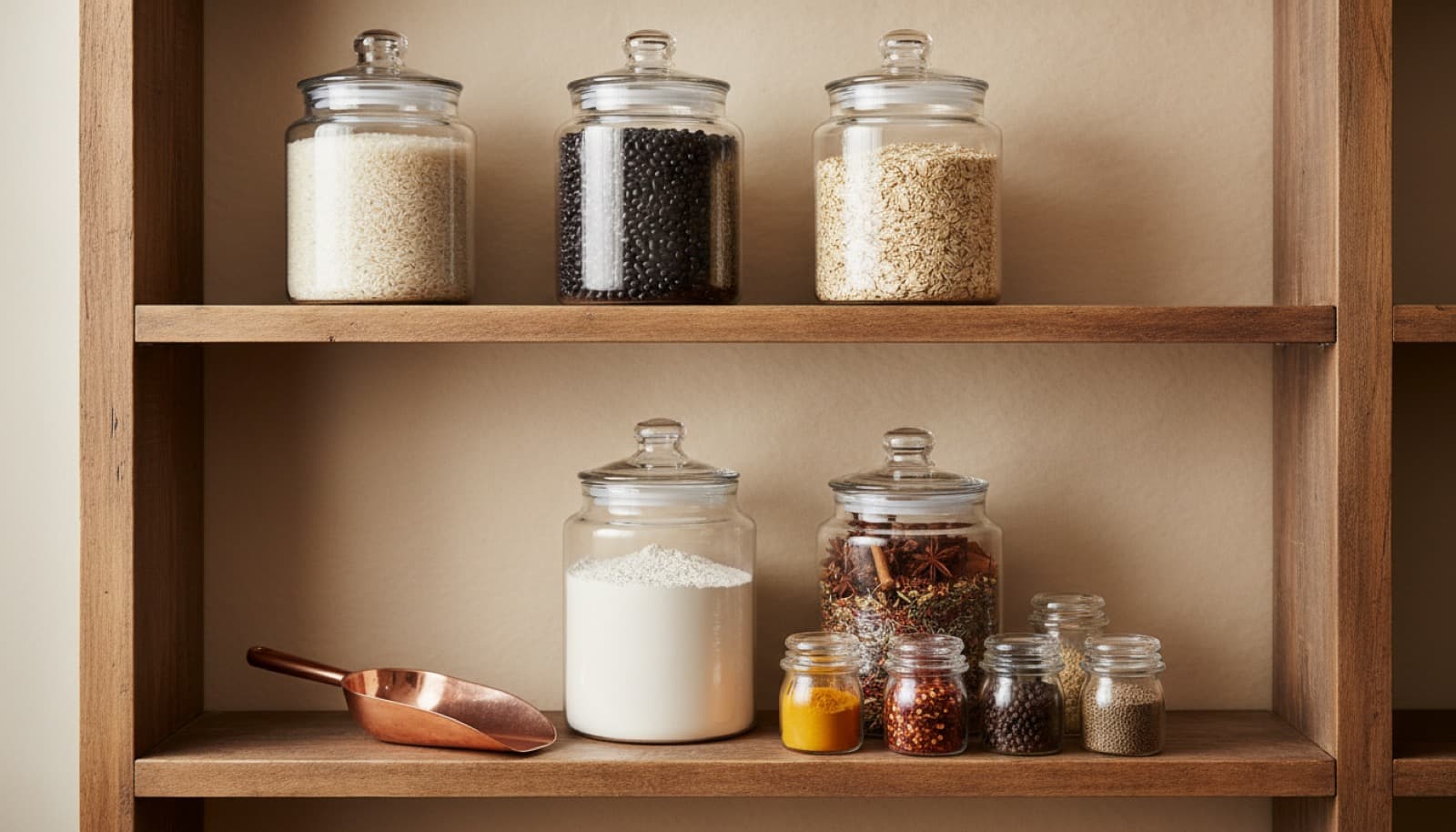
The shelf-stable short list that covers most meals, ranked by cost-per-use and shelf life. The buy-in-bulk rules, the storage gear that pays off, and what not to stockpile.
The 20-SKU core pantry, sorted by cost-per-use
A functional pantry is not a hoard, it is a short list of shelf-stable SKUs that cover the base of most meals at the lowest waste-adjusted cost. The core 20: rice and oats (carbohydrate base, 1-2 year shelf life in sealed containers), dried lentils and canned beans (cheap complete-protein pairing with grains), canned tuna and canned wild salmon (shelf-stable protein plus omega-3), whey concentrate (cheapest complete protein per gram), olive oil and a neutral high-heat oil, vinegar, canned tomatoes, onions and garlic, a core spice set, salt, honey, peanut butter, and bulk coffee. Each SKU earns its slot on two axes: cost-per-use (price divided by realistic number of uses before it degrades) and shelf life. Two rules govern the build: buy in bulk only when the unit price is 30%+ below grocery AND you will consume more than 50% before expiry (the bulk-buying-math framework), and store decanted into sealed food-grade containers, which is what converts a 6-month shelf life into 18-24 months. The container side of that decision is the best-meal-prep-containers-2026 comparison.
The questions people actually bring us.
- What are the essential pantry staples to always have?
- A defensible core is about 20 SKUs: a grain base (rice, rolled oats), legumes (dried lentils, canned beans), shelf-stable protein (canned tuna, canned wild salmon, whey concentrate), fats (olive oil, a neutral high-heat oil), acids (vinegar, canned tomatoes), aromatics (onions, garlic), a core spice set, salt, and a few high-density extras (honey, peanut butter, coffee). These cover the carbohydrate, protein, and fat base of most meals while staying shelf-stable for months to years. Build from this list before adding anything specialty, and price each addition by cost-per-use, not by shelf appeal.
- How do I decide what's worth buying in bulk?
- Use the waste-adjusted rule: bulk wins when the unit price is at least 30% below grocery AND you will realistically consume more than 50% of it before it degrades. Below either threshold, the per-week grocery cadence wins on waste-adjusted cost. Shelf-stable and freezer-durable items (whey, rice, oats, canned fish, frozen proteins, olive oil used within 12 months) reliably clear the bar; fresh produce and bread usually fail it unless you freeze on day one. The full formula, with worked examples, is in our bulk-buying-math page.
- How should pantry staples be stored to last?
- Decant into airtight, food-grade containers and keep them cool, dark, and dry. Rice, flour, and oats in original packaging are exposed to air, moisture, and pantry pests; the same staples in sealed food-grade buckets with gasketed lids reach 2-3x the usable shelf life. Oils belong in dark glass away from the stove (heat and light drive oxidation). Frozen proteins last 6-12 months in original wrap, 18-24 months vacuum-sealed. The container decision, ranked by cost-per-serving over a 5-year amortization, is in best-meal-prep-containers-2026.
- What's the cheapest way to stock a protein-forward pantry?
- Anchor on the lowest $/g complete-protein sources that store well: whey concentrate (~$0.013/g), canned tuna and canned wild salmon, and bulk eggs from the fridge alongside the pantry. Pair grains with legumes (rice plus beans or lentils) for a complementary amino-acid profile at roughly $0.02/g protein. Our 12-high-protein-foods-by-cost ranking shows the full $/g order; the pantry version is simply the shelf-stable subset of that list bought in bulk where the waste-adjusted math works.
- What should I NOT stockpile?
- Anything that degrades faster than you use it, or that bulk pricing barely improves. The recurring waste sinks: fresh produce in bulk (freeze on day one or skip the bulk size), bread (freeze immediately or buy weekly), specialty oils you use once a month (they oxidize before the second use), giant spice jars (volatile oils fade in 6-12 months, so buy spices small and often), and any bulk multipack you bought because the unit price looked good without checking whether you will finish it. The test is always cost-per-use, not cost-per-unit.
- How much does a stocked core pantry actually cost?
- The 20-SKU core, bought in bulk where the math works, runs roughly $150-220 for the initial stock-up depending on region and how much you buy in warehouse sizes, then a much lower steady-state replacement cost because the high-turnover items (rice, oats, oil, canned fish) are the cheapest per use. Add a one-time ~$150 in storage gear (food-grade buckets with gasketed lids, a few glass containers, a vacuum sealer) and the system typically pays that back within a quarter on reduced spoilage and bulk savings, per the same waste-adjusted logic in bulk-buying-math.
How this was specified
- 01Inputs measured
- Retail price (dated) · label claim · Certificate of Analysis · third-party test (Informed Sport / NSF / ConsumerLab / Clean Label) · leucine per serving from COA, not marketing.
- 02Protocols tested
- Per-kg target from four literature ranges (IOM RDA, Phillips 2017, Morton 2018, ISSN). Brands scored against Moore 2015 leucine-per-dose threshold (~0.4 g/kg).
- 03Cost-basis verified
- $/gram of protein and $/gram of leucine at warehouse pricing (Costco), mail-order (Amazon), and DTC retail. Re-checked quarterly, flagged when drift exceeds 15%.
- 04Confidence level
- High on ranked order. Medium on absolute $/g (prices drift). Low on serving-size claims where COA is older than 18 months, flagged [VERIFY].
Every claim, cited.
- [01]USDA FoodSafety.gov FoodKeeper App. 2024. Shelf-life data by product category and storage condition.
- [02]USDA. 2024. How long can I store: a guide to food storage.
- [03]Gunders D. 2012. Wasted: how America is losing up to 40 percent of its food from farm to fork to landfill. NRDC Issue Paper IP:12-06-B.
- [04]FAO. 2011. Global food losses and food waste: extent, causes and prevention. Food and Agriculture Organization of the United Nations.
The Larderlab Team builds evidence-led frameworks for eating, lifting, and stocking a kitchen. We cite every claim. We publish the spreadsheet when possible. We buy what we review at retail price. When new data lands, we revise with a dated note.
Next in this hub.
Dried Beans vs Canned Beans: Cost, Sodium, Time and One Real Hazard
One pound of dry beans yields about 6 cups cooked and replaces roughly 4 cans at 2.5 to 5 times lower cost per cup. Canned beans carry 331 to 655 mg sodium per cup against 1.7 mg home-cooked.
13 min · rev 2026-09-09Food Date Labels: What Best if Used By, Sell-By and Use-By Mean
Except for infant formula, product dating is not required by federal regulation and dates are not safety indicators. Four phrases, four different jobs, and a 30 percent waste figure attached to the confusion.
8 min · rev 2026-09-02Best Meal Prep Containers, 2026: Glass vs Polypropylene, Stack Math
Eight container systems ranked on stack-density, microwave/oven safety, and cost-per-serving over a 5-year amortization. The leaching-temperature data nobody publishes.
9 min · rev 2026-04-29Get the Larderlab Macro Planner.
A Google Sheet that calculates your protein target, splits it across 3-5 meals, and ranks 20 protein sources by $/gram. Free. Copy-and-modify your own version.
By subscribing, you agree to our Privacy Policy. Unsubscribe anytime.