How much caffeine per day, by the evidence
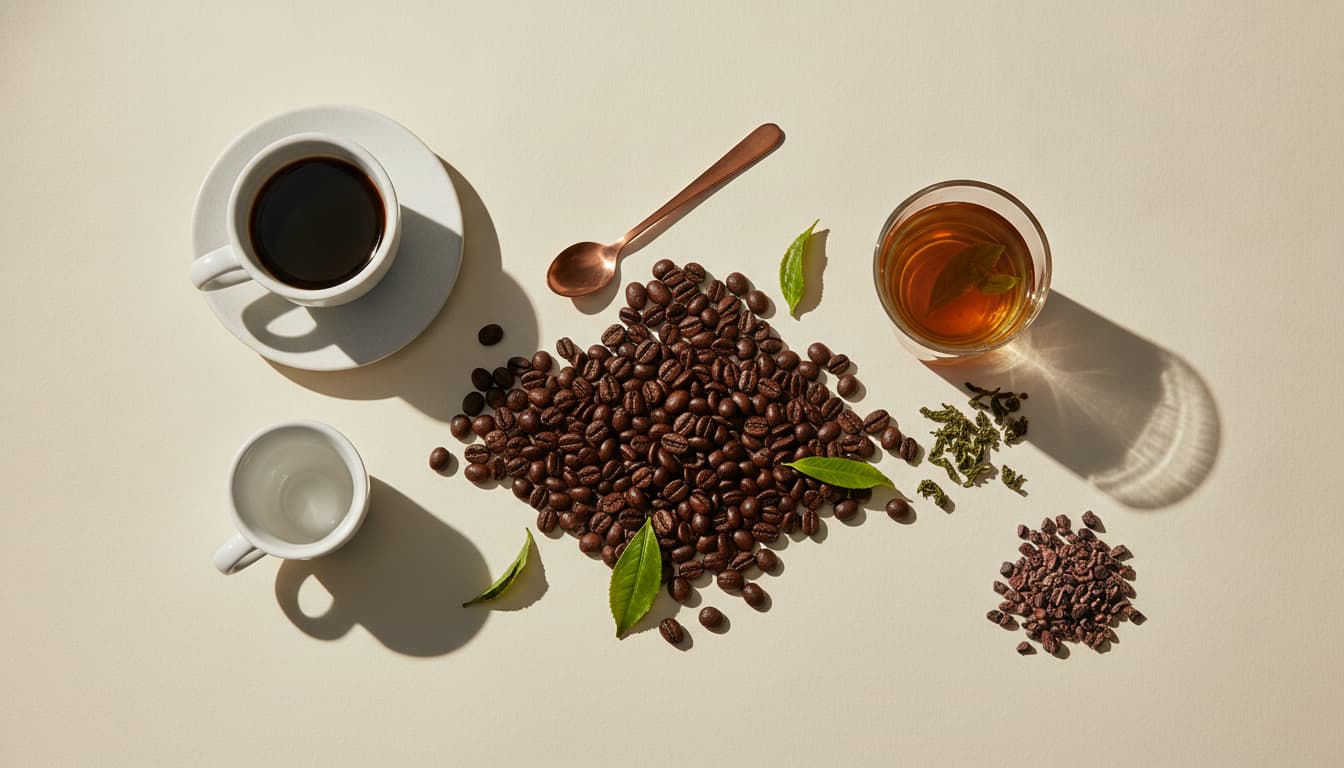
Regulators treat up to 400 mg of caffeine a day as safe for healthy adults, roughly four 8-oz cups of coffee; pregnancy caps at 200 mg and teenagers at 100 mg. The daily number, what it is in real drinks, and why timing matters as much as dose.
- 01
The ceiling: 400 mg/day for healthy adults
Both the FDA and EFSA treat up to 400 mg of caffeine per day as safe for healthy adults, with no consistent evidence of harm at or below that level (FDA; EFSA 2015). This is a ceiling, not a target, and it applies to healthy non-pregnant adults; it is also the figure behind most 'moderate intake' advice. Above it, the common effects are insomnia, jitteriness, a faster heart rate, and anxiety rather than acute danger, but the benefits of more caffeine flatten out while the sleep and anxiety costs keep rising.
- 02
What 400 mg is in real drinks
An 8-oz cup of brewed coffee is ~95 mg, so 400 mg is about four small cups, but a 16-oz coffee-shop drink can carry 150-300 mg on its own. A single espresso shot is ~63 mg, black tea ~47 mg per cup, green tea ~28 mg, a 12-oz cola ~34 mg, and energy drinks 80-150 mg per can. Decaf is not zero, at ~2-5 mg per cup. The lesson is to count drinks by size and type, not by the number of 'cups', because the mug on your desk is rarely 8 oz.
- 03
Pregnancy: keep it under 200 mg/day
The American College of Obstetricians and Gynecologists advises pregnant people to limit caffeine to under 200 mg/day, roughly one 12-oz coffee (ACOG). Caffeine crosses the placenta freely, and the fetus and newborn clear it very slowly because the enzymes that metabolize it are immature, so it accumulates. Intakes above 200 mg have been linked in some studies to higher miscarriage and low-birth-weight risk. The 200 mg figure is deliberately conservative and includes tea, cola, chocolate, and energy drinks, not just coffee.
- 04
Children and teenagers: 100 mg or none
The American Academy of Pediatrics recommends no caffeine for young children and no more than 100 mg/day for adolescents, and it advises that energy drinks have no place in the diet of children or teens (AAP 2011). Caffeine can worsen anxiety, disrupt developing sleep, and, in the high doses common to energy drinks, raise heart rate and blood pressure. Because body weight is lower, the same 200 mg dose that a large adult tolerates is proportionally much larger for a teenager.
- 05
Single dose and timing: under ~200 mg, and not late
EFSA found single doses up to about 200 mg raise no safety concern for healthy adults, a useful cap for pre-workout formulas and large energy drinks (EFSA 2015). Timing matters as much as total: caffeine's half-life is roughly 5 hours, so an afternoon dose lingers into the night, and a trial found 400 mg taken 6 hours before bed still cut total sleep (Drake et al. 2013). A practical rule is to keep single servings modest and stop caffeine about 8 hours before you plan to sleep.
- 06
Why your limit may differ: genetics and tolerance
The 400 mg figure is a population average, and individual tolerance varies widely. Most caffeine is broken down by the liver enzyme CYP1A2, and a common gene variant makes some people 'slow metabolizers' who feel effects longer and are more sensitive to sleep disruption and, in some data, cardiovascular strain. Regular use builds tolerance to the alertness effect within days. Anxiety disorders, acid reflux, certain heart-rhythm conditions, and some medications (including certain antibiotics and antidepressants) lower the sensible limit further.
- 07
The danger zone: pure powder and stacked doses
Acute toxicity, seizures, and dangerous heart rhythms become a risk with rapid intake around 1,200 mg, the level the FDA cites as producing toxic effects (FDA). The realistic way to reach that is not coffee but pure or highly concentrated caffeine: a single teaspoon of powdered caffeine can equal roughly 28 cups of coffee, and the FDA has acted against bulk powders after deaths. Stacking an energy drink, a pre-workout, and coffee in a short window is the other common overshoot. Treat concentrated caffeine products with the caution their dose deserves.
What people ask us next.
- How much caffeine is safe per day?
- For healthy adults, up to 400 mg per day is the level both the FDA and EFSA treat as safe, with no consistent evidence of harm at or below it (FDA; EFSA 2015). That is roughly four 8-oz cups of brewed coffee. Pregnant people should stay under 200 mg/day, and adolescents under 100 mg/day. Individual tolerance varies with genetics, medications, anxiety, and heart conditions, so 400 mg is a population ceiling rather than a personal target.
- How many cups of coffee is 400 mg of caffeine?
- About four 8-oz cups of brewed coffee, since a standard 8-oz cup carries roughly 95 mg. The catch is cup size: a 16-oz coffee-shop drink can hold 150-300 mg by itself, so two large drinks can reach or exceed the 400 mg ceiling. Espresso is ~63 mg per shot, so a 400 mg day is about six shots. Counting by drink size and type is more accurate than counting 'cups'.
- How much caffeine can I have during pregnancy?
- The American College of Obstetricians and Gynecologists advises under 200 mg/day, roughly one 12-oz coffee (ACOG). Caffeine crosses the placenta and the fetus clears it very slowly, so it accumulates, and intakes above 200 mg have been linked to higher miscarriage and low-birth-weight risk in some studies. The 200 mg limit counts all sources together, including tea, cola, chocolate, and energy drinks, not coffee alone.
- Can children and teenagers have caffeine?
- The American Academy of Pediatrics recommends no caffeine for young children and no more than 100 mg/day for adolescents, and it advises that energy drinks are not appropriate for children or teens at all (AAP 2011). Caffeine can worsen anxiety, disrupt developing sleep patterns, and raise heart rate and blood pressure at the high doses common in energy drinks. Lower body weight also means a given dose hits a teenager harder than an adult.
- How long does caffeine stay in your system?
- Caffeine has a half-life of roughly 5 hours in a typical adult, meaning half of a dose is still active 5 hours later and a quarter after 10 hours; the range across individuals is wide, from about 1.5 to over 9 hours. That is why an afternoon coffee can still affect sleep: a trial found 400 mg taken 6 hours before bed measurably reduced total sleep (Drake et al. 2013). Slow metabolizers, pregnancy, and some medications lengthen it considerably.
- What are the signs of too much caffeine?
- Common signs of overshooting are jitteriness, a racing or pounding heart, anxiety, headache, nausea, difficulty sleeping, and increased urination. These usually appear above the level a person is used to rather than at a fixed number. Serious toxicity, including seizures and dangerous heart rhythms, is a risk with rapid intake near 1,200 mg, which realistically comes from pure powdered caffeine or stacked energy and pre-workout products rather than from coffee (FDA).
Every claim, cited.
- [01]US Food and Drug Administration. Spilling the Beans: How Much Caffeine is Too Much? 400 mg/day generally not associated with negative effects in healthy adults; ~1,200 mg linked to toxic effects.
- [02]EFSA Panel on Dietetic Products, Nutrition and Allergies. 2015. Scientific Opinion on the safety of caffeine. EFSA Journal 13(5):4102. 400 mg/day and single doses of 200 mg raise no safety concern for healthy adults; 200 mg/day in pregnancy.
- [03]American College of Obstetricians and Gynecologists. Moderate Caffeine Consumption During Pregnancy (Committee Opinion 462, reaffirmed). Limit of under 200 mg/day.
- [04]Committee on Nutrition and the Council on Sports Medicine and Fitness, American Academy of Pediatrics. 2011. Sports drinks and energy drinks for children and adolescents. Pediatrics 127(6):1182-1189. Adolescent caffeine cap of 100 mg/day; energy drinks not recommended.
- [05]Drake C, Roehrs T, Shambroom J, Roth T. 2013. Caffeine effects on sleep taken 0, 3, or 6 hours before going to bed. J Clin Sleep Med 9(11):1195-1200. 400 mg 6 hours before bed reduced total sleep.
The Larderlab Team builds evidence-led frameworks for eating, lifting, and stocking a kitchen. We cite every claim. We publish the spreadsheet when possible. We buy what we review at retail price. When new data lands, we revise with a dated note.
Next in this hub.
Is Raw Milk Safe? The Relative Risk Has Been Quantified
Unpasteurised dairy is consumed by a small share of the population and causes most dairy outbreak illness. The modelled figures are 840 times more illnesses and 45 times more hospitalisations per unit consumed, and the nutritional claims do not survive review.
8 min · rev 2026-08-31Heavy Metals in Dark Chocolate: The Outlier Problem, by the Numbers
Across 72 products tested over eight years, 43 percent exceeded the California lead threshold and 35 percent the cadmium one, yet median levels sat below both. This is an outlier problem, and organic products tested worse.
8 min · rev 2026-08-25Arsenic in Rice: The Numbers by Variety and Origin
Inorganic arsenic by rice variety (basmati, jasmine, brown, white) and origin, with cooking methods that reduce exposure.
11 min · rev 2026-04-21Get the Larderlab Macro Planner.
A Google Sheet that calculates your protein target, splits it across 3-5 meals, and ranks 20 protein sources by $/gram. Free. Copy-and-modify your own version.
By subscribing, you agree to our Privacy Policy. Unsubscribe anytime.